Need help?
Do you have a question about the Silver King SKFI15-EL and is the answer not in the manual?
Instructions for inspecting the unit upon delivery for any freight damage.
Essential safety guidelines and warnings before operating the appliance.
Guidance on following all safety instructions and understanding OSHA regulations.
Explanation of DANGER, WARNING, and CAUTION alert levels used in the manual.
Critical warnings regarding flammable R290 refrigerant and potential fire/explosion risks.
Safety rules for appliance use, storage, and keeping the area clear.
Procedure for securely attaching the unit's casters.
Factors to consider for proper unit placement and airflow.
Guidelines for connecting the unit to a power source and circuit protection.
Details on the unit's energy efficiency rating and testing conditions.
Requirements for personnel and safety protocols when servicing R290 refrigerant units.
Procedures for checking refrigeration and electrical components before and during servicing.
Methods for detecting refrigerant leaks and procedures for removal and evacuation.
Specific warnings and requirements for charging the refrigeration system with refrigerant.
Instructions for initial startup, temperature control adjustment, and defrosting.
Recommended tasks for maintaining the unit's performance and longevity.
Comprehensive list of available replacement parts with item numbers and part numbers.
Methods to determine the thermistor's current temperature for testing.
Instructions on how to configure a multimeter for resistance measurement.
How to interpret resistance readings to determine if the thermistor needs replacement.
General terms and conditions of the manufacturer's warranty for the equipment.
Details on compressor warranty and additional guidelines for warranty claims.
Information on how to order parts, equipment, and contact service support.
The Silver King Mobile and Meatwell Freezer is a robust and reliable food service equipment designed for efficient refrigeration. This technical manual and replacement parts list provides comprehensive information for its operation, maintenance, and servicing, ensuring its longevity and optimal performance.
The Silver King Mobile and Meatwell Freezer is a self-contained refrigeration unit primarily used for storing food products at controlled low temperatures. It functions as a manual defrost freezer, maintaining a consistent cold environment essential for food preservation. The unit is equipped with a compressor and condenser fan that work in conjunction with an electronic temperature control to regulate the internal temperature. The use of R290 refrigerant, a flammable substance, necessitates adherence to specific safety precautions during installation, operation, and servicing.
The freezer is designed for ease of use and flexibility in various food service environments.
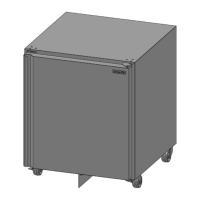
Installation and Location: Upon delivery, the unit requires uncrating and inspection for any freight damage. The stainless steel exterior is protected by a plastic covering during shipping, which should be removed before installation. The interior and exterior surfaces should then be cleaned with a mild soapy water solution. The unit comes with casters that can be easily threaded into the four rivnuts at the bottom of the cabinet, allowing for mobility. When positioning the freezer, it is crucial to ensure it is level and that there is at least 6 inches of space at both ends for proper airflow through the louvered panels. The area above the unit should remain open for product access. To prevent performance issues, the freezer should not be placed near heat sources like ovens or heating elements. If the unit has been transported on its side, it must stand upright for a minimum of 24 hours before being plugged in to allow the refrigerant to settle.
Electrical Connections: Before connecting the unit to power, users must verify the required voltage on the data plate located on the cabinet liner. The freezer is equipped with an 8-foot power cord, and any modification to the plug will void the warranty and could lead to injury. The circuit must be protected with a 15 or 20 ampere fuse or breaker, and the unit should be isolated on its own circuit, not connected via an extension cord. If the supply cord is damaged, it must be replaced by the manufacturer or a qualified service agent to prevent hazards.
Initial Start-Up: After meeting all installation requirements, the freezer is ready for operation. It will start once the power cord is connected to a live electrical receptacle. If the compressor and condenser fan do not run initially, users should check that the temperature control is not in the 'off' position. It is recommended to allow the unit to run for a minimum of two hours before loading it with product.
Temperature Control: The electronic temperature control is conveniently located at the rear of the unit. To check the set point temperature, users can press and release the 'set' button. To adjust it, press and hold the 'set' button until the display blinks, then use the up or down arrows. Pressing 'set' again or waiting 10 seconds will store the new setting. A minimum of one hour should be allowed for the unit to respond to any temperature setting adjustment.
Defrosting: The Silver King freezer is a manual defrost unit. Defrosting is necessary when the frost layer on the walls reaches 1/4 inch thick. To defrost, either turn the temperature control to 'off' or disconnect the power cord from the electrical receptacle. The lid assembly should then be removed or opened. Once the frost has melted or loosened, the cabinet interior should be wiped clean. It is crucial not to scrape or chisel off frost, as this can cause irreparable damage to the unit.
Preventative maintenance is essential for ensuring the continued operation and maximizing the lifespan of the appliance.
Cabinet Surfaces: Both the interior and exterior surfaces are made of stainless steel and should be cleaned periodically. A solution of warm water and mild soap is recommended, followed by rinsing with clean water and thorough drying. A good stainless steel cleaner can also be used. If surfaces become stained or discolored, abrasive cleaners or scouring pads should be avoided to prevent scratching. Instead, a soft cleaner should be used, rubbing with the grain of the metal. Chlorinated cleaners should not be used on stainless steel.
Condenser Cleaning: Regular cleaning of the condenser coil is vital for maintaining compressor warranty and optimal performance. The condenser is located behind the front cover at the right front of the unit. To access it, pull on the bottom edge of the cover. Accumulated dust and debris can be cleaned from the condenser with a vacuum, brush, or a chemical cleaning agent (e.g., Nu-Calgon 4171-75). Users must exercise caution during cleaning as the condenser fins are very sharp.
Caster Maintenance: The casters should be retightened regularly to prevent damage to the base of the cabinet, ensuring the unit remains stable and mobile.
Thermistor Field Testing: The manual provides a detailed guide for testing the thermistor (temperature probe) to ensure it is functioning correctly. This involves using a multimeter set to the resistance (Ω) setting, disconnecting the thermistor from the controller, and connecting the multimeter to the thermistor. The reading is then compared to a provided table (Table 2) that correlates temperature with resistance values. This allows users or service personnel to determine if the thermistor needs replacement.
Given the use of R290 flammable refrigerant, several safety precautions are emphasized throughout the manual.
General Safety: The appliance is not intended for use by persons with reduced physical, sensory, or mental capabilities, or lack of experience and knowledge, unless supervised. Users should be cautious when cleaning the condenser due to sharp fins. Explosive substances or aerosol cans with flammable propellants should not be stored in the appliance. Care must be taken when moving, installing, maintaining, and using the device to avoid damaging refrigerant tubing or increasing the risk of leaks. All component parts must be replaced with like components, and servicing must be performed by factory-authorized personnel to minimize ignition risk.
Refrigerant-Specific Warnings: The manual highlights that R290 refrigerant is flammable. Users are warned against puncturing refrigeration tubing and using mechanical devices for defrosting. Repair should only be performed by trained service personnel. Proper disposal in accordance with federal and local regulations is crucial. The appliance should be stored in a room without continuous ignition sources (e.g., open flames, operating gas appliances, electric heaters). Ventilation openings must be kept clear of obstruction.
Servicing Guidelines for R290 Refrigerant: Specialized precautions are outlined for servicing units with R290 refrigerant. Only competent persons should carry out maintenance, service, and repair operations. Safety checks are necessary to minimize ignition risk before working on systems containing flammable refrigerants. Work must be performed under controlled procedures to minimize the presence of flammable gas or vapor. The work area must be adequately ventilated, and a refrigerant detector should be used to check for toxic or flammable atmospheres. Appropriate fire extinguishing equipment (dry chemical or CO2) must be available if hot work is conducted. No ignition sources, including cigarette smoking, should be present near the work site.
Checks to Refrigeration and Electrical Equipment: Before changing electrical components, they must fit the purpose and specification, following manufacturer guidelines. Checks include ensuring the refrigerant charge is appropriate for the room size, ventilation is adequate, and markings are legible. Electrical safety checks include discharging capacitors safely, ensuring no live electrical components are exposed, and verifying earth bonding continuity. During repairs to sealed components, all electrical supplies must be disconnected, and a leak detection system should be in place if an electrical supply is necessary during servicing.
Leak Detection and Charging Procedures: Open flames or halide torches should not be used for leak detection. Electronic leak detectors, calibrated in a refrigerant-free area, are acceptable. Leak detection fluids (bubble method, fluorescent method agents) are also suitable, but detergents containing chlorine should be avoided. If a leak is suspected, all naked flames must be removed, and the refrigerant recovered from the system. When breaking into the refrigerant circuit, conventional procedures should be followed, including safely removing refrigerant, purging with inert gas, and evacuating the circuit. Charging procedures require ensuring no contamination of different refrigerants, keeping hoses short, positioning cylinders appropriately, earthing the system, and labeling the system upon completion. Extreme care must be taken not to overfill the system, and pressure and leak tests must be performed before commissioning and leaving the site.
 General
| Model | SKFI15-EL |
|---|---|
| Phase | 1 |
| Defrost Type | Manual |
| Capacity | 15 cu ft |
| Temperature Range | -10°F to 10°F |
| Power Supply | Electric |
| Voltage | 115 |
| Hertz | 60 |

 To Next Page