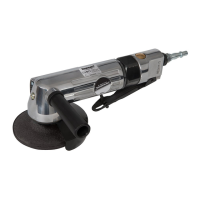
Air Micro Grinder Kit 633630
7
silverlinetools.com
• Alwaysdisconnectthetoolfromtheairsupplywhennotinuse.
• Alwaysdisconnectthetoolfromthecompressedairsupplybeforechangingaccessories,making
adjustmentsand/orrepairsandwhenmovingawayfromanoperatingareatoadifferentarea.
• Keepngersawayfromtriggerwhennotoperatingthetoolandwhenmovingfromone
operating position to another.
• Never direct compressed air at yourself, others or animals.
• Whippinghosescancausesevereinjury.Alwayscheckfordamagedorloosehosesorttings.
• Never carry or drag an air tool by its hose.
• When using air tools, do not exceed the maximum operating pressure.
• Inspecttoolsandaccessoriesbeforeeachuse.Donotuseifdamagedorexcessivelyworn.
• Airtoolsshouldonlybepoweredbycompressedairatthelowestpressurerequiredbythetaskto
reducenoiseandvibrationandminimisewear.
• Neverusepureoxygenorcombustiblegasestopoweranairtool.Airtoolsarenotdesignedfor
thesepowersourcesandtheirusecreatesareandexplosionhazard.
• Beawarethatairtoolsmaybecomecoldduringuse,affectinggrip,controlandsusceptibilityto
vibration-related injury.
IMPORTANT:Evenwhenthistoolisusedasprescribeditisnotpossibletoeliminateallresidual
risk factors. If you are in any doubt as to the safe use of this tool, do not use it.
Projectile Hazards
a) Beawarethatfailureoftheworkpiece,accessories,ortoolitselfcangeneratehigh-velocity
projectiles.
b) Alwayswearimpact-resistanteyeprotectionduringoperationofthistool.Thegradeofprotection
required should be assessed for each use.
c) Assessrisktootherswhenconsideringprojectilehazardrisk.
d) Ensurethattheworkpieceissecurelyxed.
e) Check regularly that the speed of the die grinder is not higher than that marked on it. These
speedchecksshallbecarriedoutwithouttheabrasiveproduct.
f) Ensure that sparks and debris resulting from use do not create a hazard.
Entanglement Hazards
a) Injurycanoccuriflooseclothing,personaljewellery,neckwear,hairorglovesarenotkeptaway
from the tool and its accessories.
Operating Hazards
a) Ensureusersandmaintenancepersonnelarephysicallyabletohandlethebulk,weightand
powerofthetool.
b) Hold the tool correctly; be ready to counteract normal or sudden movements such as recoil. Have
both hands available.
c) Maintain a balanced body position and secure footing.
d) Only use lubricants recommended by the manufacturer.
e) Personal protective safety glasses should be used; suitable gloves and protective clothing are
recommended.
f) Foroverheadwork,wearasafetyhelmet.
g) Avoiddirectcontactwithmovingpartstopreventinjurybypinchingorcutting.
h) Beawarethatthereisariskofelectrostaticdischargeifusedonplasticandothernon-conductive
materials.Takeappropriatestepstoreducethisriskwhenworkingwiththesematerials(e.g.
using a grounding system).
i) Beawarethatcertainmaterialsmaypresentreorexplosionriskswhenbeingprocessed.Take
appropriate precautions to reduce hazards. Employers should make risks clear to operators.
j) Switchoffdevice/releasestart-and-stopcontroliftheair/powersupplyisinterrupted.
k) Measuretheairtoolspeeddailywithatachometertomakesureitisnotgreaterthanthespeed
marked on the grinding accessory.
l) Inspect the accessory before each use. Do not use if cracked or broken or if it has been dropped.
m)Neverstartthediegrinderwhentheabrasiveisappliedtotheworkpiece.
n) Ensurethediegrinderhascometoacompletestopbeforeputtingitdown.
Repetitive Motions Hazards
When using the tool the user may experience discomfort in the hands, arms, shoulders, neck or
other parts of the body.
a) Adoptacomfortableposturewhilstmaintainingsecurefootingandavoidingawkwardor
off-balance postures. Change posture during extended tasks; this can help avoid discomfort
and fatigue.
b) Symptoms such as persistent or recurring discomfort, pain, throbbing, aching, tingling,
numbness, burning sensations or stiffness, should not be ignored. Inform employer if
appropriateandconsultaqualiedhealthprofessional.
Accessory Hazards
a) Disconnectthetoolfromtheairsupplybeforettingorchangingtheaccessory.
b) Avoiddirectcontactwiththeaccessoryduringandafteruse.Accessoriesareoftensharpandmay
become hot during use.
c) Use only sizes and types of accessories and consumables that are recommended by the
manufacturer of the tool; do not use other types or sizes of accessories or consumables.
d) Ensure the maximum operating speed of any accessory equals or exceeds the rated speed
marked on the tool.
e) Nevermountagrindingwheel,cut-offwheelorroutercutteronadiegrinder.Agrindingwheel
that bursts can cause very serious injury or death.
f) Donotusemountedwheelswhicharechippedorcracked,orwhichcouldhavebeendropped.
g) Use only permitted inserted tools of the correct shaft diameter.
h) Payattentiontothefactthatthepermittedspeedofthemountedpointhastobelowereddue
totheincreaseofthelengthoftheshaftbetweentheendofthecolletandthemountedpoint
(overhang (Lo)). Make sure that the minimum gripping length (Lg) of 10mm is observed
(seeFig.Iandtherecommendationsofthemanufacturerofmountedpoints).
i) Ensure that the diameter of the shaft of the mounted point matches that of the collet.
Work Area Hazards
a) Beawareofslipperysurfacescausedbyuseofthetoolandtriphazardscausedbytheairline.
Slips, trips and falls are major causes of injury.
b) Wherepossibledonotobstructthoroughfaresandpassagewayswithairlinesorcables.Take
appropriatemeasurestoreducetriprisksuchaserectingwarningsignsandxingcablesandair
lines in place.
c) Proceedwithcareinunfamiliarsurroundingstominimiseriskfromhiddenhazardssuchas
utility lines.
d) The tool is not intended for use in potentially explosive atmospheres and is not insulated against
contactwithelectricpower.
e) Ensurethattherearenoelectricalcables,gaspipes,etc.,whichcouldcauseahazardifdamaged
by use of the tool.
Dust and Fume Hazards
Dust and fumes can cause ill health (e.g. cancer, birth defects, asthma and/or dermatitis); risk
assessment and implementation of appropriate controls for these hazards are essential.
a) Risks assessed should include dust created by the use of the tool and the potential for disturbing
existing dust.
b) Direct the exhaust to minimise disturbance of dust.
c) Control dust and fumes at the point of emission as a priority.
d) Select, maintain and replace consumables / accessories as recommended in the instructions, to
prevent an unnecessary increase in dust or fumes.
e) Userespiratoryprotectioninaccordancewithanyemployer'sinstructionsandasrequiredby
occupational health and safety regulations.
f) Takeintoaccounttherisksassociatedwithdifferentmaterials.Workingincertainmaterials
creates dust and fumes that may cause an explosive environment.
g) Alwaysusedustextractionorsuppressionsystemswhicharesuitableforthematerialbeing
processed.
Noise Hazards
Exposure to high noise levels can cause permanent, disabling hearing loss and other problems,
suchastinnitus(ringing,buzzing,whistlingorhummingintheears).Riskassessmentanduseof
appropriate controls for these hazards are essential.
a) Use appropriate controls to reduce the risk of noise-related injury. These can include actions such
asdampingmaterialstopreventworkpiecesfrom‘ringing’.
b) Usehearingprotectioninaccordancewithanyemployer'sinstructionsandasrequiredby
occupational health and safety regulations.
c) Operate and maintain this tool as recommended in the instructions to prevent an unnecessary
increase in the noise level.
d) Select, maintain and replace the consumable / accessory as recommended in the instructions, to
prevent an unnecessary increase in noise.
e) Whereasilencerisavailable,ensureitisinplaceandingoodworkingorderwhenthetoolis
being operated.
f) Takestepstoreducenoiseintheworkareawherepossible(e.g.byusingdampingmats).
Vibration Hazards
Exposure to vibration can cause disabling damage to the nerves and blood supply of the hands
and arms. Not all vibration hazards can be eliminated by tool design or construction, and some
residualrisksremain.Checkthevibration-emissionvalue(obtainedusingISO28927-3)shownin
thespecicationtable.Ensuretheriskitrepresentsisassessedandmanaged.Iftheriskcannotbe
managedsothatitfallswithinacceptablelimits,thendonotusethetool.
Takethefollowingstepstoreduceriskofvibration-relatedinjury:
1) Wearwarmclothingwhenworkingincoldconditions.Keephandswarmanddry.
2) Ifnumbness,tingling,painorwhiteningoftheskinofngersorhandsisexperienced,stop
usingthetool,informemployer(whereappropriate)andconsultaqualiedhealthprofessional.
3) Operate and maintain the tool as recommended in the instructions to prevent an unnecessary
increase in vibration levels.
4) Whereappropriate,supporttheweightofthetoolinastand,tensionerorbalancer.
5) Theriskfromvibrationisgenerallygreaterwhenthegripforceishigher.Holdthetoolwitha
light but safe grip, taking account of the required hand reaction forces.
6) Ensurethetoolandaccessoriesareproperlymountedandingoodrepair:improperlymounted
or damaged tools can cause excessive vibration.
WARNING:Beawareofpaintnishesortreatmentsthatmayhavebeenappliedtothematerial
thatisbeingworkedon.Manytreatmentscancreatedustthatistoxic,orotherwiseharmful.If
workingonabuildingconstructedpriorto1960,thereisanincreasedchanceofencountering
lead-based paints.
WARNING:Thedustproducedwhengrindingobjectspaintedwithlead-basedpaintsis
particularlyhazardoustochildren,pregnantwomen,andpeoplewithhighbloodpressure.
Donotallowthesepeopleneartotheworkarea,evenifwearingappropriatepersonal
protective equipment.
633630_OwnerManual.indd 7633630_OwnerManual.indd 7 02/02/2024 14:2402/02/2024 14:24


 To Next Page
 Loading...