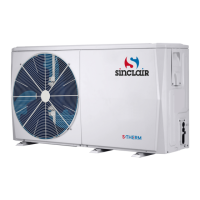
This document is an installation manual for the Sinclair STHERM Monoblock Inverter Air to Water Heat Pump, covering models SMH-XXXIRB, SMH-XXXIRB-3, SMH-XXXIRB2, and SMH-XXXIRB2-3.
Function Description:
The Sinclair DC Inverter Air to Water Heat Pump system is designed for various climate control and water heating applications. It consists of an outdoor unit, an indoor unit, and an internal fan-coil water tank. The system utilizes R32 refrigerant, which is noted for its good thermodynamic features and lower environmental impact compared to common refrigerants.
The heat pump offers a comprehensive range of operational functions:
- Cooling: In cooling mode, the refrigerant condenses in the outdoor unit and evaporates in the indoor unit, transferring heat from the water to the refrigerant, thereby decreasing the water temperature. The cooled water is then circulated through indoor fan coils and/or underground pipes to reduce indoor air temperature.
- Heating: In heating mode, the refrigerant evaporates in the outdoor unit and condenses in the indoor unit, transferring heat from the refrigerant to the water, increasing its temperature. The heated water is circulated through indoor fan coils and/or underground pipes to raise indoor air temperature.
- Water Heating: Dedicated water heating mode involves the refrigerant evaporating in the outdoor unit and condensing in the indoor unit, transferring heat to the water. This heated water is then circulated through the coil pipe of a bearing water tank to increase the water tank temperature to the desired level.
- Cooling + Water Heating: This mode allows for simultaneous cooling and water heating. Users can set a priority for either cooling or water heating. By default, the heat pump prioritizes cooling, with water heating handled by the water tank's e-heater. If water heating is prioritized, the heat pump will complete water heating before switching to cooling.
- Heating + Water Heating: Similar to the cooling + water heating mode, users can set priorities. By default, heating is prioritized, with water heating handled by the water tank's e-heater. If water heating is prioritized, the heat pump will complete water heating before switching to heating.
- Emergency Mode: This mode is available for heating and water heating. If the outdoor unit malfunctions, heating can be provided by the e-heater of the indoor unit. For water heating, the water tank's e-heater takes over.
- Fast Hot Water: In this mode, the unit operates with both the heat pump's water heating control and the water tank's e-heater running simultaneously for rapid hot water production.
- Forced Operation Mode: This mode is primarily used for refrigerant recovery and unit debugging.
- Holiday Mode: Available for heating only, this mode maintains indoor or leaving water temperature within a set range to prevent the water system from freezing or protecting indoor articles from frost damage. If the outdoor unit stops due to malfunction, both e-heaters will run.
- Disinfection Mode: This function allows for disinfection of the water heating system by reaching a set temperature for a specified duration.
- Quiet Mode: Available in cooling, heating, and water heating modes, this function automatically reduces the outdoor unit's running noise.
- Weather-Dependent Operation: This mode, available for space heating or cooling, automatically adjusts the setting value (remote room air temperature or leaving water temperature) based on changes in outdoor air temperature.
- Floor Commissioning: A function to periodically preheat the floor for initial use.
- Air Removal of the Water System: This function replenishes water and removes air from the water system to stabilize water pressure.
- Solar Water Heater: When conditions are met, the solar heater prioritizes heating the circulation water, which then exchanges heat with the water in the tank, promoting energy conservation.
- Other Thermal: If the outdoor temperature is below a set point for auxiliary heat and the compressor has stopped for three minutes due due to an error, other thermal sources will activate to supply heat or hot water.
Important Technical Specifications:
The manual provides a model line-up with capacities and power supply details.
Capacities (Heating¹ / Cooling²):
- SMH-40IRB: 4 kW / 3.8 kW
- SMH-60IRB: 6 kW / 5.8 kW
- SMH-80IRB: 7.5 kW / 6.8 kW
- SMH-100IRB/SMH-100IRB2: 10 kW / 8.8 kW
- SMH-120IRB/SMH-120IRB2: 12 kW / 11 kW
- SMH-140IRB/SMH-140IRB2: 14 kW / 12.5 kW
- SMH-160IRB/SMH-160IRB2: 15.5 kW / 14.5 kW
- 3-phase models (SMH-XXXIRB-3, SMH-XXXIRB2-3) have similar capacities.
Power Supply:
- Single-phase models (SMH-XXXIRB, SMH-XXXIRB2): 220~240VAC, 1Ph, 50Hz
- Three-phase models (SMH-XXXIRB-3, SMH-XXXIRB2-3): 380~415VAC, 3Ph, 50Hz (for -3 models), 400VAC, 3Ph, 50Hz (for -3 models with G2 series)
Operating Conditions:
- Heating: Heat Source Side Temperature: -25~35°C, User Side Temperature: 20~60°C
- Cooling: Heat Source Side Temperature: -15~48°C, User Side Temperature: 7~25°C
- Water Heating: Heat Source Side Temperature: -25~45°C, User Side Temperature: 40~80°C
Water Operating Temperatures:
- Cooling: Min 7°C, Max 25°C
- Heating: Min 20°C, Max 60°C
- Water heating: Min 40°C, Max 80°C
Water Operating Pressures:
- Min 0.05MPa, Max 0.25MPa for cooling, heating, and water heating.
Refrigerant: R32, GWP: 675 (1 kg R32 = 0.675 t CO2 eq). The charge size must be in accordance with the room size.
Water Quality Requirements:
The manual specifies strict water quality parameters for circulation water, including pH (6.8-8.0), cloudy (<1 NTU), chloride (<50 mg/L), fluoride (<1 mg/L), iron (<0.3 mg/L), sulphate (<50 mg/L), SiO2 (<30 mg/L), hardness (<70 mg/L), nitrate (<10 mg/L), conductance (<300 μs/cm), ammonia (<0.5 mg/L), alkalinity (50 mg/L), sulfid (cannot be detected), oxygen consumption (<3 mg/L), and natrium (<150 mg/L). Anti-scale composition is recommended if water quality does not meet these requirements.
Electrical Wiring Specifications:
- Power cable diameters and air break switch capacities are provided for each model, ranging from 16A with 1.5mm² power wire for smaller units to 40A with 4.0mm² power wire for larger single-phase units. Three-phase units typically require 16A with 1.5mm² power wire.
- Leakage switch with action response time less than 0.1 second and leakage circuit 30mA is required.
- Copper wires must be used.
- Power cables should be laid out through cabling trough, conduit tube, or cable channel and protected with rubber or plastic.
- All electrical installations must be carried out by professional technicians in accordance with local laws and regulations.
Expansion Vessel Calculation:
The manual provides a formula for calculating the charging pressure of the expansion vessel: Pz = (H/(10*0.3)) Bar, where H is the maximum volume of the water system. It also includes a table for water expansion factor 'e' at different temperatures.
Usage Features:
- Installation Flexibility: The monobloc unit can be installed on a firm and solid support, preferably a concrete base of 10cm height. It should be placed in a well-ventilated area to prevent overheating and ensure energy saving. Minimum clearances from barriers are specified.
- Water Pipe Connection: Horizontal water pipe connection is recommended.
- Remote Air Temperature Sensor: Installation guidelines include distance (less than 15m), height (approx. 1.5m from floor), and placement considerations to avoid hidden areas or external thermal influences.
- Thermostat: Wiring instructions are provided for connecting a 230V heating/cooling thermostat.
- 2-Way and 3-Way Valves: Detailed wiring and operational descriptions are given for 2-way valves (controlling water flow to underfloor loop) and 3-way valves (flow switching between underfloor heating and water tank heating loops).
- Optional Electric Heater and Other Thermal: Instructions for installing and wiring optional electric heaters (1 or 2 groups) and other thermal sources in series or parallel with the monobloc unit.
- Insulated Water Tank: Installation guidelines specify vertical installation, fixing to the wall, and ensuring the installation place is firm enough to support the tank's weight when full. Minimum clearance to combustible surfaces is 500mm.
- Anti-freeze Protection: In subzero conditions, anti-freeze fluid (glycol solution) must be added to the water cycle, and external water pipes should be properly insulated. A table of glycol concentrations and corresponding freezing temperatures is provided.
Maintenance Features:
- Periodical Cleaning: Regular cleaning of the unit, including the condenser fin, is recommended to ensure performance and prevent blockages.
- Water System Maintenance: Periodical cleaning of the water system filter and frequent checks of the water replenishing device are necessary.
- Water Tank Maintenance: Periodic cleaning of the water tank is crucial for good water quality. Detailed steps for water input and drainage are provided.
- Mg-Stick Replacement: To improve water tank durability, a Mg-Stick is installed and typically has a lifespan of 2-3 years, though this can be shortened by poor water quality. The manual outlines steps for draining the tank, opening the cap, unscrewing the Mg-Stick, and installing a new one. This task should be performed by professional maintenance personnel.
- Refrigerant Charging and Discharging: Instructions for safely charging and discharging R32 refrigerant, including vacuuming procedures and leak detection methods. Electronic leak detectors calibrated to R32 are recommended.
- Pre-startup Checks: A comprehensive checklist for qualified repair persons to ensure proper installation and operation before commissioning, covering appearance, accessories, wiring, earthing, water tank stability, insulation, and pressure relief devices.
- Test Run: Procedures for conducting a test run to ensure normal operation, including preheating the compressor, checking phase sequence, measuring insulation resistance, and observing component operation.
- Troubleshooting: A table listing common malfunctions, their reasons, and corresponding troubleshooting steps (e.g., checking power supply, re-fixing bolts, replacing components, evacuating, adding refrigerant, cleaning heat exchangers).
- Refrigerant Recovery and Decommissioning: Detailed procedures for safe refrigerant recovery into appropriate cylinders and decommissioning of the unit, emphasizing the use of qualified personnel, proper equipment, and adherence to safety standards.
The manual stresses the importance of qualified personnel for installation, maintenance, and repair, especially concerning flammable refrigerants and electrical components. It also highlights environmental protection through proper disposal and recycling of the appliance.

 Need help?

 To Next Page
 General