Revised April 28, 2010
12850-87
Avenue
Surrey, BC. Canada. V3W 3H9
Ph: 604-594-5404
Fx: 604-594-8845
www.singervalve.com
Installation (Cont.):
2. For most convenient operation and maintenance,
line isolation valves should be installed.
3. A suitable bypass should be provided to allow for
servicing of the valve without interrupting the flow.
4. Install pressure gauges upstream and/or
downstream of valve as appropriate. This will
facilitate ease of setting the pilot system.
5. A strainer with a suitable basket should be
installed ahead of the valve to protect it from
foreign material.
6. Sufficient space should be provided around the
valve for disassembly.
7. Flush system of all foreign matter before installing
the valve.
8. Check direction of flow (inlet of valve is marked
OR an arrow on the side of body indicates flow
direction) and install the valve accordingly.
9. VENT AIR FROM THE BONNET After installation,
when the valve is pressurized, vent air from the
bonnet:
• Valves with no Limit Switch: Loosen pipe plug at
the centre of the bonnet to bleed air. If
equipped with position indicator, use bleed-cock
on indicator.
• Valves with Limit Switch: Refer to Drawing
A0707A. Use bleed screw (63) to vent air.
SERVICE SUGGESTIONS:
POSSIBLE CAUSE / REMEDY
FAILS TO OPEN
1. Insufficient inlet pressure. / Increase pressure
2. Pressure in the bonnet is not released:
• Isolating valves on pilot lines closed. - Open
valves
• Pilot components not functioning. - Refer to
specific instructions on pilot components
• Foreign material in pilot system. - Clear
obstruction
FAILS TO CLOSE
Lack of pressure in the bonnet due to:
• Pilot components not functioning. - Refer to
specific instructions on pilot components.
• Foreign material in pilot system. - Clear
obstructions.
• Ruptured diaphragm. - Replace worn parts.
• Obstruction in the valve. - Remove obstructions.
• Worn main valve disc. - Replace disc.
PULSATIONS
• Air in the bonnet. - Vent air. Refer to "Installation
(9)" above.
• Improper adjustment to pilot components. - Refer
to specific instructions on pilot components.
• Valve oversized. A smaller valve in parallel may
be required.
MAINTENANCE:
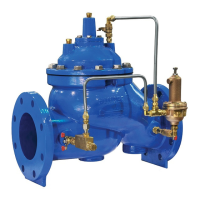
The SINGER Model S106/S206-PG requires a
minimum of maintenance. All parts are accessible for
inspection and repair without removing the valve from
the line.
1. Close upstream and downstream isolating gate
valves.
2. Disconnect body and bonnet pilot lines.
3. Remove bonnet. If bonnet does not come free
readily, it can be pried loose with a small pry-bar.
4. Remove inner valve assembly for inspection. Do
not remove seat ring unless inspection shows that
it is damaged. Be very careful not to damage
the epoxy coating when removing and
installing the inner valve assembly.
5. Replace worn or defective parts and reassemble.
NOTE REGARDING FREEZING:
This valve does not drain completely when inlet and
outlet pipes are drained. Where freezing conditions
are expected, one of the following must be performed:
• Drain valve and pilot system completely.
• Add suitable anti-freeze to valve and pilot system
(Non-potable water service only).
• Provide insulation and/or heating to keep the
valve from freezing.
IOM 224C Page 2 of 2 August 2007


 To Next Page
 Loading...