EasyManua.ls Logo

Singer 1200-1 - Page 11

Singer 1200-1
33 pages
Print Icon
To Next Page IconTo Next Page
To Previous Page IconTo Previous Page
Loading...
16
To
Prepare
for
Sewing
Witli
the
left
hand
hold
the
end
of the
thread,
leaving
it
slack
from
the
hand
to
the
needle.
Turn
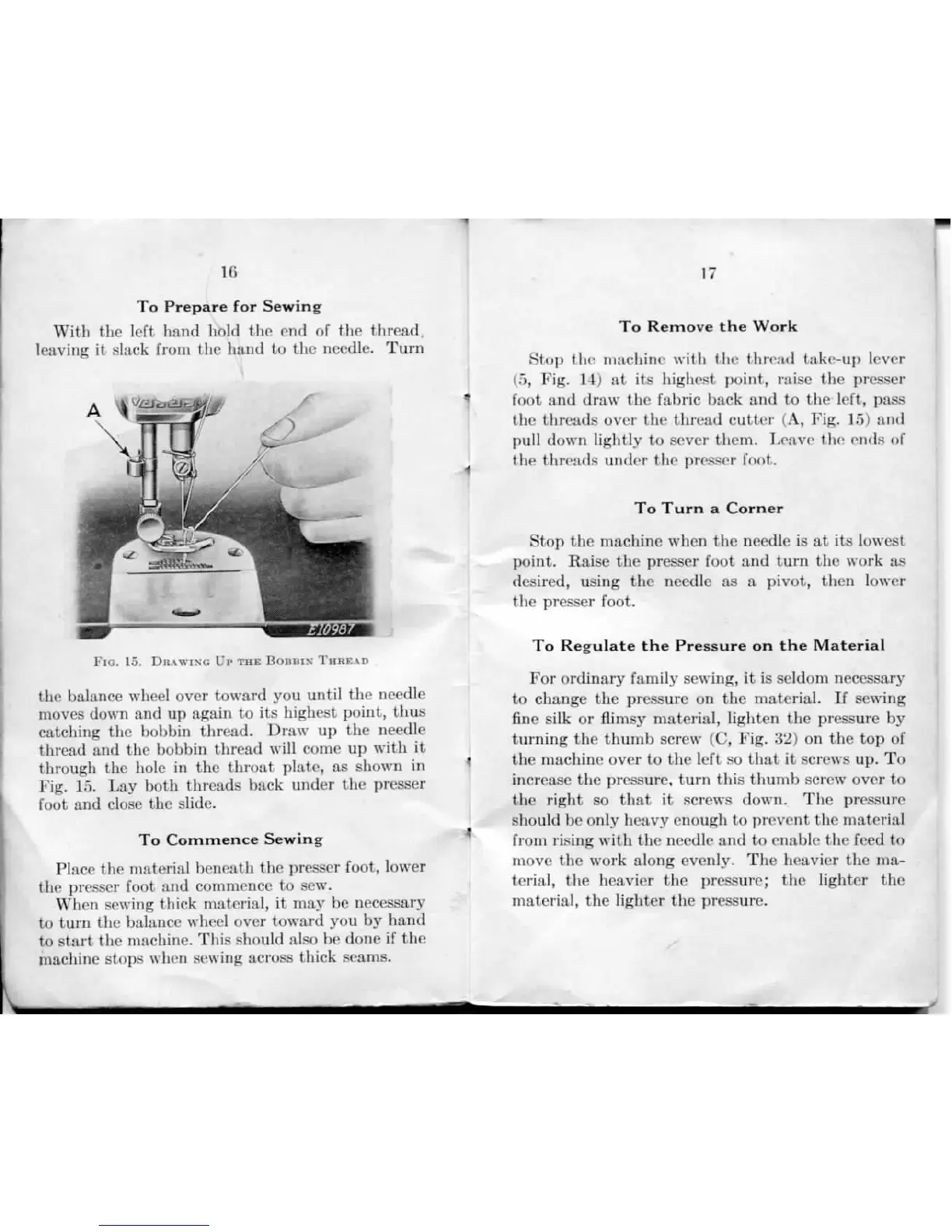
FIQ.
15.
DBA
wise
UP THE
BOBBIN
THREAD
the
balance
wheel over toward
you
until
the
needle
moves
down
and up
again
to its
highest
point,
thus
catching
the
bobbin
thread. Draw
up
the
needle
thread
and the
bobbin
thread
will
come
up
with
it
through
the
hole
in the
throat plate,
as
shown
in
Fig.
15. Lay
both threads
back
under
the
presser
foot
and
close
the
slide.
To
Commence
Sewing
Place
the
material beneath
the
presser foot,
lower
the
presser
foot
and
commence
to
sew.
When
sewing
thick
material,
it may be
necessary
to
turn
the
balance
wheel
over toward
you by
hand
to
start
the
machine. This should also
be
done
if the
machine
stops
when
sewing
across
thick
seams.
17
To
Remove
the
Work
Stop
the. machine with
the;
thread
tako-up
lever
(5,
Fig.
14) at its
highest point,
raise
the
presser
foot
and
draw
the
fabric
back
and to the
left,
pass
the
threads over
the
thread cutter
(A,
Fig.
15) and
pull
down
lightly
to
sever them.
Leave
the
ends
of
the
threads under
the
presser foot.
To
Turn
a
Corner
Stop
the
machine when
the
needle
is at its
lowest
point.
Raise
the
presser foot
and
turn
the
work
as
desired, using
the
needle
as a
pivot, then lower
the
presser
foot.
To
Regulate
the
Pressure
on the
Material
For
ordinary
family
sewing,
it is
seldom
necessary
to
change
the
pressure
on
the
material.
If
sewing
fine
silk
or flimsy
material, lighten
the
pressure
by
turning
the
thumb screw
(C,
Fig.
32)
on the top of
the
machine over
to the
loft
so
that
it
screws
up.
To
increase
the
pressure,
turn this thumb screw over
to
the
right
so
that
it
screws down.
The
pressure
should
be
only heavy enough
to
prevent
the
material
from
rising
with
the
noodle
and to
enable
the
feed
to
move
the
work along evenly.
The
heavier
the ma-
terial,
the
heavier
the
pressure;
the
lighter
the
material,
the
lighter
the
pressure.

Related product manuals