EasyManua.ls Logo

Singer 1200-1 - Needle Installation and Upper Threading

Singer 1200-1
33 pages
Print Icon
To Next Page IconTo Next Page
To Previous Page IconTo Previous Page
Loading...
18
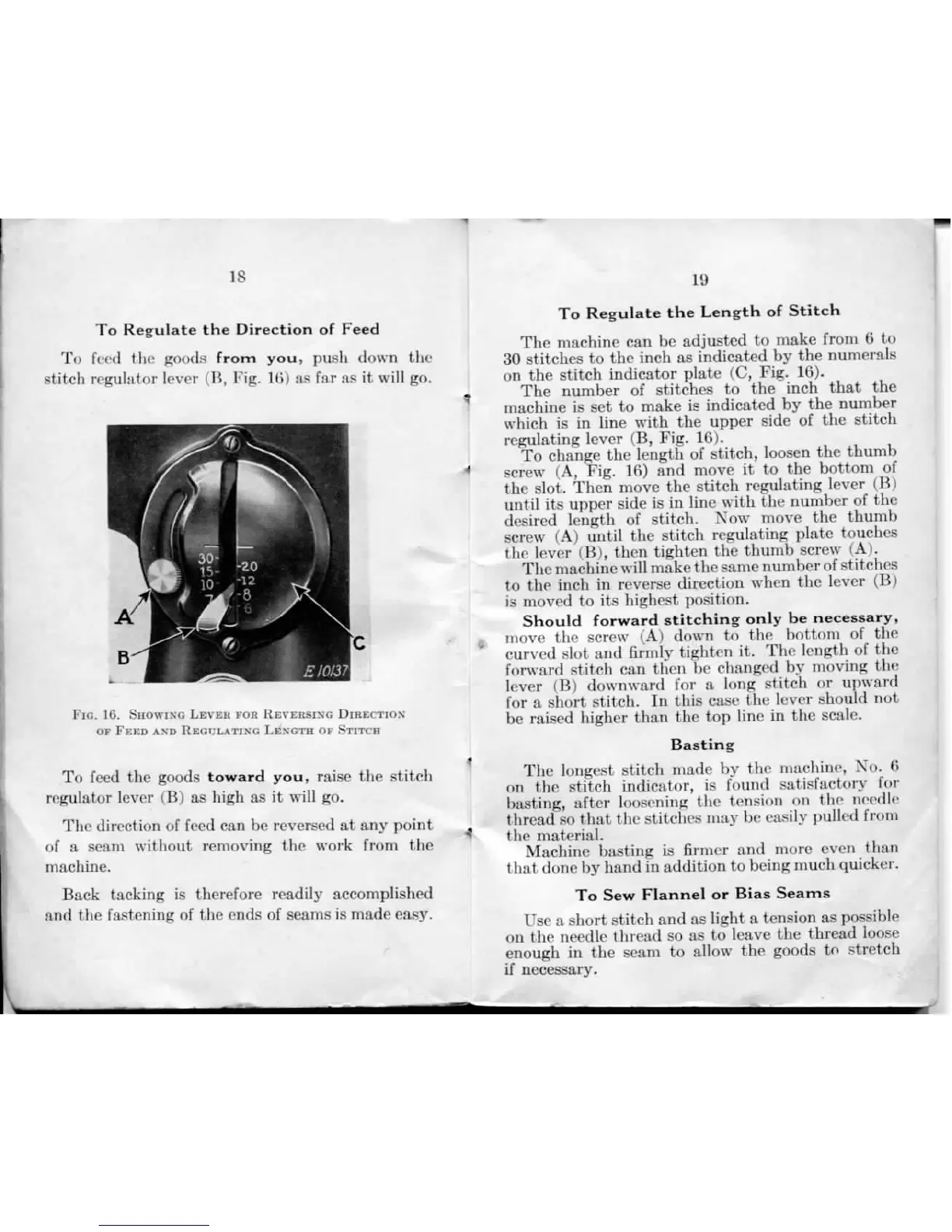
To
Regulate
the
Direction
of
Feed
To
feed
the
goods
from
you,
push
down
the
stitch
regulator
lever
(B,
Fig.
16) as
far
as it
will
go.
FIG.
16.
SHOWING
LEVER
FOE
REVERSING
DIRECTION
OF
FEED
AND
REGULATING
LENGTH
OF
STITCH
To
feed
the
goods
toward
you,
raise
the
stitch
regulator
lever
(B) as
high
as it
will
go.
The
direction
of
feed
can
be
reversed
at any
point
of
a
seam without removing
the
work
from
the
machine.
Back
tacking
is
therefore
readily
accomplished
and
the
fastening
of the
ends
of
seams
is
made
easy.
19
To
Regulate
the
Length
of
Stitch
The
machine
can be
adjusted
to
make
from
6 to
30
stitches
to the
inch
as
indicated
by the
numerals
on
the
stitch indicator
plate
(C,
Fig. 16).
The
number
of
stitches
to the
inch
that
the
machine
is set to
make
is
indicated
by the
number
which
is in
line
with
the
upper side
of the
stitch
regulating
lever
(B,
Fig.
16).
To
change
the
length
of
stitch, loosen
the
thumb
screw
(AT
Fig.
16) and
move
it to the
bottom
of
the
slot.
Then move
the
stitch regulating lever
(B)
until
its
upper side
is in
line with
the
number
of the
desired
length
of
stitch.
Now
move
the
thumb
screw
(A)
until
the
stitch
regulating
plate
touches
the
lever (B), then
tighten
the
thumb screw (A).
The
machine
will
make
the
same
number
of
stitches
to the
inch
in
reverse direction
when
the
lever
(B)
is
moved
to its
highest position.
Should
forward
stitching
only
be
necessary,
move
the
screw
(A)
down
to the
bottom
of the
curved slot
and
firmly
tighten
it. The
length
of
the
forward
stitch
can
then
be
changed
by
moving
the
lever
(B)
downward
for a
long
stitch
or
upward
for
a
short
stitch-
In
this
case
the
lover should
not
be
raised higher than
the
top
line
in the
scale.
Basting
The
longest
stitch
made
by the
machine,
Xo.
C>
on the
stitch indicator,
is
found
satisfactory
for
basting,
after
loosening
the
tension
on the
needle
thread
so
that
the
stitches
may be
easily
pulled
from
the
material.
Machine
basting
is
firmer and
more
even
than
that done
by
hand
in
addition
to
being
much quicker.
To Sew
Flannel
or
Bias
Seams
Use
a
short
stitch
and as
light
a
tension
as
possible
on
the
needle
thread
so as to
leave
the
thread
loose
enough
in the
seam
to
allow
the
goods
to
stretch
if
necessary.

Related product manuals