EasyManua.ls Logo

Singer 1200-1 - Page 13

Singer 1200-1
33 pages
Print Icon
To Next Page IconTo Next Page
To Previous Page IconTo Previous Page
Loading...
20
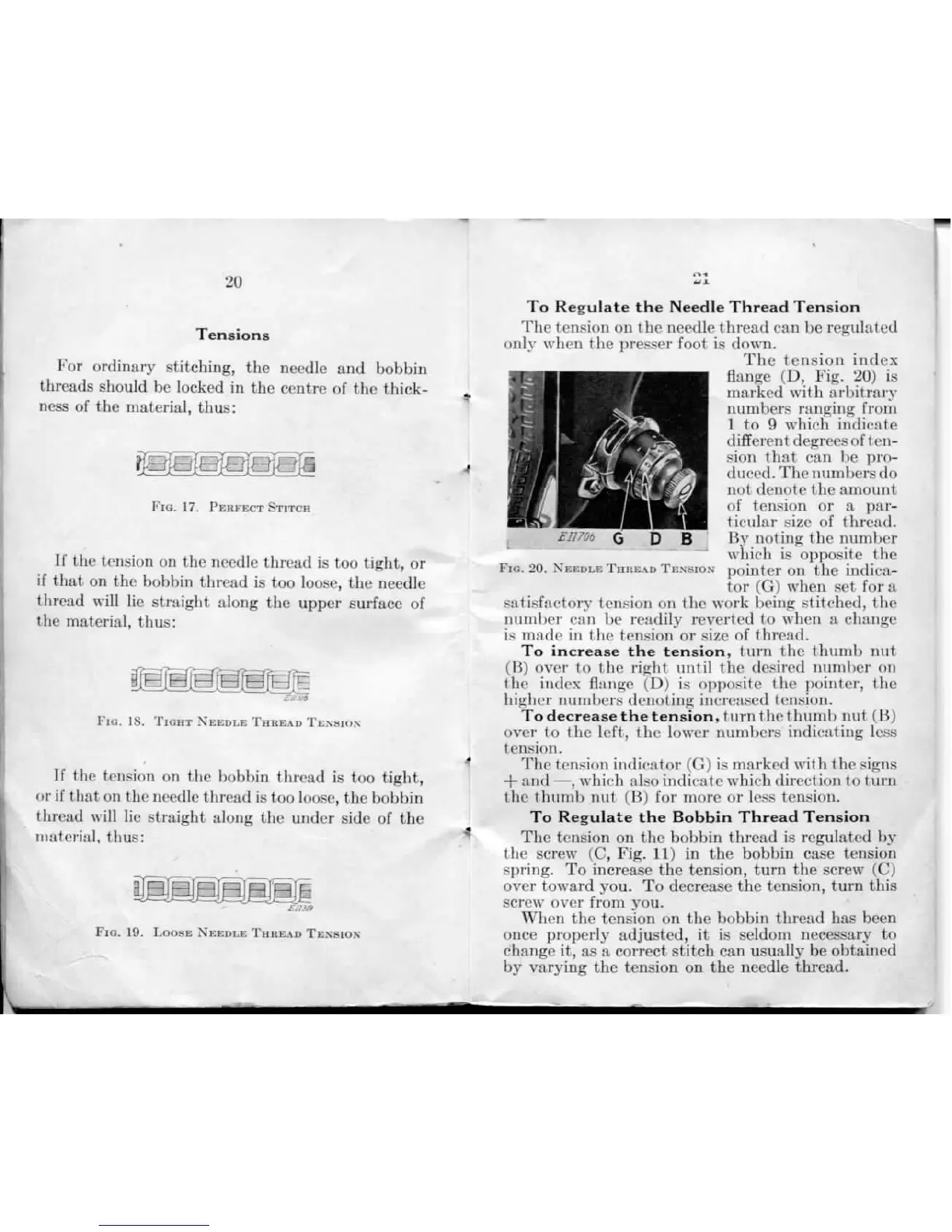
Tensions
For
ordinary stitching,
the
needle
and
bobbin
threads
should
be
locked
in the
centre
of the
thick-
ness
of
the
material,
thus:
Fiu.
17.
PERFECT
STITCH
If
the
tension
on the
needle thread
is too
tight,
or
if
that
on the
bobbin thread
is too
loose,
the
needle
thread
will
lie
straight along
the
upper
surface
of
the
material, thus:
Fiu.
IS.
TIGHT
XEEDLE
THREAD
TENSION
If
t.hc
tension
on
the
bobbin thread
is too
tight,
or
if
that
on the
needle
thread
is too
loose,
the
bobbin
thread
will
lie
straight
along
the
under side
of the
material,
thus:
FIG.
19.
LOOSE
NEEDLE
THKEAD
TENSION
B
To
Regulate
the
Needle
Thread Tension
The
tension
on the
needle
thread
can be
regulated
only when
the
presser
foot
is
down.
The
tension
index
flange
(D,
Fig.
20) is
marked
with arbitrary
numbers
ranging
from
1 to 9
which
indicate
different
degrees
of
ten-
sion that
can be
pro-
duced.
The
numbers
do
not
denote
the
amount
of
tension
or a
par-
ticular
size
of
thread.
By
noting
the
number
which
is
opposite
the
FIG.
20.
NEEDLE
THREAD
TENSION
pointer
Oil
the
indica-
tor (G)
when
set for a
satisfactory tension
on the
work
being
stitched,
the
number
can be
readily reverted
to
when
a
change
is
made
in the
tension
or
size
of
thread.
To
increase
the
tension,
turn
the
thumb
nut
(B)
over
to the
right until
the
desired
number
on
the
index
flange (D) is
opposite
the
pointer,
the
higher
numbers denoting increased tension.
To
decrease
the
tension,
turn
the
thumb
nut (B)
over
to the
left,
the
lower
numbers
indicating less
tension.
The
tension indicator
(G) is
marked with
the
signs
+ and
,
which also indicate which direction
to
turn
the
thumb
nut
(B) for
more
or
less
tension.
To
Regulate
the
Bobbin
Thread
Tension
The
tension
on the
bobbin thread
is
regulated
by
the
screw
(C,
Fig.
11) in the
bobbin
case
tension
spring.
To
increase
the
tension,
turn
the
screw
(C)
over toward you.
To
decrease
the
tension, turn this
screw
over from you.
When
the
tension
on the
bobbin thread
has
been
once
properly
adjusted,
it is
seldom
necessary
to
change
it, as a
correct
stitch
can
usually
be
obtained
by
varying
the
tension
on the
needle
thread.

Related product manuals