EasyManua.ls Logo

Singer 1200-1 - Page 15

Singer 1200-1
33 pages
Print Icon
To Next Page IconTo Next Page
To Previous Page IconTo Previous Page
Loading...
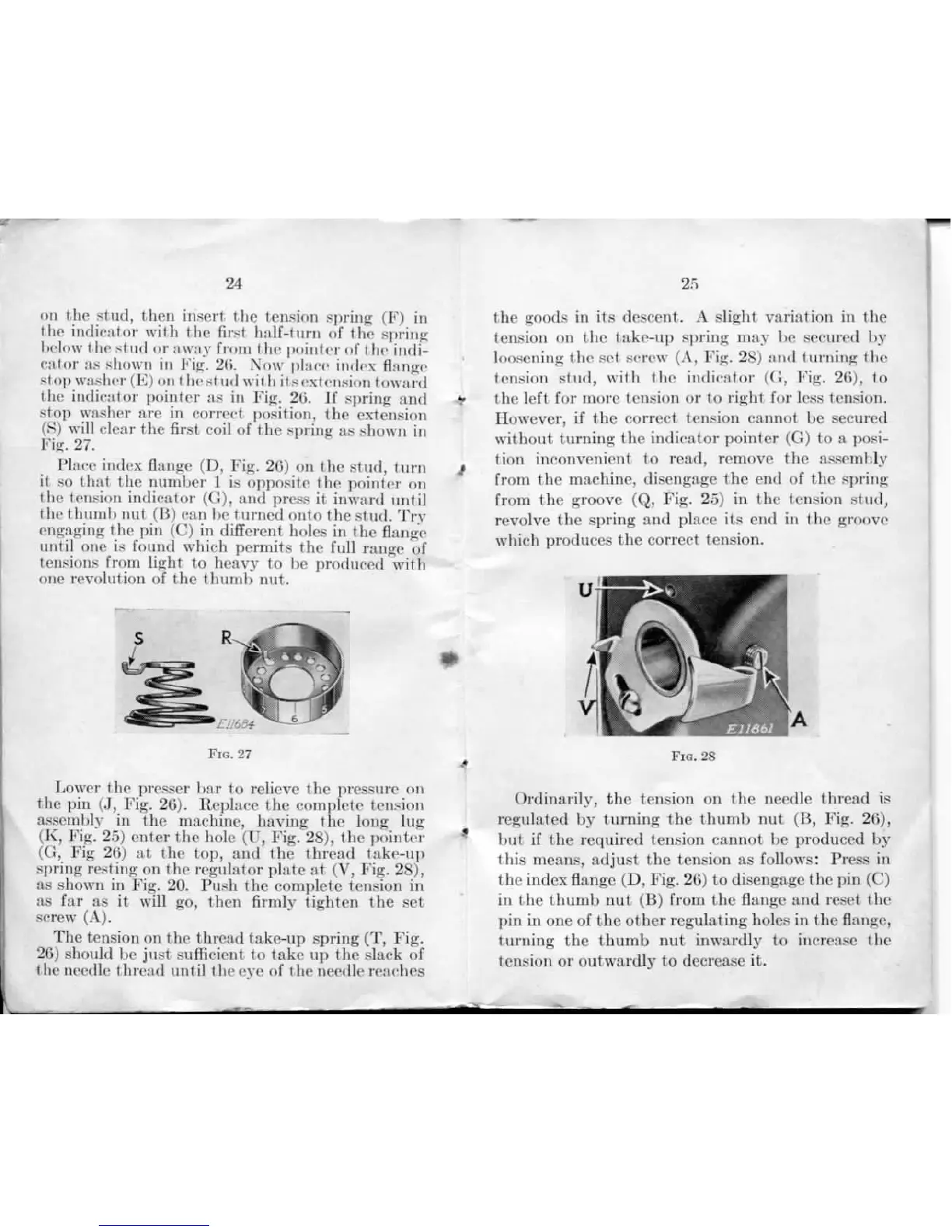
24
on
the
stud, then insert
the
tension
spring
(F) in
the
indicator
with
the
first
half-turn
of the
spring
below
(he
stud
or
away
from
the
pointer
of the
indi-
cator
as
shown
in
Fig.
26.
Xmv
place
index
flange
stop
washer
(E) on
t
lie
stud
\vii
h
its
extension
toward
the
indicator
pointer
as in
Fig.
26. if
spring
and
stop washer
are in
correct position,
the
extension
(S)
will
clear
the first
coil
of the
spring
as
shown
in
Fig.
27.
Place
index
flange (D,
Fig-
26) on the
stud,
turn
it
so
that
the
number
1 is
opposite
the
pointer
on
the
tension indicator
((".),
and
press
it
inward
until
the
thumb
nut
(15)
can be
turned onto
the
slud.
Try
engaging
the pin (C) in
different
holes
in the flange
until
one is
found
which
permits
the
full
range
of
tensions
from
light
to
heavy
to
be
produced
with
one
revolution
of the
thumb
nut.
FIG.
27
Lower
the
presser
bar to
relieve
the
pressure
on
the pin (J,
Fig.
26).
Replace
the
complete
tension
assembly
in the
machine, having
the
long
lug
(K,
Fig.'
25)
enter
the
hole
(U,
Fig. 28),
the
pointer
(G,
Fig 26) at the
top,
and the
thread take-up
spring
resting
on the
regulator plate
at (V,
Fig. 28),
as
shown
in
Fig.
20.
Push
the
complete
tension
in
as far as it
will
go,
then
firmly
lighten
the
set
screw
(A).
The
tension
on the
thread
take-up spring
(T,
Fig.
26)
should
be
just
sufficient
to
take
up the
slack
of
the
needle
thread
until
the eve of the
needle
reaches
25
the
goods
in its
descent.
A
slight variation
in the
tension
on
the
take-up
spring
may be
secured
by
loosening
the set
screw
(A,
Fig.
28)
and
turning
the
tension
stud,
with
the
indicator
(G,
Fig. 26),
to
the
left
for more
tension
or to
right
for
less
tension.
However,
if the
correct
tension cannot
be
secured
without
turning
the
indicator
pointer
(G) to a
posi-
tion
inconvenient
to
read,
remove
the
assembly
from
the
machine,
disengage
the end of the
spring
from
the
groove
(Q,
Fig.
2o)
in the
tension stud,
revolve
the
spring
and
place
its
end
in the
groove
which
produces
the
correct tension.
U
FIG.
28
Ordinarily,
the
tension
on the
needle thread
is
regulated
by
turning
the
thumb
nut
(11, Fig. 26),
but if the
required tension cannot
be
produced
by
this
means,
adjust
the
tension
as
follows:
Press
in
the
index
flange (D,
Fig.
26) to
disengage
the
pin (C)
in
the
thumb
nut (B)
from
the flange and
reset
the
pin in one of the
other regulating
holes
in the flange,
turning
the
thumb
nut
inwardly
to
increase
the
tension
or
outwardly
to
decrease
it.

Related product manuals