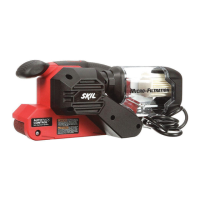
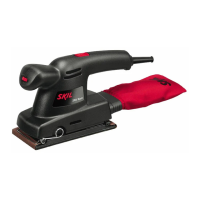
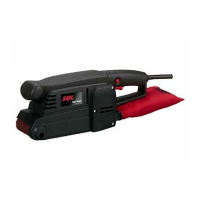
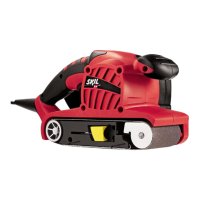
7
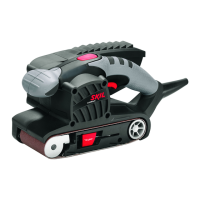
In case belt runs off tool (mostly caused by inferior belt
quality), you should
- switch on the tool
- adjust screw E 2 till the sanding belt is running in
line with the fl at side of the tool
- use new belt, if belt still runs off tool
• Dust suction 5
- empty dustbox G/dustbag F regularly for optimal
dust pick-up performance
- when using tool with vacuum cleaner, mount vacuum
cleaner adaptor H as illustrated (1215)
- when necessary, also clean the fi lter as illustrated
! do not use dustbox/dustbag/vacuum cleaner
when sanding metal
• Holding and guiding the tool 6
- guide the tool parallel to the working surface
! do not apply too much pressure on the tool; let
the sanding surface do the work for you
- do not tilt the tool in order to avoid unwanted
sanding marks
- keep ventilation slots J 2 uncovered
APPLICATION ADVICE
• For sanding bare wood surfaces move the tool in
straight movements in line with the grain
• For sanding all other surfaces move the tool in oval
movements over the material
• Mount sanding frame K (SKIL accessory 2610398244)
for equalizing surfaces without scratches or grooves,
and ensure it is in place securely 7
! sanding frame K becomes hot during use; do not
touch it before it has cooled down
• Never use the same sanding belt for wood and metal
• Recommended sanding belt grits:
coarse - for removing paint;
for sanding of extremely rough wood
medium - for sanding of rough or plain wood
fi ne - for smoothing of wood;
for fi nishing of bare wood;
for smoothing surfaces with old paint
• Use different grit sizes when the working surface is
rough:
- start sanding with coarse or medium grit
- fi nish with fi ne grit
• For more tips see www.skileurope.com
• Vibration level
The vibration emission level stated at the back of this
instruction manual has been measured in accordance
with a standardised test given in EN 60745; it may be
used to compare one tool with another and as a
preliminary assessment of exposure to vibration when
using the tool for the applications mentioned
- using the tool for different applications, or with
different or poorly maintainted accessories, may
signifi cantly increase the exposure level
- the times when the tool is switched off or when it is
running but not actually doing the job, may
signifi cantly reduce the exposure level
! protect yourself against the effects of vibration by
maintaining the tool and its accessories, keeping
your hands warm, and organizing your work
patterns
MAINTENANCE / SERVICE
• Always keep tool and cord clean (especially the
ventilation slots J 2)
- remove adhering sanding dust with a brush
! disconnect the plug before cleaning
• If the tool should fail despite the care taken in
manufacturing and testing procedures, repair should be
carried out by an after-sales service centre for SKIL
power tools
- send the tool undismantled together with proof of
purchase to your dealer or the nearest SKIL service
station (addresses as well as the service diagram of
the tool are listed on www.skileurope.com)
ENVIRONMENT
• Do not dispose of electric tools, accessories and
packaging together with household waste material
(only for EU countries)
- in observance of European Directive 2002/96/EC on
waste of electric and electronic equipment and its
implementation in accordance with national law,
electric tools that have reached the end of their life
must be collected separately and returned to an
environmentally compatible recycling facility
- symbol 8 will remind you of this when the need for
disposing occurs
F
Ponceuse à bande 1210/1215
INTRODUCTION
• Cet outil est conçu pour le ponçage à sec avec une
grande capacité à enlever la matière du bois, plastique,
métal et mastic et des surfaces peintes
• Lisez et conservez ce manuel d’instructions 3
SPECIFICATIONS TECHNIQUES 1
ELEMENTS DE L’OUTIL 2
A Interrupteur marche/arrêt
B Bouton de verrouillage de l’interrupteur marche/arrêt
C Levier pour changer la bande de ponçage
D Flèche
E Vis pour régler le centrage de la bande
F Sac à poussière
G Réservoir à poussière
H Adaptateur de l’aspirateur
J Fentes de ventilation


 To Next Page
 Loading...