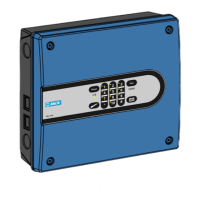
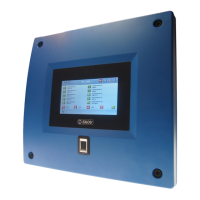
The DOL 2200 Alarm System is a comprehensive unit designed primarily for monitoring ventilation in livestock houses, capable of monitoring temperature in up to ten sections. It can also be configured to trigger alarms for other conditions such as empty silos, blocked augers, or oil burner defects. The alarm unit can alert users via phone, beep, flash, and an external horn/siren.
Function Description
The DOL 2200 system offers both absolute and relative temperature alarms. Absolute temperature alarms trigger when the temperature exceeds a set maximum (e.g., 32°C) or falls below a set minimum (e.g., 14°C). Relative temperature alarms are based on the "Normal temp." (an average house temperature from 6:00-7:00), triggering if the temperature deviates by a set amount (e.g., +5°C or -4°C from normal).
Alarm handling can be performed directly on the DOL 2200 unit by pressing the START/STOP button to acknowledge, switch off the siren, and terminate phone calls. The system can then be restarted for monitoring. Alarms can also be stopped over the phone by pressing the '#' button or by calling the system and entering a password. For GSM-enabled units, alarms can be acknowledged via SMS by sending the password.
The system includes a testing function to verify its operational status. Users can display information about the system status and the status of individual inputs. Inputs can be configured for various alarm types, including "Horn+dialup" (activates horn/siren and dials out), "Soft (beep), night" (flashes alarm lamp and beeps), and "Only horn" (activates horn/siren). Input types can be set as Temperature, ON/OFF, or Ω ON/OFF, with specific functionalities for each, including fire alarm detection.
The DOL 2200 features a speech computer for remote control and inquiries via telephone. Users can enter telephone numbers, change input names, modify the access code, set auto-answer rings, and define dial-up patterns. The speech computer also provides error messages through the loudspeaker. Remote control via SMS is also possible for certain functions.
A log function records up to 200 events, including temperature changes, alarms, and alarm code changes. This includes a graphical log displaying temperature courses over time and an event log with time and date indications.
Important Technical Specifications
- Software Version: 2.03 (released 2014)
- Mains Supply: 230 or 240VAC +/-10%, 50/60Hz, 40VA power consumption.
- 12VDC Output: Maximum power load of 3.0A.
- Telephone Module: Analogue module, DTMF signalling.
- GSM Module (MC45/MC46): Supports 900, 1800, 1900 MHz (MC45) and 850, 1800, 1900 MHz (MC46 for North America).
- GSM Signal Level: Minimum (minus)-95dbm for stable connection.
- Cable Knock-out Punches: 20 for metric screwed cable entries m25x1.5.
- Operating Temperature: -10 to +40°C (+14 to +140°F).
- Warehouse Temperature: -25 to +60°C (-13 to +140°F).
- Humidity: 0-80% RH.
- Enclosure Class: Splashproof IP 54.
- Dimensions (DOL 2200): H x W x D: 381 x 400 x 170mm.
- Shipping Weight: 9.5 kg.
- RS485 Network: Max cable length 1,200 meters (depending on cable cross-section).
- DOL 13 Cables: Max cable length 300m, min cross-section 0.5mm².
Usage Features
- User Interface: Features right and left adjustment knobs for menu selection and line selection, respectively. A "NEXT" button is used to view submenus or navigate through pages.
- Temperature Alarms: Configurable maximum, minimum, and relative temperature alarm limits. "Summer rise" function compensates for high outside temperatures, raising alarm limits for maximum relative temperature during heatwaves.
- Input Naming: Users can change the name of each input, choosing from a list of standard names or creating combinations of up to three words via telephone encoding.
- System Station Number: For systems with multiple DOL 2200 units, each panel can be assigned a unique system station number, allowing for system error reporting and input scanning.
- Remote Control: Full remote control capabilities via telephone or SMS, including starting/stopping monitoring, restarting inputs after alarms, checking entries, and activating service breaks.
- Speech Computer: Provides spoken feedback for various system states and commands.
- Log Functions: Graphical display of temperature trends and an event log for alarm history.
Maintenance Features
- Battery Test: An automatic daily battery test is performed at 8 am, where the 230V supply is cut out, and the battery is subjected to power resistance for 10 minutes. An alarm triggers if the voltage drops below 11.5V. This feature requires dipswitch 6 to be ON.
- System Test: Includes "Function test" (triggers alarm every 7 days) and "Verifying alarm" (triggers alarm at 1, 2, 4, or 8-week intervals) to ensure external alarm transmission, siren functionality, and sensor operation.
- Line Monitoring: Tests the telephone line by measuring voltage; an alarm triggers if it drops below 5V.
- Dial Tone Test: Checks for a dial tone every two hours, triggering an alarm if none is detected.
- Error Diagnosis (RS485 Network): Provides steps for checking station numbers, RS485 connections, and measuring voltages to diagnose communication issues.
- Cleaning: Recommends cleaning the DOL 2200 with a damp cloth without solvents, avoiding high-pressure cleaners.
- Recycling/Disposal: Products are marked for recycling, with instructions for customers to dispose of them at local collecting points.

 Need help?
 General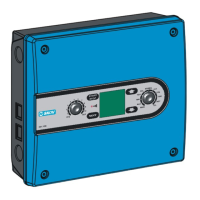

 To Next Page