This document is a user manual for the Skymsen Commercial Tilting Blender, available in 15-liter and 25-liter capacities, identified by models LAR-15LMB and LAR-25LMB respectively. The manual provides comprehensive information on the blender's safety, components, technical specifications, installation, operation, maintenance, and troubleshooting.
Function Description
The Skymsen Commercial Tilting Blender is designed for commercial kitchens, including restaurants, cafeterias, hospitals, bakeries, and similar establishments, to prepare juices, soups, and creamy soups/creams. Its primary function is to blend various food products. The tilting feature allows for easier pouring and cleaning of the cup.
Important Technical Specifications
The blender is available in two models, LAR-15LMB and LAR-25LMB, differing primarily in cup capacity:
- Cup Capacity: 15 liters (LAR-15LMB) and 25 liters (LAR-25LMB).
- Rotation: Both models operate at 3500 rpm.
- Voltage: Both models are designed for 115V or 230V.
- Frequency: Both models operate at 60 Hz.
- Power Rating: Both models have a power rating of 1.5 CV.
- Dimensions:
- Height: 42 inches (LAR-15LMB) and 46 1/2 inches (LAR-25LMB).
- Width: 13 3/16 inches (LAR-15LMB) and 15 3/8 inches (LAR-25LMB).
- Depth: 20 5/8 inches for both models.
- Weight:
- Net Weight: 46.2 lb (LAR-15LMB) and 49.3 lb (LAR-25LMB).
- Gross Weight: 50.6 lb (LAR-15LMB) and 55 lb (LAR-25LMB).
- Material: Stainless steel stand and seamless cup.
- Safety System: Equipped with a safety system to prevent involuntary operation after a power shortage.
- Electrical Connection: Requires a 3-pin power cord and proper grounding.
Usage Features
The blender is designed for ease of use and safety in a commercial environment.
- Installation: The appliance must be positioned and leveled on a dry and firm surface. Electrical installation requires checking the voltage on the label and connecting to a properly grounded outlet. The power cord has 3 pins, and all three pins must be properly connected before starting the equipment. The manual explicitly states not to use extension cords or power strips.
- Pre-Operation: Before using, all parts that come into contact with the product should be washed with water and soap. The cup has a versatile fitting system, making it easy to fit and remove. To tilt the cup, the operator must turn off the equipment by pressing the OFF switch, remove the lid, hold the cup handle firmly, and press the foot pedal to release the cup for tilting. The upperlid should be rotated clockwise until it is loose for removal.
- Operation:
- To start the machine, plug the device into the outlet.
- Switch ON the blender using the appropriate switch (position "I" for ON, "O" for OFF).
- The maximum cup volume is determined by the word MAX on the inside of the cup.
- The blending time may vary depending on the product. It is not recommended to shred solid products without the help of liquids because overheating can damage the cup seal.
- Never switch the equipment on without load, as this can cause damage.
- Safety System: The equipment has a safety system that prevents it from being involuntarily activated after an eventual power outage. The operator must ensure the integrity of the safety system, and other procedures to operate the equipment are unsafe if the equipment should not be used.
- Cautions with Stainless Steels: The stainless steel may present rust signs if cleaning or sanitization is not constant and appropriate. Acid solutions, salty solutions, disinfectants, and certain sterilizing solutions (hypochlorites, tetravalent ammonia salts, iodine compounds, nitric acid, and others) must be avoided as they can cause corrosion. Abrasive materials like steel wool and carbon steel brushes should be avoided.
Maintenance Features
Regular maintenance is crucial for the longevity and safe operation of the blender.
- Cleaning and Sanitizing:
- The equipment must be completely clean and sanitized before being used for the first time, after everyday operation, when it hasn't been used for a long time, and before using it after some time of inactivity.
- Parts to be removed for cleaning include the lid and upperlid.
- Wash all parts with water and mild soap.
- To wash inside the jug, fill it up to half of its capacity with water and add a bit of mild detergent.
- Put the lid on and switch on the blender for 30 seconds.
- Remove the liquid and rinse it.
- If necessary, use a nylon brush to help remove materials that are difficult to remove.
- Do not use direct water jets on the equipment.
- Routine Inspection:
- Check the tension of belts and chains; do not insert fingers between the belts and pulleys.
- Check the motor and sliding or turning parts for abnormal noise.
- Check the tension of belts and chains and replace them if signs of wearing are present.
- Check protections and safety devices to ensure they work properly.
- After Finishing the Work: Turn off the machine before cleaning and remove the plug from the socket. Never clean the machine unless it has come to a complete stop.
- Maintenance Schedule: Maintenance must be considered a set of procedures to keep the equipment in best operating conditions, increasing its lifespan and safety.
- Monthly Check:
- Check electrical installation.
- Measure the voltage at the socket.
- Measure the working current and match it with the nominal current.
- Check the tightening of all electrical terminals to avoid bad contacts.
- Check electric motor shaft clearance.
- Check the wiring for overheating, insulation failures, and mechanical damages.
- Every Three Months Check:
- Check electrical components such as ON/OFF switch, emergency button, reset button, electronic circuits, overheating, insulation failures, or mechanical damages.
- Check bearings clearances.
- Check retainers, O'rings, V'rings, and other seals.
- Verify that the rollers are not worn out.
- Verify the retention devices, O-rings, V-rings, and other sealing systems.
- Troubleshooting: The manual includes a chart (CHART 02) listing common problems, their causes, and solutions, such as electricity shortage, burning smell, damaged cord, unusual noises, product pieces too large, blunt knife, and cup leaking. Solutions typically involve checking electricity, calling technical assistance, or addressing specific issues like motor problems or sealing system problems.

 Need help?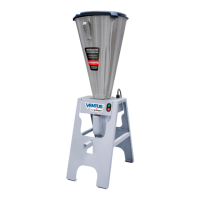

 To Next Page
 General