Need help?
Do you have a question about the Skywalk ARAK and is the answer not in the manual?
Detailed steps for performing the 'Big Ears' descent maneuver for rapid altitude loss.
Details on LTF/EN certifications and limitations of homologation test results.
Illustrative diagram showing the paraglider's line layout and connections.
Detailed visual checks of the canopy's surfaces, profiles, lines, seams, and connection points.
Assessment of line/riser lengths, canopy firmness, porosity, and line condition.
Evaluation of the glider's overall condition and recording of any necessary repairs.
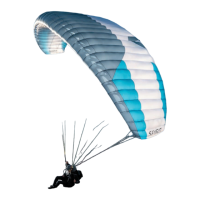
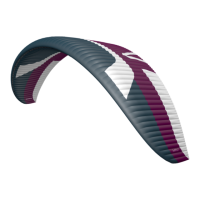
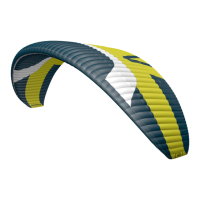
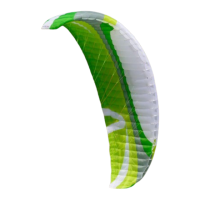
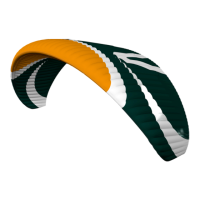
The Skywalk ARAK is a paraglider designed for intermediate pilots, offering a blend of easy handling, performance, and fun. It is suitable for occasional pilots, ambitious thermal flyers, and XC pilots.
The ARAK is a paraglider intended for flight, utilizing a foot-operated acceleration system for increased speed. It is also well-suited for winch towing, provided certified winches are used and the pilot has proper towing instruction. The glider is designed for controlled descent techniques such as "Big Ears" to quickly leave dangerous areas or lose altitude, and "B-line Stall" for rapid descent without forward flight.
The ARAK is available in XXS, XS, S, M, and L sizes, all featuring 57 cells. Key specifications vary by size:
| Size | Area flat (m²) | Wingspan flat (m) | Aspect ratio flat | Area projected (m²) | Wingspan projected (m) | Aspect ratio projected | Weight (kg) | Take-off weight from - to (kg) | Extended weight range (kg) | Maximum speed bar travel (mm) | Brake line travel max. (cm) |
|---|---|---|---|---|---|---|---|---|---|---|---|
| XXS | 21.40 | 10.75 | 5.40 | 18.30 | 8.60 | 4.03 | 4.3 | 65-85 | 85-90 | 150 | 60 |
| XS | 23.30 | 11.22 | 5.40 | 20.00 | 8.98 | 4.03 | 4.5 | 70-95 | 95-100 | 150 | 62 |
| S | 24.80 | 11.58 | 5.40 | 21.30 | 9.26 | 4.03 | 4.7 | 85-105 | 105-110 | 170 | 64 |
| M | 26.40 | 11.94 | 5.40 | 22.60 | 9.55 | 4.03 | 5.0 | 95-120 | 120-125 | 170 | 66 |
| L | 28.60 | 12.42 | 5.40 | 24.50 | 9.93 | 4.03 | 5.0 | 95-120 | 120-125 | 170 | 69 |
The glider features JET FLAP Technology and is Accelerator certified. It is winch certified but not certified for paramotor homologation. The homologation for size XXS is still in progress.
The ARAK is certified to LTF 09 and EN926-1, EN926-2 in the category B. It is defined as a lightweight sport aircraft with an empty weight of less than 120kg in the paraglider category. Certification maneuvers were carried out with a harness in the group GH with a carabiner distance (middle to middle) of 42-46 cm.
The ARAK's line system is designed for optimal load distribution and longevity, using a mix of durable, low-stretch, and low-drag materials. It features 3 A-, 3 B-, 3 C-, and 1 stabilo line, with the main-stabilo connected to the B-riser. Brake lines are non-load-bearing and lead from the trailing edge over the main brake lines through pulleys on the C-risers to the brake handles. A marking on the main brake line indicates the handle attachment position, which should not be altered.
For easier sorting and overview, the lines are color-coded:
The ARAK has 4 risers per side:
The acceleration system affects the A1, A2, and B-risers, none of which are equipped with trimmers.
Descent techniques:
The manual includes a "TEST PROTOCOL" for recording various checks and inspections of the paraglider. This protocol covers:
The glider is manufactured from high-quality materials, with the upper sail made of Porcher Skytex 38g / Dominico Dokdo 32g, lower sail of Dominico Dokdo 32g, and ribs of Dominico Dokdo 32g hard. Lines are made from Liros PPSLS 180/125, Liros PPSLS 125, Liros DC 60, and Liros DFLP 200/32. Risers are made of 12mm webbing, chosen for high stretching values, strength, and stability.
The ARAK comes standard with an inner bag, compression strap, glider backpack, riser bag, and a "BASIC GUIDE" for general safety-relevant information. The latest version of the manual can be found on www.skywalk.info.

 To Next Page
 General