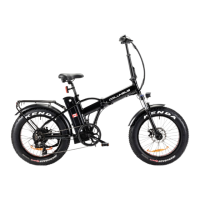
This document is a user manual for the Slane AJAX E-Bike, available in both Fat Tire and Regular Tire models. It provides comprehensive information on the assembly, operation, maintenance, and safety guidelines for the electric bicycle.
Function Description
The Slane AJAX E-Bike is an electric bicycle designed for personal transportation, offering pedal-assisted riding and throttle-only operation. It aims to provide a comfortable, enjoyable, and safe riding experience. The E-Bike incorporates a motor to assist pedaling, making it easier to ride uphill or cover longer distances. It features a gear system for varied terrain and speed control, as well as front and rear brakes for stopping. The battery powers the electric motor and can be charged either while on the bike or removed for indoor charging.
Important Technical Specifications
The manual details specifications for both AJAX Regular Tire and AJAX Fat Tire models:
| Specification |
AJAX Regular Tire |
AJAX Fat Tire |
| Motor Rated Power (W) |
450 |
500 |
| Motor Rated Voltage (V) |
48 |
48 |
| Speed (Km/h) |
32 |
32 |
| Range (km) |
30-45 |
35-45 |
| Load Capacity (lb) |
250 |
280 |
| Front & Rear Brake |
Disc brake |
Disc brake |
| Suspension |
Front Suspension |
Rigid |
| Battery Type |
Lithium-ion Battery |
Lithium-ion Battery |
| Battery Capacity (Ah) |
12 |
12 |
| Battery Charging Time (Hr) |
4-6 hr |
4-6 hr |
| Net Weight (lb) |
60 |
65 |
| Pedal Assist |
Yes |
Yes |
| Throttle |
Yes |
Yes |
| Tire Size (in) |
27.5"x 2.1 |
26"x 4.0 |
Usage Features
- Assembly: The manual guides users through assembling the handlebar and installing the front wheel, including details on quick-release binders.
- Adjustments: Instructions are provided for adjusting the steering wheel, saddle height and tilt, and front brakes.
- Gear Shifting: The E-Bike is equipped with a derailleur system, and the manual explains how to use the shifter for up-shifting and down-shifting, emphasizing the need to pedal forward during shifts.
- Powering On/Off & Settings: The E-Bike is powered on by pressing a button on the battery case and then on the LED display. Users can adjust speed levels using "+" and "-" buttons. The front light can be turned on/off by pressing and holding the "+" button.
- Pedal Assist System (PAS): This system provides power assistance only while pedaling. The amount of power depends on pedaling force and the selected assistance level. It disengages when pedaling stops or speed exceeds 25 KM/h (15.5 MPH).
- Throttle: The thumb throttle allows for speed control without pedaling. Pressing it slowly increases speed, and releasing it, along with applying brakes, stops the bike. The brake handle cuts power to the throttle when activated.
- Battery Management: The battery can be unlocked and removed from the frame for charging. The manual provides detailed instructions on charging, including recommended charging times (6-8 hours for lithium batteries) and warnings against overcharging (not more than 24 hours). An indicator light on the charger shows charging status (red for charging, green for charged).
- Safety Guidelines: Emphasizes reading the manual before riding, wearing a helmet, checking all bike parts before each ride, and adhering to local traffic laws. It warns against overloading (max 250 lbs), riding under the age of sixteen, and touching battery electrodes with bare or wet hands.
- Riding Conditions: Provides advice for riding safely on the road, in wet conditions (brake earlier, decrease speed, use reflective clothing), and at night (ensure front lights are on, wear reflective clothing, use familiar roads).
- Parking: Instructions include shutting off power, removing the key, and avoiding frequent start-ups to preserve battery and motor life.
Maintenance Features
- Regular Inspections: Users are advised to perform mechanical safety checks before every ride and after long rides, exposure to water/grit, or every 100 miles. This includes checking for loose headsets, smooth steering, and tight bolts/nuts.
- Cleaning: The manual specifies cleaning the E-Bike with a damp cloth and mild cleaning product, avoiding high-pressure washers, and drying immediately. It also advises lubricating the chain, freewheel cogs, and rear derailleur pulley bushings, but not applying oil to brake components, tires, battery, or controller.
- Battery Storage: For extended storage, the battery should be charged every 60 days to prevent capacity loss. It should be stored in a cool, dry place (32-77°F / 0-25°C), disconnected from the charger, and protected from extreme temperatures and condensation.
- Flat Tire Repair: Detailed steps are provided for removing the wheel, deflating the tire, removing the inner tube, checking for punctures, patching or replacing the tube, and reinstalling the tire and wheel.
- Broken Spoke: Advises riding slowly and carefully if a spoke breaks, as it weakens the wheel and can cause wobbling. Instructions are given to twist the broken spoke around the spoke nest to prevent it from interfering with the wheel or frame.
- Troubleshooting Guide: A table lists common malfunctions (E-Bike won't start, speed issues, motor not working, low mileage, charger not charging), their analyses, and corresponding solutions. For complex issues, it recommends consulting a qualified technician or dealer.
- Warranty: The warranty policy covers quality problems and functional failures of the motor, controller, charger, lithium-ion battery, handlebar, frame, front fork, steering column, and rear flat fork for one year from the purchase date. It explicitly states that the warranty does NOT cover tires, tubes, chains, spokes, misuse, or accidents.
- Power-Saving Tips: Suggestions include using pedal-assist uphill, charging the battery regularly, pressing the throttle slowly, maintaining a consistent speed (15-18 km/h), and avoiding excessive braking.

 Need help?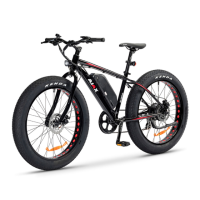

 To Next Page
 General