ChlorEase Manual Version 2.2
6
Current 6,000 gal 8,000 Gal 10,000 Gal 12,000 Gal 14,000 Gal 16,000 Gal 18,000 Gal
Stabilizer (22,500 L) (30,000 L) (37,500 L) (45,000 L) (52,500 L) (60,000 L) (67,500 L)
0 ppm 4.0 5.3 6.7 8.0 9.4 10.7 12.0
(1.8) (2.4) (3.0) (3.6) (4.3) (4.9) (5.4)
10 ppm 3.5 4.7 5.8 7.0 8.2 9.4 10.5
(1.6) (2.1) (2.6) (3.2) (3.7) (4.3) (4.8)
20 ppm 3.0 4.0 5.0 6.0 7.0 8.0 9.0
(1.4) (1.8) (2.3) (2.7) (3.2) (3.6) (4.2)
30 ppm 2.5 3.3 4.2 5.0 5.9 6.7 7.5
(1.1) (1.5) (1.9) (2.3) (2.7) (3.0) (3.4)
40 ppm 2.0 2.7 3.3 4.0 4.7 5.4 6.0
(0.9) (1.2) (1.5) (1.8) (2.1) (2.4) (2.7)
50 ppm 1.5 2.0 2.5 3.0 3.5 4.0 4.5
(0.7) (0.9) (1.1) (1.4) (1.6) (1.8) (2.0)
60 ppm 1.0 1.3 1.7 2.0 2.4 2.7 3.0
(0.5) (0.6) (0.8) (0.91) (1.1) (1.2) (1.4)
70 ppm 0.5 0.7 0.8 1.0 1.2 1.4 1.5
(0.2) (0.3) (0.4) (0.45) (0.54) (0.64) (0.68)
80 ppm 0.0 0.0 0.0 0.0 0.0 0.0 0.0
Stabilizer (Cyanuric Acid)
When checking salt level, always check the level of Cyanuric acid as well since it is likely that they will decline together. Use Table 4 to determining how much
stabilizer must be added to raise levels to the optimum level of 80ppm. First find the column that represents the gallons of your pool. Then locate the row that
shows your current level of Cyanuric Acid. The box that intersects those two will tell you the lbs or (kg) needed to raise levels in your pool to 80ppm.
Remember that Cyanuric Acid or conditioner takes some time to dissolve so check levels for several days after adding, or before adding more.
Table 4
POUNDS AND (KG) OF STABILIZER (CYANURIC ACID) NEEDED TO RAISE LEVELS TO 80 PPM
If proper chlorine levels cannot be maintained, and if salt levels and pH readings are correct, the cell must be
cleaned. FIRST UNPLUG THE CHLOREASE UNIT FROM THE AC SOCKET. THE UNIT SHOULD
ONLY BE SERVICED AFTER IT HAS BEEN UNPLUGGED.
The water that you fill your pool with may contain high amounts of calcium. The time period to clean the ChlorEase
cell will vary. It is recommended that you clean your cell on a BI-WEEKLY basis.
For models with an on off switch, turn unit to the off position. UNPLUG THE CHLOREASE UNIT FROM
THE AC SOCKET. THE UNIT SHOULD ONLY BE SERVICED AFTER IT HAS BEEN UNPLUGGED.
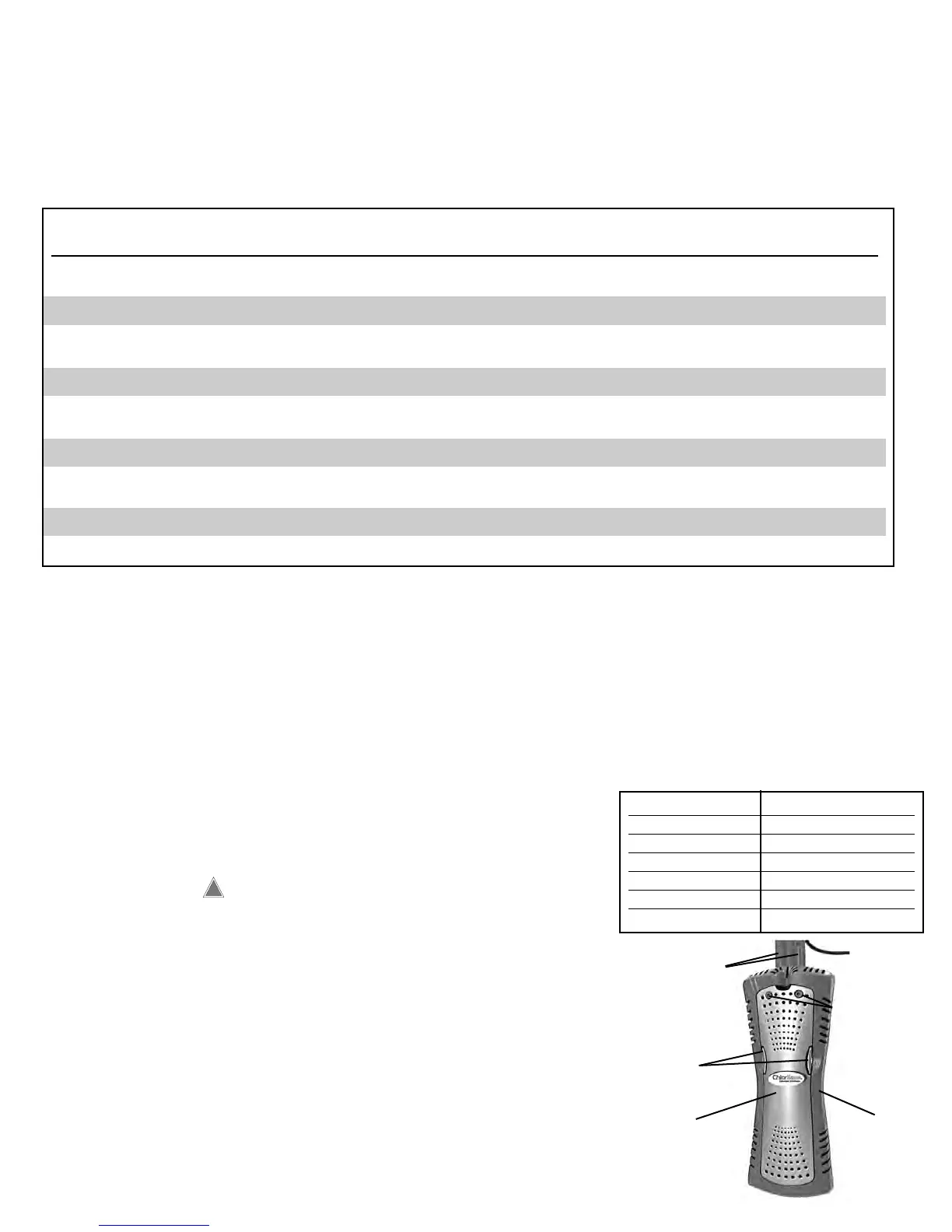
Remove the ChlorEase housing from the pool by pushing in the retaining clips to unlock the housing from
the metal bracket, using the plastic tool provided. Remove the front cover from the housing by first
unscrewing the two plastic screws on the front using the plastic key provided, and then grasp the two side
clips to remove the front cover. Next, pull out the wire spool and unwind the excess cord allowing the
housing to be pulled over outside of pool. Visually inspect the metal elements inside the mesh covering of the
chlorinating cell. If heavy scale is present, the scale should be removed (see next section).
Retaining Clips
Plastic Screws
Side Clips
Housing
Font Cover
Startup and Spring Opening
Check water chemistry and refer to Table 1 as a guide for optimum water chemistry for ChlorEase. Then add a saltwater-compatible chlorinating product initially to bring
chlorine level to 3 ppm (See Table 2.1). This is likely the only time you’ll need to add chlorine to your pool. This will charge the water with chlorine as the ChlorEase begins to
generate chlorine in the pool. ChlorEase will then maintain your chlorine level after the initial shock treatment. ALL METALS: COPPER, IRON, MANGANESE, ZINC, ETC.
MUST BE REMOVED FROM THE WATER PRIOR TO USE. USE A SEQUESTERING AGENT TO BIND ALL CALCIUM SHOULD YOUR WATER CONTAIN GREATER
THAN 200 PPM O F CALCIUM.
Table 1
Optimum Water Chemistry
Salt 3200 to 3700 ppm
Free Chlorine 1.0 to 3.0 ppm
pH 7.0 to 7.4
Total Alkalinity 80 to 100 ppm
Calcium Hardness 100 to 200 ppm
Cyanuric Acid 60 to 80 ppm
Metals 0 ppm
ITEM RECOMMENDED LEVEL
(ppm= parts per million)
Maintenance of your ChlorEase System
Follow these simple steps to maintain the best results from your ChlorEase:
1. Make sure that your water chemistry is within the optimum range (see chart opposite):
Adding Salt
Begin by testing the salt levels of the pool using saline test strips available at your local pool store. The
salt level must be above 3200 ppm. If the salt level is low, refer to Table 3 for amount of salt to add.
2.
It is recommended that you check your cell for calcium build up (white residue on cell) on a BI-WEEKLY
basis. If calcium appears on the cell, follow the “cleaning the cell” instructions on the next page.
Cleaning the Cell DO NOT REMOVE THE MESH COVERING THE CELL!
INSIDE ELEMENT IS SHARP!


 To Next Page
 Loading...