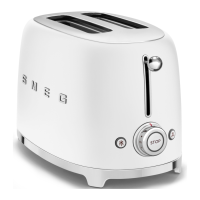
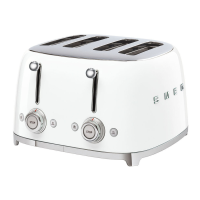
This document describes the Smeg TSF03 4-Slice Toaster, a kitchen appliance designed for domestic use, part of Smeg's 50's Style range. It combines iconic design with innovative technical features.
Function Description:
The Smeg TSF03 is a 4-slice toaster primarily designed for toasting bread. It features two independent control panels, each managing two slots, allowing for different settings to be applied simultaneously. The appliance can also be used for preparing toasted sandwiches and warming small bread rolls, flatbread, or pastries, provided specific optional accessories (sandwich racks and bun warmer) are used.
Important Technical Specifications:
- Model: TSF03
- Type: 4-Slice Toaster
- Slots: Extra-wide slots with self-centring racks
- Control Panels: Two independent control panels
- Browning Levels: 6 browning levels
- Special Functions: Defrost, Bagel, Reheat, and Stop functions.
- Safety Features: Breadlift, crumb trays.
- Optional Accessories: Sandwich racks (Model TSSRO1) and bun warmer (Model TSBW01).
Usage Features:
- Operation:
- Shorten the power cable by winding it under the base if necessary.
- Plug the toaster into an earthed three-pin power outlet.
- Place bread slices into the slots. If a slice is not square, it may be turned on its side to optimize the toasting surface.
- Select the desired browning level (1 to 6, light to dark) or the Reheat function using the browning control knob for the relevant pair of slots. The central LED lights up during toasting.
- Push the breadlift downwards until it clicks to activate the toasting cycle.
- Optionally, select the Defrost or Bagel functions.
- The heating elements switch on, and the bread is automatically centred for even toasting.
- Toasted bread will pop up automatically when ready.
- Special Functions:
- Cancelling/Stopping: The toasting cycle can be cancelled or stopped at any time by pressing the STOP button.
- Defrost Function: Useful for toasting frozen bread. Insert bread, select browning level, push breadlift, then press the defrost button. The indicator light turns on, and toasting time is automatically increased. The light switches off when toast pops up.
- Bagel Function: Ideal for bagels, flatbread, muffins, baguettes. Toasts one side without toasting the other. Insert bread with the side to be toasted facing outwards, select browning level, push breadlift, then press the Bagel function button. The indicator light turns on and switches off when toast pops up.
- Reheat Function: Used to reheat cold sandwiches or continue a toasting cycle if the result is unsatisfactory. Insert bread, select Reheat on the browning control knob, and push the breadlift. The central light of the browning control knob lights up and switches off when the bread pops up.
- Combined Functions: The Defrost, Bagel, and Reheat functions can be selected at the same time.
- Using Optional Accessories:
- Sandwich Racks (TSSRO1): Allow toasting of filled sandwiches or easier removal of small rolls.
- Open the rack handles.
- Place the sandwich into the rack.
- Close the handles to grip the sandwich.
- Insert the rack into the slot and select a browning level. If not sufficiently browned, press the Reheat button.
- Push the breadlift downwards to activate.
- Remove the rack when the cycle ends.
- Tips: Use thinly sliced ingredients, finely grated cheese, and cold meat (not straight from the refrigerator). Do not overfill. If using low browning, cheese/meat may be moderately warm; leave sandwich in slot longer or use Reheat.
- Bun Warmer (TSBW01): Useful for warming small bread rolls, flatbread, or pastries.
- Place the bun warmer on top of the toaster, ensuring wire feet fit into the slots.
- Place items on top of the warmer and select browning level '1' (not higher).
- Push the breadlift downwards to activate.
- Warning: Use only one bun warmer at a time to prevent overheating.
- General Tips:
- The first cycle allows heating elements to reach temperature; subsequent cycles may be faster.
- Bread type and freshness affect toasting time and required browning levels.
- For best results, toast one type of bread at a time, use slices of the same thickness (no thicker than 30 mm), and cut hand-sliced bread as evenly as possible.
- Avoid very thin or broken slices as they may burn.
- Do not use the appliance close to or below combustible materials.
- Ensure the breadlift is in the raised position before inserting/removing the plug.
- Ensure free air circulation around the toaster; do not place anything on top.
- Do not try to remove bread while the toaster is in operation.
- Do not place metallic objects (knives, forks, spoons) on the appliance during use or to clean it.
- If the appliance is not connected to the mains power supply, the breadlift will not lock.
Maintenance Features:
- Cleaning Surfaces (Regularly after use):
- Allow the appliance and accessories to cool down first.
- Use products without abrasives or chlorine-based acids.
- Pour product onto a damp cloth, wipe the surface thoroughly, and dry with a soft cloth or microfibre cloth.
- For grease/oil splatters, remove immediately with a damp soft cotton cloth.
- Do not use steel sponges, sharp scrapers, abrasive/corrosive detergents (e.g., powder products, stain removers, metallic sponges), rough/abrasive materials, or sharp metal scrapers.
- Do not use steam jets.
- Cleaning Crumb Trays (After each use):
- Disconnect the plug from the power outlet.
- Press the crumb tray to release it, pull it out, and empty it.
- Hand-wash the crumb trays, rinse, and dry thoroughly.
- Push the crumb tray back into the toaster firmly until it clicks into position.
- Do not use the toaster without the crumb tray properly installed.
- Cleaning Optional Sandwich Rack and Bun Warmer:
- Can be washed by hand.
- After washing, rinse and dry them thoroughly with a soft cloth.
Safety Instructions:
- General Safety:
- Do not immerse the appliance, power cable, or plug in liquid.
- Do not use if the power cable or plug is damaged, or if the appliance has been dropped or damaged.
- Do not place on or near active gas/electric hobs or in a heated oven.
- Do not use an extension cable.
- Repairs must be carried out by a qualified technician.
- Switch off immediately after use.
- Never use water to extinguish flames; turn off, unplug, and smother with a lid or fire blanket.
- Do not modify or attempt to repair the appliance yourself.
- Contact technical support if the power supply cable is damaged.
- Intended Use:
- For indoor domestic use only, specifically for toasting bread.
- Not designed for external timers or remote control systems.
- Not for use by children under 8 or individuals with reduced physical, sensory, or mental capacity without supervision or instruction from responsible adults.
- Children must not play with the appliance and should be kept out of reach.
- Electrocution Hazard:
- Insert the plug into an earthed three-pin power outlet.
- Do not remove the earth pin.
- Do not use an adapter or extension cable.
- Disconnect the plug from the power outlet before cleaning.
- Burn Hazard:
- The toaster becomes very hot during operation; do not touch hot surfaces. Use knobs, controls, breadlift, and optional accessories.
- Allow the appliance to cool down before cleaning.
- Bread may burn; do not use near combustible materials.
- Sandwich racks and bun warmers become very hot; take care when removing them.
- Risk of Damage to Surfaces:
- Do not use steam jets.
- Do not use cleaning products containing chlorine, ammonia, bleach on steel or metallic finishes.
- Do not use abrasive or corrosive detergents, rough/abrasive materials, or sharp metal scrapers.
Manufacturer Liability:
The manufacturer declines all liability for damage caused by:
- Use for purposes other than intended.
- Not reading the user manual.
- Tampering with any part of the appliance.
- Use of non-original spare parts.
- Failure to follow safety instructions.
Identification Plate:
The identification plate contains technical data, serial number, and brand name. Do not remove it.
Disposal:
- Dispose of separately from other waste (Directive 2012/19/EU).
- Take old electrical appliances to an appropriate recycling centre for electrical and electronic waste.
- Packaging materials are non-polluting and recyclable; deliver them to the appropriate recycling centre.
- Plastic Packaging (Danger of Suffocation): Do not leave packaging unattended or allow children to play with plastic bags.

 Need help?

 To Next Page
 General