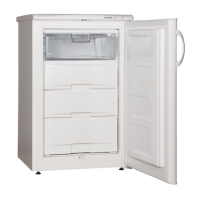
This document provides an instruction manual for SNAIGĒ ICE LOGIC Upright Freezers, specifically models F 22SM, F 27SM, and F 10SM.
Function Description:
The SNAIGĒ ICE LOGIC Upright Freezer is a household appliance designed for freezing and long-term storage of food. It is suitable for various settings including staff dining rooms in shops and offices, student dormitories, hotels, country houses, guesthouses, and other living quarters. The freezer compartment allows users to store frozen food efficiently. The appliance is equipped with a thermostat knob for temperature regulation, power supply indication, and a temperature rise indicator to alert users to potential issues.
Important Technical Specifications:
- Refrigerant Gas: R600a. This is a flammable gas, requiring careful handling and ventilation if the refrigeration system is damaged.
- Blowing Agent: C-Pentane, used in the insulation foam, is also a flammable gas.
- Climate Class: The appliance operates reliably within specific ambient temperature ranges:
- N: +16 to +32 degrees Celsius
- ST: +16 to +38 degrees Celsius
- T: +16 to +43 degrees Celsius
- Relative Air Humidity: The manufacturer guarantees reliable operation when the relative air humidity is not greater than 70 percent.
- Electrical Connection: The appliance requires connection to an earthed socket installed in accordance with regulations, with the supply voltage matching the rating label.
- Temperature Regulation:
- Factory set temperature: -18 °C.
- F 22SM and F 27SM models: Temperature regulated on a seven-digit scale (0-7), where 0 means compressor off (but not electrically disconnected), 1 is the highest temperature (lowest cooling), and 7 is the lowest temperature (highest cooling).
- F 10SM model: Temperature regulated on a four-digit scale, where "•" means compressor off (but not electrically disconnected).
- Fast Freeze Section: Designated area (section 4) for freezing fresh food.
- Storage Compartments: Drawers (section 5) for storing frozen products.
- Minimum Gap for Frozen Products: Not less than 2.5 cm between the top of frozen products and the bottom of the drawer above them.
- Transportation Tilt Limit: Do not tilt more than 30° from the vertical position. If tilted more than 30°, wait at least 4 hours before connecting to power. If tilted more than 30° during transport, wait at least 4 hours before connecting to power.
Usage Features:
- Initial Setup: Before first use, wash the interior and accessories with lukewarm water and neutral soap, then dry thoroughly. After transport, if tilted more than 30°, wait 4 hours before connecting. For first start-up or after a period of disuse, allow the appliance to run for at least 2 hours before loading products.
- Positioning:
- Install in a dry, well-ventilated indoor area.
- Avoid excessively humid or cold areas (e.g., garages, wine cellars).
- Keep away from heat sources (stoves, radiators, direct sunlight).
- Maintain minimum distances from heat sources: 30 mm from electric/gas ovens, 300 mm from oil/coal fired ovens, 50 mm from built-in ovens. Use an insulation board if distances cannot be met.
- Ensure good air circulation around the appliance; a gap of at least 10 cm between the appliance body and any furniture is recommended to prevent overheating.
- The appliance must stand on a level surface and not touch the wall. Height can be adjusted using levelling feet.
- If placed in a corner, leave a gap for the freezer door to open sufficiently to pull out drawers.
- Door Reversal: The manual provides detailed instructions for changing the opening direction of the doors for models F 22SM, F 27SM, and F 10SM, requiring specific tools (spanners No. 8 and No. 10, head screwdriver). This procedure should be done with a helper and the freezer should not be laid horizontally.
- Food Freezing and Storage:
- Place fresh food in the fast freeze section (4).
- Transfer frozen food to storage drawers (5).
- Do not exceed the maximum amount of frozen food indicated in the product data sheet.
- Do not place unwrapped foodstuffs directly in freezer sections.
- Do not refreeze partially thawed products.
- Fresh food for freezing should not touch already frozen foodstuffs.
- Do not freeze foodstuffs warmer than room temperature.
- Do not freeze liquid foodstuffs in glass vessels or bottles.
- Observe validity dates on packaging.
- Recommended storage times: Fish and sausage (up to 6 months); cheese, poultry, pork, lamb (up to 8 months); beef, fruit, and vegetables (up to 12 months).
- In case of accidental defrosting (e.g., power failure exceeding "rising time"), consume defrosted food quickly or cook and refreeze after cooling.
- Safety Precautions:
- Keep ventilation openings clear.
- Do not use mechanical devices or other means to accelerate defrosting other than those recommended by the manufacturer.
- Do not use electrical appliances inside food storage compartments unless recommended.
- Ensure the supply cord is not trapped or damaged.
- Do not locate multiple portable socket-outlets or power supplies at the rear.
- Do not damage the refrigeration system. In case of damage, avoid open flames, sparks, or turning on electrical appliances.
- Ventilate the room immediately if the cooling system is damaged (room size at least 4 m³ for isobutane/R600a products).
- Disposal must follow national rules.
- Do not store explosive substances (e.g., aerosol cans with flammable propellant) or flammable liquids (e.g., petrol) near the appliance.
- Use only for storing foodstuffs.
- Children aged 8 and above, and persons with reduced physical, sensory, or mental capabilities, can use the appliance with supervision or instruction. Children aged 3-8 can load/unload.
- Do not allow children to play with the appliance or packaging.
- Connect only to an earthed socket. Faulty cables must be replaced by the manufacturer, customer service, or qualified personnel.
- Do not readjust or modify any parts. Do not damage the capillary tube in the compressor recess.
- Avoid adapters, multiple sockets, and two-wire extension leads. If an extension lead is necessary, it must be VDE/GS certified, equipped with a protection ring and single socket, and placed away from sinks or areas prone to water.
- Do not use a technically damaged appliance.
- If unplugged, wait 15 minutes before switching on again.
- Disconnect from power supply during cleaning, maintenance, or moving. Pull the plug body, not the cord.
- Do not set up outdoors.
- In an emergency, pull the power plug immediately.
- Do not place switched-on electrical devices or dishes with liquids on top of the appliance.
- Do not climb, sit, lean, or hang on the appliance doors.
- Do not remove or touch items from the freezer with wet hands.
- Do not use water spray or steam for cleaning.
- Keep children under 8 away from the power cord and packaging. Remove or destroy existing snap and bolt locks on old appliances.
Maintenance Features:
- Defrosting: Defrost at least twice a year or when ice layer exceeds 5 mm.
- Turn off and unplug the appliance.
- Remove food, covering it with a thick cloth and keeping it in a cool place.
- For F 22SM, F 27SM: Pull out the melt water gutter, turn it 180°, and hook it up. Place a container under it.
- Leave the freezer door open.
- After thawing, dry the interior and accessories thoroughly.
- For F 22SM, F 27SM: Remove the melt water gutter, turn it 180° again, and replace it.
- Close the door and turn on.
- Cleaning:
- Always disconnect from mains before cleaning.
- Protect inner surfaces and plastic parts from fats, acids, and sauces. Clean spills immediately with warm soapy water or dishwashing detergent and wipe dry.
- Regularly clean and dry door gaskets.
- At least once a year, clean dust from the back of the appliance body and compressor using a soft brush, electrostatic cloth, or vacuum cleaner.
- Do NOT use detergents containing abrasive particles, acid, alcohol, or benzene. Do NOT use coarse cloths or sponges.
- Troubleshooting (Operation Problems and Their Solutions):
- Appliance not working, no power indicator: Check house electricity supply and plug connection.
- Increased noise: Check stability on a level surface, regulate front feet, ensure no contact with furniture or walls, check for rattling bottles/cans/dishes.
- Rubber sealing gasket pulls out: Clean gasket and groove with warm soapy water, wipe dry, reinsert gasket.
- Red temperature rise indicator light illuminated: Indicates first connection, disconnection for a long time, open/frequently opened door, large amount of fresh food loaded, or temperature above -9 °C. Light should go out when temperature drops below -9 °C. If it stays on for over 6 hours (and compressor is running or not switching off), consult service.
- High temperature, short compressor pauses: Check if door is shutting tightly, if door was kept open too long, or if a large amount of warm food was placed inside.
- Condensation on top: Ambient relative air humidity is above 70%. Ventilate the room and remove humidity source if possible.
- Operating Noise: Various murmuring, bubbling, rustling, popping, or clicking sounds are normal during operation and not a sign of malfunction.

 Need help?

 To Next Page
 General