Need help?
Do you have a question about the SNOWJOE TJ601E and is the answer not in the manual?
Basic safety precautions for electric tiller use to reduce risks of fire, shock, and injury.
Instructions for operators on safe tiller operation, including reading manuals and supervision.
Pre-operation checks and area preparation for safe tiller operation, including object removal.
Guidelines for safe use of electrical components and extension cords, including grounding.
Guidelines for safe handling, movement, and environment during tiller operation.
Warnings and advice on using extension cords for the electric tiller, including GFCI.
Steps to take during work interruptions or when changing work areas, ensuring power is off.
Instructions for routine maintenance, cleaning, and proper storage of the tiller.
Explanation of safety symbols found on the tiller and their meanings.
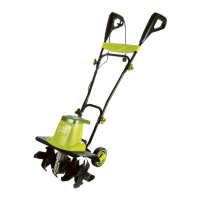
Identification of tiller components with corresponding labels.
Lists specifications like power, voltage, working width, and weight.
Lists standard package contents and initial unpacking steps.
Guides on attaching grab handles and the connector to the tiller.
Explains how to adjust the wheel setting for different tilling depths.
Guidelines for operating the tiller safely and effectively in the soil.
Specifics on choosing and using outdoor extension cords for the tiller.
Procedures for turning the tiller on and off safely using the controls.
How to walk and use the tiller in the soil at a normal pace.
Safety precautions during cleaning, maintenance, and storage, including cooling down.
Instructions for replacing the tiller's tine wheels, ensuring correct direction.
Contact details and information for service and technical assistance.
Explains the importance of model/serial numbers for service and support.
Details of the product warranty coverage for residential use in the US and Canada.
This document serves as the operator's manual for the Electric Tiller/Cultivator, Model No. TJ601E, manufactured by Snow Joe, LLC. It provides comprehensive instructions for safe operation, maintenance, and storage of the device, emphasizing user safety through clear warnings and guidelines.
The Electric Tiller/Cultivator is designed for breaking up and tilling coarse soil in domestic areas, primarily for mixing in fertilizer, peat, and compost. Its intended use is strictly for these purposes; any other application may lead to damage to the tool and pose a serious injury hazard to the operator. The machine is not to be used in rain or damp surroundings, and only adults who are familiar with the manual should operate it. Children and individuals unfamiliar with the manual are strictly prohibited from using the tool. The manufacturer disclaims liability for damage resulting from improper use or incorrect operation.
Before operating the tiller, users must thoroughly inspect the area for any objects such as stones, sticks, wires, or foreign debris that could be thrown by the tines or cause the operator to trip. Safety glasses or eye shields are mandatory during operation, adjustment, or repair to protect against thrown objects. Appropriate garments, including footwear that provides sure footing, must be worn; jewelry and loose clothing that could become entangled in moving parts should be avoided. Users should also be aware of and comply with any noise-prevention regulations.
The tiller is equipped with a polarized plug and requires a polarized extension cord for electric shock reduction. Users must ensure the plug fits fully into the extension cord and wall outlet; if not, they should reverse the plug or obtain a correct polarized extension cord. Any modification to the equipment plug, extension cord receptacle, or extension cord plug is strictly prohibited. Before each tilling session, operators should familiarize themselves with the controls, especially the emergency stop function. Only responsible individuals with a thorough understanding of these instructions should operate the tiller, and children are never permitted to use it.
When operating, the tiller should be held with both hands, ensuring the grips are dry. Hands and feet must be kept away from rotating parts. The tilling pattern should be planned to avoid discharging material towards people, pets, or property, such as windows or cars. Discharge should never be directed at children, bystanders, or pets, and no one should be allowed in front of the machine. A safety zone of at least 25 feet should be maintained around the tiller during operation; if people or pets enter this area, the tiller must be stopped.
Operation should only occur in good visibility and dry conditions. Operators must always watch their footing, maintain a firm hold on the grips, and walk, not run. The tiller should not be operated on slippery surfaces. Caution is advised when changing direction and operating on slopes, keeping feet and legs a safe distance from the machine and looking out for hidden obstacles or hazards. The machine should not be overloaded by attempting to till too deeply or in ground that presents excessive resistance. If the tiller vibrates abnormally, it must be stopped immediately and inspected for damage.
For electrical safety, a grounded three-wire extension cord made of rubber and intended for outdoor use must always be used. The extension cord should be kept away from moving tines and the hot motor housing, and contact with metal objects should be avoided. Ground Fault Circuit Interrupter (GFCI) protection is recommended for the circuits or outlets used with the gardening appliance. The extension cord must be in good condition and heavy enough to carry the current drawn by the product to prevent power loss and overheating. The appliance should never be carried by the cord or yanked to disconnect it from the receptacle, and the cord should be kept away from heat, oil, and sharp edges.
To start the machine, the Safety Button must be pressed simultaneously with the Power Switch. Releasing the Power Switch will turn the machine off. The tines will begin to rotate and dig into the ground upon activation. After completing work, the Power Switch should be released to turn off the machine. The electric tiller should be walked through the soil at a normal pace and in a straight line, always tilling away from the electrical outlet and ensuring the extension cord is kept clear of the work area. Users should avoid tilling too deeply or forcing the tiller into extremely hard or resistant soil, as this can cause the machine to shut down until the motor cools. A firm grip must be maintained on the tiller at all times, and it should be lifted over hard surfaces rather than lifted or dragged while the motor is running.
Regular maintenance is crucial for the safe and efficient operation of the tiller. Safety and instruction labels must be maintained or replaced as needed. Before cleaning, repairing, or inspecting the tiller, all controls must be disengaged, the engine stopped, and the tines allowed to come to a complete stop.
Regular checks include:
After each use, the machine should be cleaned by removing soil, dirt, and foliage from the tines, driveshaft, tool surface, and vents with a brush or dry cloth. Biodegradable oil should be sprayed or rubbed onto the tines. Soiled grips should be cleaned with a damp cloth. Protective gloves should be worn when cleaning or maintaining the machine. Cleaning fluids, solvents, or water spray (especially under pressure) should not be used on the machine.
The tiller is fitted with six tine wheels that can be easily changed. Tine wheels can be fitted on either the left or right side, but all tines must be changed simultaneously to prevent imbalance and damage. To change the tines, the electric tiller should be placed on the ground with the rating label facing upward. The hex bolt and self-locking nut must be unscrewed, and the tine wheels removed from the driveshaft. The driveshaft should then be cleaned with biodegradable oil. New tines should be placed onto the driveshaft, ensuring the holes align and the tines are set in the correct turning direction, matching the arrows on the tines and gearbox. Finally, the hex bolt should be inserted through the holes and tightened with the self-locking nut, replacing the new tines in the exact sequence the old ones came off.
The motor housing remains hot for a short period after the machine is turned off; it should be allowed to cool before touching or storing near combustible material. When not in use, the appliance should be stored indoors in a dry, high, or locked-up place, out of reach of children. The cutting edge should be kept sharp and clean for best performance and to reduce injury. The appliance cord and extension cords should be inspected periodically and repaired by an authorized service facility if damaged. The handle should be kept dry, clean, and free from oil and grease.
 General
| Model | TJ601E |
|---|---|
| Type | Electric Tiller/Cultivator |
| Power Source | Electric |
| Motor | 6.5 Amp |
| Tilling Depth | 8 inches |
| Tines | 4 steel tines |
| Foldable Handle | Yes |
| Warranty | 2 years |
| Tilling Width | 16-in (40.6 cm) |

 To Next Page