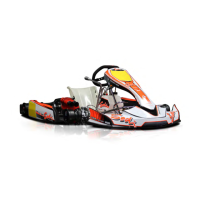
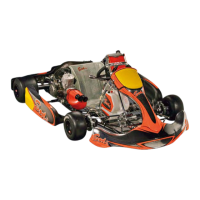
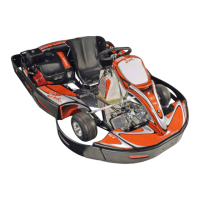
This document is a user and maintenance manual for a SODI kart, specifically the MAN_Sigma_EN_02 model, including RSS KZ DD2 variants. It covers general information, assembly, commissioning, adjustments, maintenance, troubleshooting, and homologation details.
Function Description:
The SODI kart is a high-performance racing vehicle designed for use on approved tracks. It is intended for drivers holding a valid membership card from their karting federation. The manual emphasizes safety, proper assembly, and regular maintenance to ensure optimal performance and driver safety.
Important Technical Specifications:
While specific engine details are not provided, the manual outlines various adjustable parameters critical to the kart's performance and handling:
- Stub Axle Height: Adjustable for both dry and wet track conditions. For dry tracks, A = 6 mm, B = 8 mm. For wet tracks, A = 10 mm, B = 4 mm.
- Front Tracking Width:
- Without Front Brake (Sigma RS): Dry track: A = 3 rings inside (15 mm), B = 90 mm. Wet track: A = 5 rings inside (25 mm), B = 100 mm.
- With Front Brake (Sigma RS): A = 2 rings inside (10 mm), B = 90 mm.
- With Front Brake (Sigma KZ - DD2): A = 3 rings inside (15 mm), B = 90 mm. Wet track (Sigma RS - KZ - DD2): A = 4 rings inside (20 mm), B = 90 mm.
- Maximum spacer for front brake equipped chassis is 20 mm (1x 15mm + 1x 5mm).
- Front Wheel Height Adjustment: Total A + B = 14 mm. Standard adjustment is A=6, B=8.
- Rear Tracking Width:
- Sigma RS: A = 1390 mm to 1400 mm (dry), A = 1360 mm to 1380 mm (wet).
- Sigma KZ - DD2: A = 1400 mm (dry), A = 1370 mm to 1380 mm (wet).
- Rear Axle Position:
- Sigma RS - KZ - DD2: Medium (dry).
- Sigma RS: Medium (wet).
- Sigma KZ - DD2: High (wet).
- Position of Eccentrics (Caster/Camber):
- Sigma RS - KZ - DD2: Eccentrics 1°, TOP Mark forward, BOTTOM Mark inside (dry). Eccentrics 3° and 4°, TOP 4° Mark forward, BOTTOM 3° Mark Backward (wet).
- Steering Tie Rod Ends:
- Sigma RS: Short tie rod, A2 (dry and wet).
- Sigma KZ - DD2: Long tie rod, B1 (dry). Short tie rod, A2 (wet).
- Seat Stiffeners:
- Sigma RS: Left side (A): 2, Right side (B): 1 (dry and wet).
- Sigma KZ: Left side (A): 2, Right side (B): 2 (dry and wet).
- Sigma DD2: Left side (A): 1, Right side (B): 0 (dry and wet).
- Brake System: Uses DOT 4 brake fluid (TYP200, Ref: LU842.010). Not compatible with DOT 5. Minimum brake pad thickness: D18 (front) 4 mm, D20 (rear) 6 mm, D28 (rear) 8 mm. Bleed screw tightening torques: M8 12 Nm, M10 16 Nm.
- Tightening Torques:
- Ø 6 screws: 10 to 12 Nm.
- Ø 8 screws: 12 to 23 Nm.
- Ø 10 screws: 23 to 47 Nm.
- Tekneex rear axle bearing 80/50 C4: 8 Nm.
- Rims on hub: 25 Nm.
- Brake hose screw: 20 Nm.
- Calliper mounting screws (D18/D20): 15 Nm.
- Bleed screws (D18/D20): 12 Nm.
- Calliper mounting screws (D28): 25 Nm.
- Bleed screws (D28): 16 Nm.
- Axle Types: Various stiffness options (Soft, Medium, Hard) are available (Q20, Adapt C25, Q30, Q32, TM20, TS20, TH20 TS25, TH25, TH30 THH20). TS20, TMS20, TM20, THM20, and TH20 axles without inner sleeve are not recommended for KZ category.
Usage Features:
- Safety Flags: Green (throttle out), Black (pit lane, staff instructions), Blue (faster driver behind), Yellow (dangerous situation, ease off, no passing), Red (trouble on track, drive slowly to pit lane), Checkered (session finished, enter pit lane slowly).
- Safety Stickers: Important safety instructions and "BRAKE FLUID DOT 4 ONLY" warnings are prominently displayed.
- Pilot Protection: Mandatory use of CIK-FIA approved integral helmet, suit (level 1 or 2), gloves, neck protection, and recommended rib protection and rain suit. Driving is prohibited for pilots with health problems or under the influence of drugs/alcohol, or those wearing loose clothing/long hair.
- Adjustments: The manual provides detailed instructions for adjusting front tracking width, front wheel height, caster, camber, tie rods, rear hub position, rear axle type, seat position, and brake distributor. These adjustments allow drivers to fine-tune the kart's handling for different track conditions (dry/wet), driving styles, and engine characteristics.
- Brake Distributor: Allows adjustment of braking power distribution between front and rear brakes. Standard setting is 15 "clicks" back from max front. Turning counter-clockwise increases front braking, clockwise increases rear braking.
Maintenance Features:
- General Precautions: Emphasizes keeping the kart in its original state, using only original SODIKART parts, proper ventilation when using toxic/flammable products, never using petrol as cleaning solvent, checking brake hoses for leaks, ensuring safety stickers are present, organizing parts for reassembly, using specified tools, cleaning parts before reassembly, using specified lubricants/glues, replacing O-rings, self-locking nuts, split pins, circlips, and other specific parts after disassembly, cleaning contact areas, and tightening all bolts to specified torques.
- Brakes - Usual Maintenance:
- Fluids and Lubricants: Use DOT 4 brake fluid. Clean disc and pads with brake cleaner. Use PFG110 grease for seals.
- Frequency: Regular checks (before any session, after 1 meeting/100 km, 3 meetings/300 km, 5 meetings/500 km, or as required) for brake fluid level, pad wear, leaks, hose condition, screw tightness, and disc condition.
- Pad Replacement: Detailed steps for replacing pads on D18 (front), D20 (rear), and D28 (rear) callipers. Crucially, never operate brake lever/pedal without pads installed to prevent piston damage and fluid leaks. Always replace pads on both callipers simultaneously.
- Bleeding: Instructions for bleeding both front and rear brake circuits to remove air bubbles. Recommend draining and refilling after every brake pad change.
- Cleaning: Use dry cloth and brake cleaner only. Do not use WD40 or other greasy products on callipers or discs, as this can severely impair braking. Never spray brake cleaner on master cylinder or calliper seals.
- Brakes - Workshop Maintenance:
- Calliper Seal Replacement: Detailed procedures for replacing seals and pistons on D18 (front), D20 (rear), and D28 (rear) callipers. This operation must be performed by a SODIKART dealer. Always use new seals and clips, replace defective parts with original SODIKART parts, and install new pads after servicing.
- Master Cylinder Seal Replacement: Instructions for replacing master cylinder seals and pistons. This operation must also be performed by a SODIKART dealer.
- Tyres:
- Change: Instructions for changing tyres, including greasing the tyre bead, ensuring correct rotation direction, strapping the tyre for inflation, and adjusting pressure.
- Maintenance: Always change the whole set of tyres. Never inflate above 4 bars. Check tyre wear daily and replace damaged rims. Store tyres properly to prevent fire hazards.
- Chassis Cleaning: Use a special cleaning product (from ITAKA web site) to clean the chassis and components, protecting brake callipers and discs. Clean regularly to detect damages.
- Maintenance Summary: Daily checks on screws and bolts (stub axle, tie rods, wheel bolts, hub screws, engine support, seat screws), steering components (column plastic support torque, stub axle alignment, tie rod condition), bodywork parts (no sharp edges, fastenings), and braking system (functionality, fluid condition, pad thickness, hose leaks).
The manual includes a comprehensive index for easy navigation and homologation forms for the chassis, braking systems (2WP and 4WP), front panel, front fairing, front fairing mounting kit, side bodywork, and rear wheel protection, indicating compliance with CIK-FIA regulations.

 Need help?
 General

 To Next Page