Need help?
Do you have a question about the SolidHub HSE1000/3 and is the answer not in the manual?
Introductory remarks and purpose of the operating manual for the semi-electric forklift.
Key technical specifications, load capacity, dimensions, and motor details of the HSE1000/3.
Essential safety rules, warnings, and precautions for safe operation of the forklift truck.
Guidance on hydraulic oil checks, daily inspection, and lubrication of moving parts.
Step-by-step instructions and environmental considerations for charging the forklift's storage battery.
Explanation of the Emergency Switch, Voltmeter, and Control Stick functions on the forklift.
List of common forklift problems, their causes, and recommended fixing methods.
This document outlines the assembly, operation, and maintenance instructions for a semi-electric forklift, specifically the HSE1000/3 model. The manual emphasizes safe and correct usage to ensure the longevity and reliable performance of the truck.
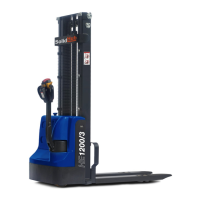
The HSE1000/3 is a semi-electric forklift truck designed for lifting and transporting goods. It features an electric lifting mechanism for vertical movement of the forks, while horizontal movement is typically manual. The truck is built with high-quality materials to ensure durable and reliable operation. Its primary function is to facilitate the movement and stacking of loads in various environments, such as warehouses or industrial settings. The control panel includes an emergency switch, a voltmeter, and a control stick, providing essential functionalities for operation and monitoring. The emergency switch allows for immediate power disconnection, enhancing safety. The voltmeter displays the battery voltage, indicating when charging is required. The control stick is used to manipulate the forks, enabling both lifting and lowering actions.
Operating the HSE1000/3 requires familiarity with its controls and adherence to safety guidelines. Before use, operators must read and understand all warning signs on the truck and the instructions provided in this manual. Training is essential, and the truck should only be operated by trained personnel. A pre-operation check is crucial to ensure the truck is in perfect condition, paying close attention to components like the chain, wheels, drawbar, chassis, control unit, mast, and battery. The forklift is designed for use on clean floors and should not be operated in explosive environments.
Safety is paramount during operation. It is strictly forbidden to transport persons on the forks. When lifting, operators must ensure no one stands or walks beneath the forks. Wearing gloves during operation is recommended for safety. The stacker should not be moved if goods are lifted above 300 mm. A safety distance of 600 mm must be maintained by all persons when the truck is transporting or lifting goods. Proper load distribution is critical; the weight of the goods must be evenly distributed on both forks, and only one fork should never be used. The center of gravity of the goods should align with the middle of the two forks. Operators must never exceed the maximum load capacity specified for the truck. When the truck is not in use, the forks should be set to their lowest position to prevent accidents and maintain stability.
Regular maintenance is vital for the safe and efficient operation of the HSE1000/3. The manual provides specific instructions for hydraulic oil checks, daily inspections, and care of moving parts.
Hydraulic Oil: The hydraulic oil level should be checked every six months. The recommended hydraulic oil is ISO VG32, with a viscosity of 32cSt at 40°C, and a total volume of approximately 4.0 liters.
Daily Check and Maintenance: A daily inspection of the truck is required before each use. Operators should pay particular attention to the wheels and axles, ensuring they are free from foreign objects like cloths that could obstruct movement. The fork, mast, or chain should also be checked for any obstructions or damage. After completing work, the forks should be unloaded and lowered to their lowest position.
Care of Moving Parts: All moving parts of the forklift should be lubricated regularly using engine oil or grease to ensure smooth operation and prevent wear.
Battery Charging: The battery typically requires charging after approximately 4 hours of normal load. Charging must be done in well-ventilated areas, away from fire sources. Once charging is complete, the plug should be disconnected from the mains and stored safely in the chassis. A fully discharged battery takes approximately 6 hours to charge. The battery should be charged when its voltage drops below 10 volts. Before charging, the battery fluid level should be checked, and if insufficient, distilled water should be added. Operators must wear suitable protective clothing, including glasses and gloves, when handling battery fluid. If the truck is not used for an extended period, the battery should be charged for at least two hours per week. During charging, the voltage displayed should not exceed 15 volts, and the truck should not be used.
Troubleshooting: The manual includes a troubleshooting section to address common issues. For instance, if the forks cannot be lifted to the maximum height, the hydraulic oil level might be insufficient. If the engine is not running, it could be due to the emergency switch being pressed, low battery voltage, loose electrical connections, or poor DC motor contact. Issues with lowering the forks might indicate a deformed piston rod or mast, rust on the piston rod, or an unopened drain valve. Leaks typically point to worn or damaged sealing parts or cracked components. If the fork lowers without the release valve working, impurities in the oil, worn sealing parts, or a damaged drain valve could be the cause. Finally, if the battery cannot be recharged, it might be faulty, or the charging plug could be loose. It is strictly forbidden to carry out repairs without proper permission or training.
 General
| Drive Type | Electric |
|---|---|
| Load Capacity | 1000 kg |
| Power Type | Battery |
| Battery Voltage | 24 V |
| Lift Height | 3 m |
| Turning Radius | 1.5 m |

 To Next Page