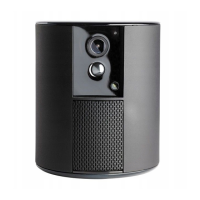
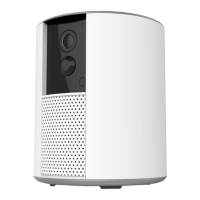
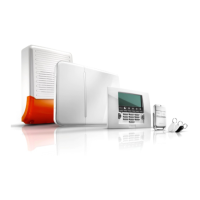
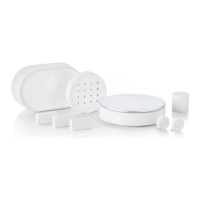
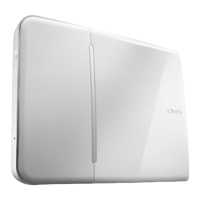
This document describes the PROTEXIOM GSM Wireless radio alarm system from Somfy, a comprehensive security solution designed for homes. The system is fully upgradeable and offers various devices for intrusion and domestic fault detection, as well as deterring, alerting, and signaling capabilities.
The Somfy alarm system boasts several key performance features:
- Battery-powered devices: All devices in the installation are battery-powered, ensuring autonomy.
- Secure dual-frequency radio technology: Utilizes an exclusive, patented process with two alternating frequencies for radio transmission, guaranteeing 100% information transfer.
- Regular system self-monitoring: Devices (except remote controls) periodically send their operating status (battery level, door open, etc.) to the central unit.
- Tamper switch vandalism protection: Sirens are activated for 2 minutes and an alarm message is sent if any device is vandalized. The central unit, sirens, and keypad are protected if removed from the wall or their covers are opened. Detectors are protected if their front panel is opened. Tamper switches are active from the first arming of the alarm.
Activation and Control
The system can be controlled using various devices:
- Keypads, remote controls, and badges: Used to control the alarm system by individual zone or as a whole, providing a visual display of the system status.
- LCD keypad and multi-application remote control: Can control Somfy automatic devices such as motorized gates, garage doors, lighting, roller shutters, or blinds.
- Remote control by telephone: Allows remote control of the alarm, roller shutters, and lights.
Intrusion Detection
The system offers a range of intrusion detectors:
- Movement detectors: Detect any movement and temperature variation caused by a moving body.
- 2 pet movement detectors: Protect rooms even when pets are present.
- Movement detector with photo capture: Takes up to four photos to confirm intrusion and monitor the home.
- Outdoor movement detector: Alerts if something is detected outside the house.
- Opening detectors: Detect when a door or window is opened, emitting a chime on the indoor siren (Kiela function).
- Opening and glass breakage detector: Detects window opening, glass vibration from attempted intrusion, and glass breakage.
- Audiosonic glass breakage detector: Detects the acoustic frequency of breaking glass and pressure differences, protecting external windows only.
- Garage door opening detector: Detects the opening of a garage door.
- Roller shutter opening detector: Detects a 5 cm upward movement of the last shutter strip.
Domestic Fault Detection
The system also includes domestic detectors for various issues:
- Water leakage detector: Detects the presence of water.
- Smoke detector: Triggers the system if smoke is detected. Somfy motorized roller shutters can be opened automatically in this event.
- Power detector: Alerts if there is a power failure.
Deterring, Alerting, and Signaling
- Sirens: Increase volume to deter intruders.
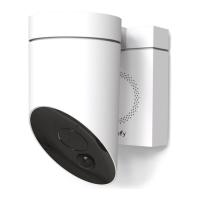
- Outside siren with flash: Alerts and signals intrusion to anyone nearby.
- Central unit/phone dialer/siren (with GSM module): Analyzes detector information, triggers sirens, and sends alarm messages via SMS to up to 4 telephone numbers or alerts a remote monitoring center. A SIM card is included.
- Automatic device control: Can program Somfy RTS roller shutters to close automatically upon intrusion or open upon smoke detection. Can also control RTS lighting to activate upon intrusion.
Installation Recommendations
- Optimal device placement: Choose correct locations for each device to ensure optimum operation.
- Good radio transmission: Radio wave propagation depends on material type (wood, brick, reinforced concrete, metal). Place the central unit in a clear, central area, more than 60 cm above the floor, and at least 1 meter away from electrical fuse boards, cable bundles, earth/metal plates, or radio interference sources (e.g., TV).
- Tamper switch operation: Choose a wall space with good surface condition for central unit and LCD keypad to ensure tamper switch efficiency.
- Zone assignment: Intrusion detectors can be assigned to up to three zones (A, B, C) for partial or full arming. Zone A can have delayed or immediate triggering, while Zones B and C have immediate triggering.
- Battery insertion: Batteries are pre-inserted in remote controls. A beep sounds when batteries are installed in the central unit and indoor siren. Ensure correct polarity.
- Storing devices: Separately purchased devices must be stored in the central unit. The central unit has a 2-minute storage mode, indicated by a steady red light and a beep upon successful storage.
- Fixing devices:
- Opening detector: Fix inside the house on the upright of the opening part, horizontally or vertically, opposite hinges. Ensure perfect alignment with the magnet-holder. Avoid metal parts.
- Movement detectors: Avoid positioning directly facing windows, mirrors, curtains, heat sources, in draughts, or damp rooms. Beams should not intersect.
- Standard movement detector: Place in a corner 2.30 m above the floor.
- Movement detector for big dogs: Wall-mounted at 1.20 m above the floor.
- Movement detector for small pets: Wall-mounted between 2.10 and 2.40 m above the floor.
- Audiosonic glass breakage detector: Mount approximately 2 m above the floor. Avoid the same wall as windows to be protected.
- Roller shutter opening detector: Install inside the shutter frame, flat in the center, with the cord traveling freely.
- Garage door opening detector: Fix the detector to the floor, avoiding metal parts. Fix the magnet to the garage door. Fix the electronic unit to the wall.
- Power detector: Fix on a wall near a mains socket (230V), as high as possible.
- LCD keypad: Install inside the house, preferably near the front door. Essential near automatic devices for safety if controlling them.
- Control keypad: Install inside the house, near the front door or inside the garage.
- Indoor siren: Install in the center of the house, at a high level, difficult to access (e.g., stairwell, top of wardrobe) for better sound propagation.
- Outside siren with flash: Mount right way up (flash upwards), sheltered from sunlight and water.
Connecting the Central Unit
- GSM antenna: Essential for data transmission. Install inside the house, at least 1 m from metal items and the central unit, with the end upwards.
- SIM card: Insert the micro SIM card (supplied) into the GSM module.
- Battery: Connect the GSM battery for function. Provides 3-month backup in case of power failure.
- Cables: Run Ethernet and USB mains cables through the bottom hole. Connect Ethernet to the IP module and power to the POWER socket.
- Mains adapter: Connect to a wall socket; green indicator on GSM module lights up.
- LR20 battery: Insert; red indicator on GSM module flashes.
- Fixing: Mark and drill holes, then fix the central unit to the wall.
Configuration
The alarm system can be configured via a computer or the LCD keypad.
- Computer interface:
- Connect Ethernet cable to broadband router/modem.
- Find IP address (menu 780 on LCD keypad).
- Access via web browser by typing IP address.
- Log in as "Installer" (factory code: 2222).
- Authentication code: Generate and print a new card for User 1 account for security.
- Customizing IP address: Change the last number of the central unit's IP address to between 201 and 240.
- Network settings: Record MAC address, central unit IP, and broadband router/modem IP. Check "Remote access" box for remote control.
- Somfy address server account: Create an account on www.alarmsomfy.eu for remote access.
- LCD keypad:
- Enter menu by pressing "menu", then installer code (2222).
- Language: Set display and voice language.
- Codes: Customize installer and user codes (0001-9998). User codes 1, 2, 3 arm/disarm the system. Mute duress code disarms and sends a silent alert. Duress code with siren disarms, sends alert, and triggers sirens.
- Phone settings: Store up to 4 mobile numbers for alarm SMSs. Customize SMS sender name.
- GSM settings: Identify strongest GSM network, check status, configure SIM card, send test SMS. Set delay for "GSM network fault" SMS. Enter PIN and PUK if needed.
- Date and time: Time-stamp alarm messages.
- Device list: Define device names, view status (battery, alarm, tamper, radio link).
- Event log: View last 300 events.
- Advanced functions:
- Entry delay: Set delay (1-60 seconds) for intrusion detectors in zone A.
- Fault erasing: Erase faults on LCD keypad.
- Sound options: Customize BEEPs on indoor siren, central unit, and wireless sirens. Set siren sound level.
- Jamming detection: Log jamming events on LCD keypad.
- Automatic device command: Store Somfy automatic devices, assign to f1/f2 keys, create scenarios.
- Time programming: Program automatic arming, light switching, and roller shutter movement.
- IP settings: View central unit and router/modem IP addresses.
- Remote monitoring: Connect to remote monitoring center (e.g., Securitas).
Usage Features
- Arming the alarm:
- Partial mode (max 2 zones): Press on remote control or on keypad (with user code or badge). Two green flashes and "BEEP BEEP" confirm.
- Full mode (3 zones): Press on remote control or on keypad (with user code or badge). Three green flashes and "BEEP BEEP BEEP" confirm.
- Delayed arming: System operational after 2 minutes. Movements not detected during this period (unless Kiela mode activated).
- Disarming the alarm: Press on remote control or on keypad (with user code or badge). One green flash and "BEEP" confirm.
- Intrusion/Attack:
- Full trigger: Arm the alarm. Sirens activate, GSM central unit sends SMS to 4 recipients.
- Simulated disarming (if threatened): On keypad, press then type mute duress code. Sirens not activated, but GSM central unit sends SMS to 4 recipients.
- Intrusion event: Sirens activate for 2 minutes. GSM central unit sends SMS to 4 recipients.
- Kiela mode (part arming): Zone A delayed triggering: CHIME on siren, no outdoor siren sound, no alarm SMS. Zone A immediate triggering: Sound alert on central unit/indoor siren, alarm SMS sent, outdoor siren alarm.
- SMS information: Priority alarm messages (Intrusion/Alarm, Self-monitoring) sent to 4 recipients. Alert messages (Battery fault, Radio link lost, Arming, Disarm, GSM network failed) sent to 1st recipient.
- Controlling automatic devices from LCD keypad: Use f1 and f2 keys (if programmed) to control lights, roller shutters, gates, garage doors.
- Viewing stored information: If a fault is detected, the orange indicator flashes. Enter installer code, then menu 5 "Device list" to view. Erase faults by fully arming/disarming or via menu 72 "Fault erasing".
- Remote control by SMS (with GSM module): Send control SMS (e.g., "ON A", "OFF ABC", "Open shutter", "Light on") to the GSM central unit's SIM card number. SMS must start with the 4-digit user code 1.
Maintenance
- Battery replacement:
- Indicator: Rapid BEEPs when armed, or red icon on "List of devices" screen.
- Identification: Press detector button; if indicator doesn't light, batteries need changing.
- Procedure: Deactivate tamper switch (hold OFF on remote control for 2 minutes), open device, replace batteries (ensure correct polarity).
- Battery types and service life: Various LR20, LR03, LR6, CR123A, CR2430, 6LR61, and Somfy batteries with service lives from 3 to 5 years.
- System reset:
- Lost remote control/badge: Delete device from "List of devices" menu (page 35 or 57).
- Lost installer code: Delete all stored devices. Deactivate tamper switch, remove 1 battery, hold PROG button while replacing battery, wait for BEEP and flashing indicator, release button. This deletes all devices and installer code. Re-store all devices, customize codes, date/time.
- Troubleshooting: Solutions for common problems with sirens, movement detectors, opening detectors, control devices, and the central unit are available on www.somfy.uk (FAQ section).

 Need help?
 General

 To Next Page