EasyManua.ls Logo

Sony BVU-950 - Page 37

Sony BVU-950
92 pages
Print Icon
To Next Page IconTo Next Page
To Previous Page IconTo Previous Page
Loading...
FOR
TRAINING
PURPOSES
ONLY
Section
2.
DYNAMIC
TRACKING
BVU-920
-PRELIMINARY-
1.
Strain
Gauge
(S.G)
SUBJ
ECT
TO
CHANGE
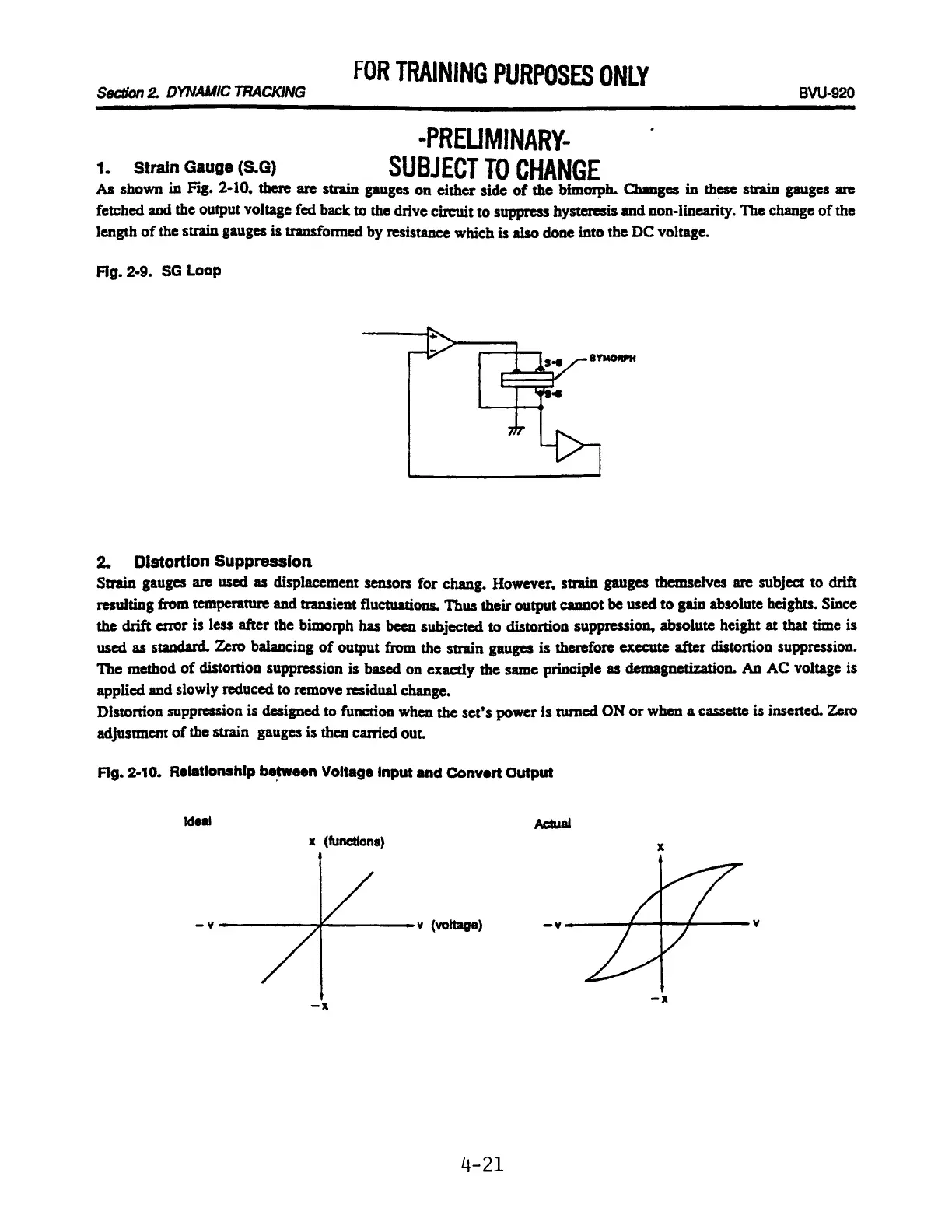
As
shown
in
Fig.
2-10,
there
are
strain
gauges
on
either
side
of
the
bimorph.
Changes
in
these
strain
gauges
are
fetched
and
the
output
voltage
fed
back
to
the
drive
circuit
to
suppress
hysteresis
and
non-linearity.
The
change
of
the
length
of
the
strain
gauges
is
transformed
by
resistance
which
is
also
done
into
the
DC
voltage.
Fig. 2-9.
SG
Loop
$°6
SYMORPH
2.
Distortion
Suppression
Strain
gauges
are
used
as
displacement
sensors
for
chang.
However,
strain
gauges
themselves
are
subject
to
drift
resulting
from
temperature
and
transient
fluctuations.
Thus
their
output
cannot
be
used
to
gain
absolute
heights.
Since
the
drift
error
is
less
after
the
bimorph
has
been
subjected
to
distortion
suppression,
absolute
height
at
that
time
is
used
as
standard.
Zero
balancing
of
output
from
the
strain
gauges
is
therefore
execute
after
distortion
suppression.
The
method
of
distortion
suppression
is
based
on
exactly
the
same
principle
as
demagnetization.
An
AC
voltage
is
applied
and
slowly
reduced
to
remove
residual
change.
Distortion
suppression
is
designed
to
function
when
the
set’s
power
is
turned
ON
or
when
a
cassette
is
inserted.
Zero
adjustment
of
the
strain
gauges
is
then
carried
out.
Fig.
2-10.
Relationship
between
Voitage
input
and
Convert
Output
Ideal
Actual
x
(functions)
nie,
-Vv
v
(voltage)
se
—Xx
AL
t
4-21

Related product manuals