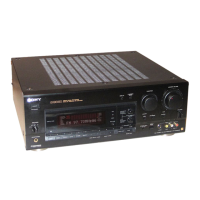
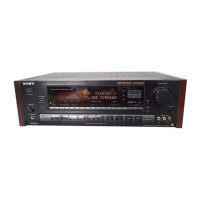
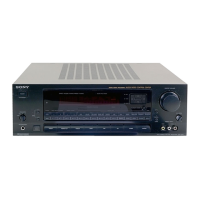
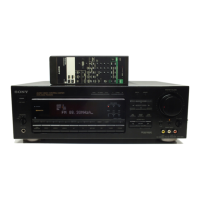
This document is the operating instructions for the Sony STR-GX49ES FM Stereo/FM-AM Receiver, model number 3-755-038-21(2), copyrighted in 1992 by Sony Corporation.
The Sony STR-GX49ES is a receiver designed to control various audio/video sources, allowing users to easily switch between different programs.
Function Description:
The receiver functions as an amplifier, tuner, and a control center for audio and video components. It supports FM Stereo and FM-AM broadcasts and allows for connection to a variety of external devices such as record players, CD players, tape decks, and VCRs. The unit can be operated via front panel controls or a remote commander.
Amplifier Features:
- Optical Legato Linear A System: This system allows the receiver to automatically operate as a Class A amplifier at low levels and transition to a Class B amplifier at high levels without distorting the sound signal. This design aims to minimize total harmonic distortion across all sound stages.
- Spontaneous Twin Drive Power Circuit: Utilizes large-capacity condensers independently for the voltage amplification drive stage (Class A) and the power output stage (Class B). This ensures stable output and high-quality sound by excluding power interferences. The Class A stage maintains stable operation even with instantaneous or strong output.
- Source Direct Switch: This feature bypasses the tone control, loudness switch, and balance control circuits to reproduce high-fidelity sound, ensuring the audio signal is as pure as possible.
- Audio Adjustments: Includes controls for volume (ATTENUATOR), bass and treble tone quality, loudness for bass reinforcement at lower volumes, and balance for adjusting the relative strength of left and right speaker output.
- Muting Function: Temporarily reduces sound output by 20 dB.
Tuner Features:
- Quartz-Locked Digital Synthesizer System: Provides precise tuning for FM/AM stations.
- Preset Memory: Allows users to memorize a total of 30 FM/AM stations across 3 memory pages (A, B, and C), facilitating station classification and quick access.
- Automatic and Manual Tuning: Supports both automatic sweeping for finding stations and manual tuning for precise frequency selection.
- FM Mode: Allows switching between stereo and monaural reception for FM broadcasts. Monaural mode can improve reception for noisy or weak stereo signals.
- AM Tuning Interval: Preset to 10 kHz, but can be adjusted to 9 kHz for regions with different frequency allocation systems. Note that changing this setting will erase all memorized preset stations.
Remote Commander (RM-S103) Features:
- Controls most of Sony's audio equipment from a distance.
- Includes buttons for power, tuner preset, volume, muting, and function selection (CD, Tape Deck A, Tape Deck B).
- Specific buttons for CD player operations (disc skip, CD function, CD playback) and tape deck operations (tape function, tape playback).
- Note: The DBFB and SURROUND buttons on the remote commander do not operate with this receiver.
Recording Features:
- Audio Tape Recording: Allows recording from various program sources (record player, CD player, VCR, tuner) onto a tape deck.
- Tape Dubbing: Facilitates copying from one tape deck to another.
- VCR Recording: Enables recording audio program sources onto a video tape via a VCR.
- Monitoring Recorded Sound: If a three-head tape recorder is connected to the TAPE MONITOR jacks, recorded sound can be monitored directly through the receiver's speakers.
- Recording Controls: The volume, BASS, TREBLE, and BALANCE controls do not affect the recording output, ensuring a consistent recording level.
Important Technical Specifications:
Audio Power Specifications:
- 8-ohm load (both channels driven, 20-20,000 Hz): Rated 60 watts per channel minimum RMS power, with no more than 0.08% total harmonic distortion from 250 milliwatts to rated output.
- 4-ohm load (both channels driven, 20-20,000 Hz): Rated 60 watts per channel minimum RMS power, with no more than 0.08% total harmonic distortion from 250 milliwatts to rated output.
Amplifier Section:
- Dynamic power output (at 1 kHz IHF):
- 75 watts + 75 watts (8 ohms)
- 100 watts + 100 watts (4 ohms)
- 105 watts + 105 watts (2 ohms)
- Harmonic distortion: Less than 0.08% at rated output.
- Frequency response:
- PHONO: RIAA equalization curve ±0.5 dB
- CD, TAPE, VIDEO, TAPE MONITOR: 5 Hz - 50 kHz (+0/-1.5 dB)
- Residual noise: Less than 70 µV (8 ohms, network A)
- Damping factor: 50 (8 ohms, 1 kHz)
- PHONO:
- Sensitivity: 2.5 mV
- Impedance: 50 kilohms
- S/N (weighting network, input level): 87 dB (79 dB* (A, 2.5 mV))
- CD, VIDEO, TAPE, TAPE MONITOR:
- Sensitivity: 150 mV
- Impedance: 50 kilohms
- S/N (weighting network, input level): 105 dB (86 dB* (A, 150 mV))
Outputs:
- VIDEO AUDIO OUT:
- Voltage: 150 mV
- Impedance: 10 kiloohms
- SPEAKER A, B: Accepts speakers of 4 - 16 ohms.
- HEADPHONES: Accepts low and high impedance headphones.
- BASS tone control: ±8 dB at 100 Hz.
- TREBLE tone control: ±8 dB at 10 kHz.
- Muting: -20 dB.
FM/AM Tuner Section:
- FM Tuning Range: 87.5 - 108 MHz
- AM Tuning Range: 530 - 1,710 kHz (10 kHz interval) or 531 - 1,710 kHz (9 kHz interval)
- FM Antenna: 300 ohms balanced, 75 ohms unbalanced.
- AM Antenna: External antenna terminal, loop antenna.
- FM Usable sensitivity: 11.2 dBf, 2 µV (IHF)
- AM Usable sensitivity: Loop antenna: 50 dB/m (at 1,000 kHz), External antenna: 100µV (at 1,000 kHz)
- FM Signal-to-noise ratio: 82 dB (mono), 76 dB (stereo)
- AM Signal-to-noise ratio: 54 dB (at 50 mV/m)
- FM Harmonic distortion: 0.1% (mono), 0.2% (stereo) at 1 kHz
- AM Harmonic distortion: 0.3% (at 50 mV/m, 400 Hz)
- FM Selectivity: 60 dB at 400 kHz
- AM Selectivity: 40 dB at 10 kHz, 35 dB at 9 kHz
- FM Separation: 45 dB at 1 kHz
- FM Frequency response: 30 Hz - 15 kHz (+0.5/-1.5 dB)
- FM IM distortion: 0.1% (mono), 0.2% (stereo)
- FM Capture ratio: 1.2 dB
- AM suppression ratio: 54 dB
- Image response ratio: 80 dB
- IF response ratio: 90 dB
- Spurious response ratio: 100 dB
- RF Intermodulation: 65 dB (800 kHz)
- Auto tuning threshold: 30 dBf
General System:
- Tuner section: PLL quartz-locked digital synthesizer system.
- Preamplifier section: Low-noise NF type equalizer amp.
- Power amplifier section: Pure-complementary SEPP.
- Power requirements: 120 V AC, 60 Hz.
- Power consumption:
- USA model: 130 watts
- Canadian model: 150 W
- AC outlets (two switched):
- USA model: 100 W
- Canadian model: 120 W/1A
- Dimensions (w/h/d): Approx. 430 x 135 x 375 mm (17 x 5 3/8 x 14 3/4 inches) including projecting parts and controls.
- Weight: Approx. 8.1 kg (17 lb 14 oz) net, 9.5 kg (21 lb) in shipping carton.
- Accessories supplied: FM wire antenna (1), AM loop antenna (1), Remote Commander (1) RM-S103, Sony batteries SUM-3(NS) (2).
Usage Features:
- Easy Setup: Clear instructions for connecting AM and FM antennas, speaker systems (A and B), and other audio equipment to AC outlets.
- Speaker Impedance Selector: A switch on the rear panel (4-6Ω or 8-16Ω) must be set according to the impedance of the connected speakers. When operating two speaker systems simultaneously, speakers with impedance greater than 8 ohms should be used, and the selector set to 4-6Ω.
- Headphone Use: The SPEAKERS selector on the front panel should be set to OFF when using headphones.
- AC Outlet Caution: Total power consumption of equipment connected to the receiver's AC outlets must not exceed 100 watts (USA) or 120 watts/1A max (Canada). High-wattage appliances like electric irons or TVs should not be connected.
- Antenna Ground: A ground wire can be connected to the ANTENNA ground terminal to prevent hum. Essential for outdoor antennas for lightning protection.
- TAPE MONITOR Button Priority: This button has priority over other function selectors. It must be released (set to OFF) when not listening to a taped program, otherwise, the selected program source will not be heard.
Maintenance Features:
- Installation Guidelines: Place the unit in a location with adequate air circulation, away from heat sources, direct sunlight, excessive dust, vibration, or shock. Ensure top ventilation holes are unobstructed.
- Cleaning: Clean the cabinet, panel, and controls with a soft cloth lightly moistened with mild detergent solution. Avoid abrasive pads, scouring powder, alcohol, or benzine.
- Battery Installation: Install two AA (R6) batteries in the remote commander, observing correct polarity.
- Battery Life: Normal operation of the remote commander can be expected for about half a year with Sony SUM-3 (NS) batteries, or a year with Sony AM-3 (NW) alkaline batteries. Remove batteries if the commander will not be used for a long time to prevent leakage and corrosion.
- Packing Material: Retain the carton and packing material for potential future repair work or transport.
- Preset Station Retention: Memorized stations are maintained for approximately one month even if the power cord is disconnected. If erased, stations must be stored again.
- Troubleshooting Guide: Provides a comprehensive list of common problems, their causes, and remedies, including connection checks, control adjustments, and advice on signal reception. For persistent issues, consulting a Sony dealer is recommended.
- Safety Precautions: Operate on 120 V AC, 60 Hz. Unplug if a solid object or liquid falls into the cabinet, or if not used for an extended period. Pull the plug, not the cord, to disconnect. The polarized plug has one wider blade for safety. Ensure power is off and unit is unplugged before making connections. Turn off power when not in use to conserve energy and extend unit life.

 Need help?

 To Next Page
 General