EasyManua.ls Logo

Sony TA-E88B - Circuit Description; Output Amplifier; Power Supply; Relay Drive Amplifier

Sony TA-E88B
28 pages
Print Icon
To Next Page IconTo Next Page
To Previous Page IconTo Previous Page
Loading...
TA-E88/ES8B
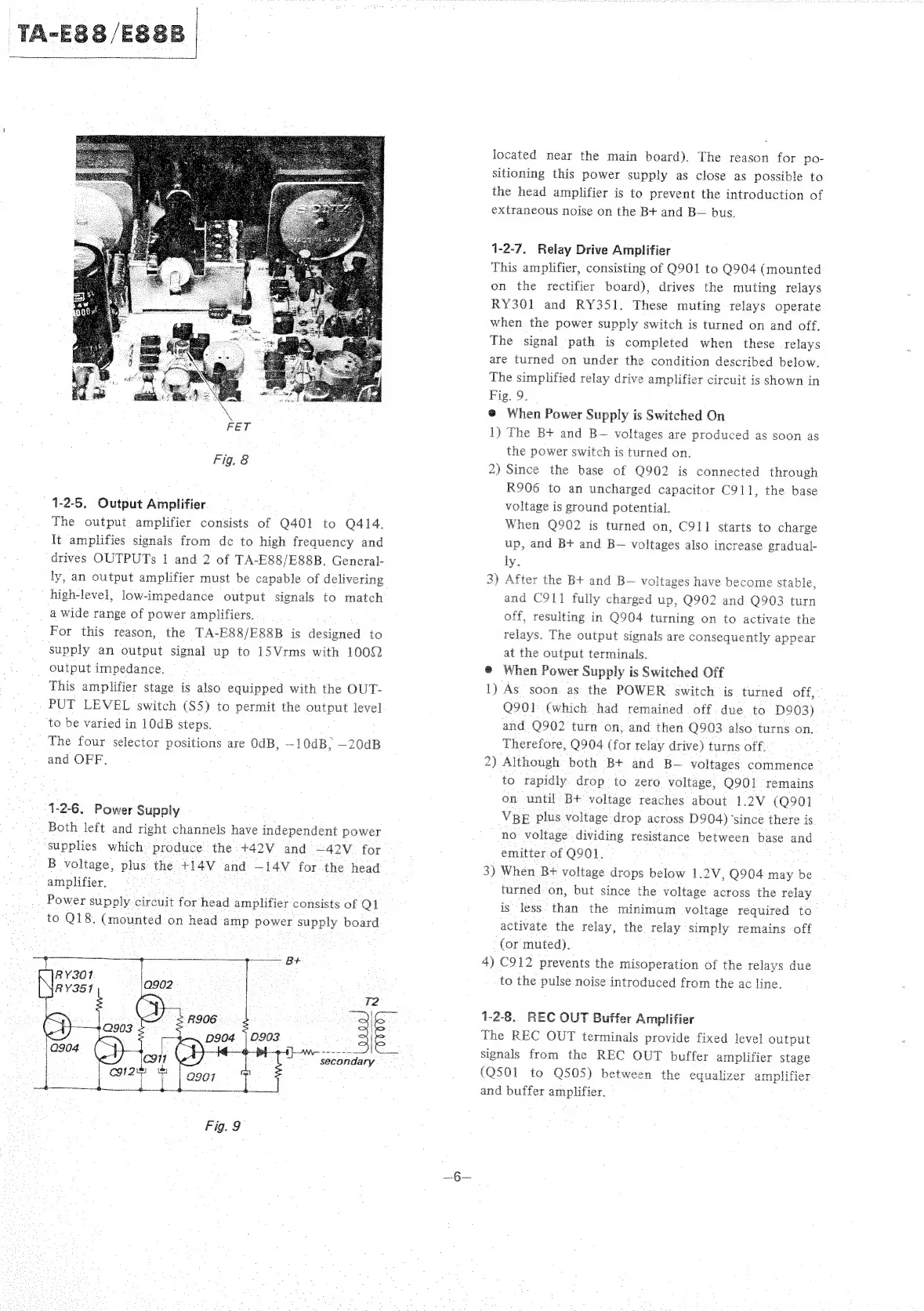
FET
Fig.
8
1-2-5,
Output
Amplifier
The
output
amplifier
consists
of
Q401
to
Q414.
It
amplifies
signals
from
de
to
high
frequency
and
drives
OUTPUTs
1
and
2
of
TA-E88/E88B.
General-
ly,
an
output
amplifier
must
be
capable
of
delivering
high-level,
low-impedance
output
signals
to
match
a
wide
range
of
power
amplifiers.
For
this
reason,
the
TA-E88/E88B
is
designed
to
supply
an
output
signal
up
to
15Vrms
with
10092
output
impedance,
This
amplifier
stage
is
also
equipped
with
the
OUT-
PUT
LEVEL
switch
(S5)
to
permit
the
output
level
to
be
varied
in
10dB
steps.
The
four
selector
positions
are
0dB,
-10dB/
—20dB
and
OFF.
1-2-6.
Power
Supply
Both
left
and
right
channels
have
independent
power
supplies
which:
produce
the
+42V
and
—42V_
for
B
voltage,
plus
the
+14V-and-—14V
for
the
head
amplifier,
Power
supply
circuit
for
head
amplifier
consists
of
Ql
to
Q18.
(mounted
on
head
amp
power
supply
board
Bt
RY301
|
RY351
|Q902
T2
R906
|
D904
|
D903.
|
a904
(Nt)
fp
ig
ob
te
twee
er
secondary
ce
|
agar.
ate
1
alee
es
|
ot
Fig.
9
located
near
the
main
board).
The
reason
for
po-
sitioning
this
power
supply
as
close
as
possible
to
the
head
amplifier
is
to
prevent
the
introduction
of
extraneous
noise
on
the
B+
and
B—
bus.
1-2-7.
Relay
Drive
Amplifier
This
amplifier,
consisting
of
Q901
to
Q904
(mounted
on
the
rectifier
board),
drives
the
muting
relays
RY301
and
RY351.
These
muting
relays
operate
when
the
power
supply
switch
is
turned
on
and
off.
The
signal
path
is
completed
when
these
relays
are
turned
on
under
the
condition
described
below.
The
simplified
relay
drive
amplifier
circuit
is
shown
in
Fig.
9.
®
When
Power
Supply
is
Switched
On
1)
The
B+
and
B—
voltages
are
produced
as
soon
as
the
power
switch
is
turned
on.
2)
Since
the
base
of
Q902
is
connected
through
R906
to
an
uncharged
capacitor
C911,
the
base
voltage
is
ground
potential.
When
Q902
is
turned
on,
C911
starts
to
charge
up,
and
B+
and
B—
voltages
also
increase
gradual-
ly.
3)
After
the
B+
and
B—
voltages
have
become
stable,
and
C911
fully
charged
up,
Q902
and
Q903
turn
off,
resulting
in
Q904
turning
on
to
activate
the
relays.
The
output
signals
are
consequently
appear
at
the
output
terminals.
®
When
Power
Supply
is
Switched
Off
1)
As
soon
as
the
POWER
switch
is
turned
off,
Q901
(which
had
remained
off
due
to
D903)
and
Q902
turn
on,
and
then
Q903
also
turns
on.
Therefore,
Q904
(for
relay
drive)
turns
off.
2)
Although
both
B+
and
B—
voltages
commence
to
rapidly.
drop
to
zero
voltage,
Q901
remains
on
until
B+
voltage
reaches
about
1.2V
(Q901
VBE
Plus
voltage
drop
across
D904)
since
there
is
no
voltage
dividing
resistance
between
base
and
emitter.
of
Q901,
3)
When
B+
voltage
drops
below
1.2V,
Q904
may
be
turned.
on,
but
since
the
voltage
across
the
relay
is
less
than
the
minimum
voltage
required
to
activate.
the
relay,
the
relay
simply
remains
off
(or
muted).
4)
C912
prevents
the
misoperation
of
the
relays
due
to
the
pulse
noise
introduced
from
the
ac
line.
1-2-8.
REC
OUT
Buffer
Amplifier
The
REC
OUT
terminals
provide
fixed
level
output
signals
from
the
REC
OUT
buffer
amplifier
stage
(Q501
to
Q505}
between
the
equalizer
amplifier
and
buffer
amplifier.

Related product manuals