EasyManua.ls Logo

Sony TCM-150 - Service Manual

Sony TCM-150
17 pages
Print Icon
To Next Page IconTo Next Page
Loading...
TCM-150
E Model
Chinese Model
SERVICE MANUAL
Sony Corporation
Personal Audio Company
Published by Sony Engineering Corporation
9-874-161-03
2003F16-1
© 2003.06
SPECIFICATIONS
Ver 1.2 2003. 06
Model Name Using Similar Mechanism NEW
Tape Transport Mechanism Type MT-150-175
CASSETTE-CORDER
Battery life*
(approx. hours)
Sony Sony
alkaline R6P
LR6 (SG)** (SR)
Playback 16 4
Recording 25 6.5
* Measured value by the standard of
JEITA (Japan Electronics and
Information Technology Industries
Association). (Using a Sony HF
series cassette tape)
** When using a Sony LR6 (SG)
“STAMINA” alkaline dry batteries
(produced in Japan)
Note
The battery life may shorten
depending on the operation of the
unit.
For maximum performance we
recommend that you use alkaline
batteries.
House Current
Connect the AC power adaptor to
DC IN 3V and to a wall outlet. Use
the AC-E30HG AC power adaptor
(not supplied). Do not use any other
AC power adaptor.
Polarity of
the plug
Notes
Specifications for AC-E30HG vary
for each area. Check your local
voltage and the shape of the plug
before purchasing.
Do not touch the AC power adaptor
with wet hands.
Connect the AC power adaptor to an
easily accessible AC outlet. Should
you notice an abnormality in the AC
power adaptor, disconnect it from
the AC outlet immediately.
Recording system
2-track 1 channel monaural
Tape speed
4.8 cm/s or 2.4 cm/s
Frequency range
250 - 6 300 Hz using nomal (TYPE
I) cassette
Speaker
Approx. 5.0 cm (2 in.) dia.
Power output
250 mW (at 10% harmonic
distortion)
Output
Earphone jack (minijack) for 8 -
300 earphone
Power requirements
•3 V DC batteries R6 (AA) x 2
External DC 3 V power sources
Dimensions (w/h/d) (incl. projecting
parts and controls)
Approx. 86.9 × 116.3 × 36.5 mm
(3
1
/
2
× 4
5
/
8
× 1
7
/
16
in.)
Mass (main unit only)
Approx. 169 g (6.0 oz.)
Design and specifications are subject
to change without notice.
Question and Answer IconNeed help?

Do you have a question about the Sony TCM-150 and is the answer not in the manual?

Overview

This document is a service manual for the Sony TCM-150, an E Model/Chinese Model cassette-corder. It provides detailed information for servicing, including specifications, disassembly procedures, mechanical and electrical adjustments, diagrams, and an electrical parts list.

Function Description

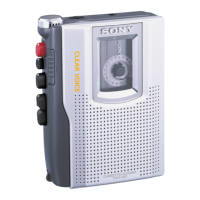
The Sony TCM-150 is a compact cassette-corder designed for recording and playback of audio. It operates on a 2-track, 1-channel monaural recording system. The device features a built-in microphone for convenient recording and an earphone jack for private listening. It supports two tape speeds, allowing for flexibility in recording duration and quality. The unit can be powered by batteries or an external DC power source. Key controls include REC, STOP, REW/REVIEW, PAUSE, and VOL (volume). The device also incorporates a power switch (S102) that detects REC/PLAYBACK on, which is mounted on the main board.

Important Technical Specifications

  • Recording System: 2-track, 1-channel monaural
  • Tape Speed: 4.8 cm/s or 2.4 cm/s
  • Frequency Range: 250 - 6,300 Hz (using normal (TYPE I) cassette)
  • Speaker: Approximately 5.0 cm (2 in.) diameter
  • Power Output: 250 mW (at 10% harmonic distortion)
  • Output: Earphone jack (minijack) for 8 - 300 Ω earphone
  • Power Requirements:
    • 3 V DC (R6 (AA) x 2 batteries)
    • External DC 3 V power sources
  • Dimensions (W/H/D): Approximately 86.9 × 16.3 × 36.5 mm (3 1/2 × 4 5/8 × 7/16 in.)
  • Mass (Main Unit Only): Approximately 169 g (6.0 oz.)
  • Battery Life (Approx. Hours):
    • Playback: 16 hours (Sony alkaline LR6 (SG)), 4 hours (Sony R6P)
    • Recording: 25 hours (Sony alkaline LR6 (SG)), 6.5 hours (Sony R6P)
    • Note: Measured by JEITA standard using Sony HF series cassette tape. Battery life may vary with operation. Alkaline batteries are recommended for maximum performance.
  • External Power Adaptor: AC-E30HG (not supplied), DC IN 3V. Specifications for AC-E30HG vary by region; users should check local voltage and plug shape before purchasing.

Usage Features

The TCM-150 is designed for straightforward operation. The controls are clearly labeled:

  • REC: For initiating recording.
  • STOP: To halt playback or recording.
  • REW/REVIEW: For rewinding the tape or reviewing recorded audio.
  • PAUSE: To temporarily stop playback or recording.
  • VOL: To adjust the audio output level.
  • BATT: Indicates battery status.
  • Built-in microphone: For integrated audio capture.
  • EAR: Earphone jack for private listening.
  • DC IN 3V: Port for connecting an external AC power adaptor.

The device's compact size and lightweight design make it portable and easy to carry. The ability to use both battery and external power sources offers flexibility for various usage scenarios.

Maintenance Features

The service manual outlines several procedures for maintaining and repairing the TCM-150:

  • Disassembly: Detailed steps are provided for disassembling key components such as the speaker, cassette lid assembly, rear cabinet, main board, and mechanism deck. This includes instructions on removing screws and desoldering connections.
  • Mechanical Adjustments:
    • Cleaning: Instructions to clean the record/playback head, erase head, capstan, pinch roller, rubber belt, and idlers with a denatured-alcohol-moistened swab.
    • Demagnetization: The record/playback head should be demagnetized with a head demagnetizer, taking care not to bring it close to the erase head.
    • Tool Usage: Emphasizes not using magnetized screwdrivers for adjustments.
    • Locking Compound: Advises applying suitable locking compound to adjusted parts.
    • Power Supply: Adjustments should be performed with a rated power supply voltage of 2.5 V.
    • Torque Measurement: Specifies torque values for FWD, FWD Back Tension, FF, and REW modes using CQ-102C and CQ-201B torque meters.
    • Tape Tension Measurement: Specifies tape tension for FWD mode using a CQ-403C torque meter.
  • Electrical Adjustments:
    • Settings: Specifies a supplied voltage of 2.5 V and control positions (VOL: mechanical center, PAUSE: OFF).
    • Record/Playback Head Azimuth Adjustment: Involves playing a P-4-A063 test tape (6.3 kHz, -10 dB) and adjusting a screw to obtain maximum reading on a level meter.
    • Tape Speed Adjustment: Involves playing a WS-48A test tape (3 kHz, 0 dB) and adjusting RV601 so that the frequency counter reads 3,040 Hz (specification: 3,030 to 3,050 Hz). It also requires confirming that deflection of the frequency counter reading between the beginning and end of the tape is within 1% (approx. 30.4 Hz).
  • Flexible Circuit Board Repairing:
    • Soldering Temperature: Maintain soldering iron temperature around 270 °C.
    • Conductor Contact: Avoid touching the soldering iron on the same conductor more than three times.
    • Force Application: Be careful not to apply force on the conductor when soldering or unsoldering.
  • Notes on Chip Component Replacement:
    • Never reuse a disconnected chip component.
    • Be aware that the minus side of a tantalum capacitor may be damaged by heat.

The manual also includes block diagrams, printed wiring board layouts, schematic diagrams, and exploded views with parts lists to aid in identification and replacement of components.

Sony TCM-150 Specifications

General IconGeneral
BrandSony
ModelTCM-150
CategoryVoice Recorder
LanguageEnglish

Related product manuals