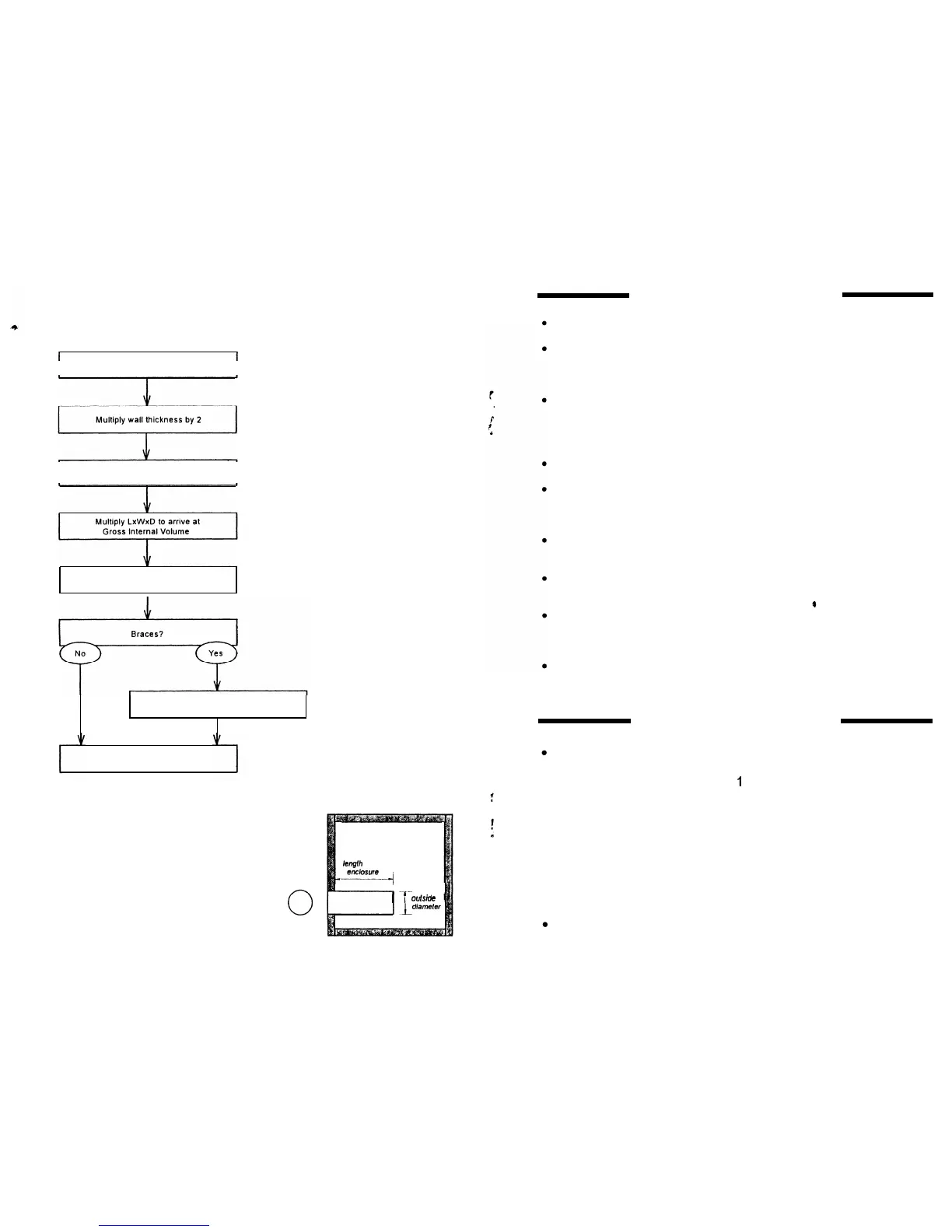
actual air space available. The following worksheet has been designed
to provide you with the necessary steps to accurately calculate the
absolute (Net) internal volume of any given enclosure.
I
Measure maximum possible dimensions
I
I
Subtract this from each dimension to
arrive at Gross Internal Dimensions
I
Deduct Vf (volume of the speaker frame)
from Gross Internal Volume
K
Calculate brace volume and deduct
from Gross Internal Volume
You are at Net Internal Volume
in cubic Inches (in’)
70 convert
to
LITERS:
Divide
in3
by 61.03
70 convert to CUBIC FEET:
Divide
in’
by 1728
Calculating Cylindrical Port Volume
1
.
2
Measure the outside diameter of the
port and divide by 2
for the radius.
Square the radius and multiply by
3.14 (x) to arrive at outside port area.
3.
Multiply the
area by the length o
port inside the enclosure for the
volume.
f the
port
6
7
BUILDING THE ENCLOSURE
Determine the dimensions of your enclosure.
Be certain the box you have designed will fit into the location you have
chosen.
Sometimes making a cardboard box with the same outside
dimensions is helpful.
Use 3/4 inch thick Medium Density Fiberboard (MDF) or High Density
Particleboard. It is preferable to cut the wood with
a table saw to ensure
straight, even joints.
If a
table saw is not available, a circular saw is
acceptable.
Use a “T” square to verify precise right angle gluing.
Use a high quality wood glue and air nails or wood screws to assemble the
enclosure.
Elmer’s@ woodworker’s glue and
Weldwood@
work well. To
guarantee an airtight box, seal each inside joint with RTV silicone glue.
For Sealed Enclosures, stuff the chamber with 50-75% filling (approximately
1.5 pounds per cubic foot) of fiberglass insulation or Dacron.
For Vented Enclosures, staple
1
inch thick fiberglass insulation or Dacron to
all walls of the enclosure except the baffle to which the woofer is mounted.
Use eight(8) wood screws or T-nuts and bolts to secure the woofer.
Progressively tighten each of the bolts or screws to prevent warping the
woofer frame.
Use slide-on connectors to attach speaker wires (SS-8). Do not solder wires
to the provided terminals as this may cause damage to the factory wire
connection. This may also void the speaker’s warranty.
length
inside
-
1
i
of&de
SUGGESTED ENCLOSURES
The following designs include a variety of enclosure types. Each
design has a frequency response curve that shows predicted output
with 2.0 volts input, measured at
I
meter. 2.0 volts across a
4ohm
load
corresponds to 1 watt per speaker. Also, each frequency response
curve was generated using a
12
dB/octave
low pass filter at 100 Hz.
The performance of each of these enclosures will be different once
installed in a car. The amount each enclosure will vary depends on the
car and installation location. The “standard” curves given correspond
to performance outside the car to help you visualize relative
performance differences. Read through the descriptions given for
each enclosure and select the one that suits your needs.
Remember: all suggested enclosure volumes are Net, and DO NOT
include woofer, port, and bracing displacement!





 To Next Page