
 Need help?
Do you have a question about the sourcenext POCKETALK S and is the answer not in the manual?
Procedure to power on the POCKETALK S device.
Choosing the language for device interface and explanations.
Accepting the End-User License Agreement.
Confirming user's age during setup.
Accepting the terms of the Privacy Policy.
Establishing a connection to the mobile network for data.
Configuring Wi-Fi connection or skipping the step.
Confirmation that the initial setup process is finished.
List of items packaged with the POCKETALK S unit.
Identification of physical components and ports on the device.
Important warnings and guidelines to ensure safe operation.
Explanation of touch gestures like tap, scroll, and swipe.
Steps for performing voice translation by speaking into the unit.
Viewing and listening to the translated output on the screen.
How to control the device's audio volume levels.
Switching the source and target languages for translation.
Selecting and changing the languages used for translation.
Accessing and viewing past translation records.
Adding frequently used translations to a favorites list.
Removing unwanted translation entries from the history.
Description of the primary navigation screens.
Explanation of icons indicating device status like network and battery.
Introduction to other functionalities available on the device.
Accessing and adjusting general device settings.
Steps to set up and perform text translation using the camera.
Specifying translation area and checking results.
Accessing and viewing past image translations.
Introduction to the feature for converting units.
Steps for selecting units and performing conversions.
Introduction to the role play feature for language practice.
Engaging in simulated conversations with characters using the feature.
Adding frequently used translations to a favorites list.
Removing entries from the favorites list.
Viewing earned medals for achievements.
Configuring mobile data connections and network preferences.
Connecting the device to a Wi-Fi network.
Connecting to Bluetooth devices like headphones or speakers.
Controlling the device's volume for audio output.
Adjusting the screen brightness level.
Modifying the font size for on-screen text display.
Instructions for updating the device's software to the latest version.
Creating shortcuts for quick access to frequently used features.
Enabling and configuring the screen lock feature for security.
Managing device notifications for updates and alerts.
Configuring the inactivity timer before the device enters sleep mode.
Selecting the language for the user interface and device messages.
Configuring regional settings for optimal network performance.
Verifying the details and validity of the data transmission plan.
Accessing device details and software license agreements.
Restoring device settings to factory defaults or clearing data.
Enabling or disabling mobile data.
Selecting the SIM card to use for mobile data.
Steps to connect to available Wi-Fi networks.
Detailed steps for connecting to Wi-Fi networks, including hidden ones.
Connecting the device to Bluetooth accessories like headphones or speakers.
Controlling the device's volume for audio output.
Adjusting the screen brightness level.
Modifying the font size for on-screen text display.
Instructions for updating the device's software to the latest version.
Setting up alerts for new software versions.
Creating shortcuts for quick access to frequently used features.
Enabling and configuring the screen lock feature for security.
Configuring the inactivity timer before the device enters sleep mode.
Selecting the language for the user interface and device messages.
Configuring regional settings for optimal network performance.
Verifying the details and validity of the data transmission plan.
Accessing device details and software license agreements.
Restoring device settings to factory defaults or clearing data.
Step-by-step guide for installing a SIM card.
Troubleshooting steps for when the unit is not operating correctly.
A Q&A section addressing frequent user inquiries.
Addressing problems related to device charging and power.
Resolving issues with internet connection and overheating.
Details on size, weight, OS, CPU, and memory.
Information on Wi-Fi, Bluetooth, SIM card support, and accessories.
Ways to get help and contact customer support via different channels.
Crucial warnings for safe operation, handling, and potential hazards.
Specific guidelines to prevent damage to the device and ensure user safety.
Precautions regarding the built-in battery's use, charging, and disposal.
Guidelines for using the device near sensitive electronic equipment.
Important safety measures to follow during the device charging process.
Instructions for cleaning the device and proper methods for disposal.
The official compliance statement for the device in the USA.
Specific actions or conditions required for FCC compliance.
Device FCC ID and manufacturer's contact details.
Details on Specific Absorption Rate and RF exposure guidelines.
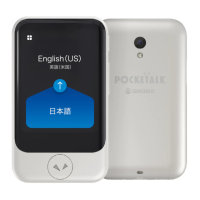
The POCKETALK S Voice Translator is a portable device designed to facilitate real-time voice translation, enabling users to communicate across language barriers. Its primary function is to translate spoken words into another language, displaying the text on screen and playing it back as speech. This makes it suitable for various scenarios, from casual conversations to travel and business interactions.
The core functionality of the POCKETALK S revolves around its ability to capture spoken language, process it, and deliver a translation. Users initiate a translation by pressing and holding a dedicated "Talk button" on the device, speaking into the microphone, and then releasing the button. The device then displays the spoken words and their translation on the touch screen. For languages with speech playback, the translation is also spoken aloud. The device supports a wide range of languages, and the translation direction can be easily swapped, allowing for two-way communication.
Beyond basic voice translation, the POCKETALK S offers several advanced features to enhance its utility:
Image Translation (Camera Function): This feature allows users to translate text from images, such as city signs, restaurant menus, or documents. By tapping the camera icon, users can take a photo of the text they wish to translate. The device then processes the image, allowing the user to specify the area of text for translation, and displays the translated text over the original image. This is particularly useful for navigating foreign environments where written language is prevalent. The device also maintains a history of image translations, which can be reviewed later.
Convert Units Feature: The POCKETALK S includes a unit conversion tool that can handle various types of conversions, including currency, length, weight, and temperature. Users can select the desired conversion type, input a value, and the device will display the converted amount. For currency, it can automatically detect the current location's currency, and conversion rates are updated regularly.
Role Play Feature: This unique function leverages AI technology to help users practice foreign languages in common real-world settings, such as an airport or hotel. Users can select a scenario and lesson, and the device will simulate a conversation, allowing them to practice their responses and improve their language skills. This interactive learning tool provides a practical way to build confidence in speaking a new language.
Translation History and Favorites: The device automatically stores a history of voice translations, allowing users to scroll through and review past conversations. Users can also save frequently used phrases or important translations to a "Favorites" list by swiping the translation bubble. This makes it easy to quickly access and replay key phrases without re-translating them.
Medal Feature: To encourage engagement and track progress, the POCKETALK S incorporates a "Medal" system. Users can earn medals by achieving certain milestones, such as translating a specific number of times or visiting a certain number of countries. These medals are categorized by difficulty (Gold, Silver, Bronze) and can be viewed to see when they were earned.
The POCKETALK S is designed for intuitive and user-friendly operation, primarily through its touch screen display and physical buttons.
Initial Setup: Upon first power-on, the device guides users through an initial setup process. This includes turning on the power, selecting the display language, agreeing to the End-User License Agreement (EULA), connecting to a mobile network (if applicable), and optionally setting up Wi-Fi. This ensures the device is ready for translation and connected to the internet, which is essential for its functionality.
Basic Operations (Tap, Swipe, Scroll): The touch screen supports standard gestures. "Tap" is used for selecting items, "Tap and hold" for sustained actions, "Swipe" for dragging fingertips across the screen (e.g., changing translation direction or navigating menus), and "Scroll" for viewing lists or other parts of a screen.
Power On/Off and Restart: The device can be turned on or off by pressing and holding the power button and selecting the appropriate option on the screen. A restart option is also available for troubleshooting.
Language Selection: Users can easily change the translation languages by tapping on the displayed language names. The device offers various methods to search for languages, including displaying all available languages, selecting from previously used languages, filtering by country, or using voice search.
Main Menu and Shortcuts: A "Main Menu" provides access to all features and settings. Users can also create shortcuts to frequently used features on the Home screen for quick access, enhancing efficiency.
Lock Screen: The lock screen displays the current location and time, as well as previously visited locations. Users can unlock the screen by swiping up or entering a PIN if set.
Volume and Brightness Adjustment: The device allows users to adjust the volume of speech playback and operation sounds, as well as the display brightness, using sliders in the settings menu or dedicated volume buttons.
Text Size Adjustment: Users can select from five different text sizes for the display, catering to individual preferences and improving readability.
Notifications: The device can be configured to provide notifications for software updates and medal achievements, keeping users informed about new features and their progress.
Sleep Settings: Users can set the amount of time the device waits before going to sleep, conserving battery life.
Region of Use: This setting is particularly important for users in China, as it adjusts the device's functionality to comply with regional internet restrictions.
The POCKETALK S includes features and guidelines to ensure its proper functioning and longevity.
Software Update: The device can be updated with the latest software versions to improve performance, add new features, and address any issues. Users are notified when updates are available and can download them, provided the battery level is sufficient and the device is connected to the internet.
Mobile Network Settings: Users can manage their mobile data connection, including turning it on/off and switching between different SIM cards. The device supports nano SIM cards, and instructions are provided for inserting SIM cards from different carriers.
Wi-Fi Connectivity: The device allows users to connect to Wi-Fi networks, which is crucial for translation when mobile data is unavailable or preferred. It supports connecting to both visible and hidden Wi-Fi networks.
Bluetooth Connectivity: The POCKETALK S can be paired with Bluetooth devices, such as headphones or speakers, for private listening or enhanced audio output. Users can easily pair and unpair devices.
Reset Options: For troubleshooting or preparing the device for new ownership, the POCKETALK S offers reset options. Users can clear all Favorites, delete translation history, or restore the unit to factory default settings. It's important to note that restoring to factory settings does not revert the software to its initial state.
Charging: The device is charged using the included USB wall charger and USB cable. Users are advised to use the specified charging procedure and avoid damaged cables or charging in moist conditions to prevent damage or injury.
SIM Card Insertion: For models that support external SIM cards, instructions are provided on how to open the SIM tray and insert a nano SIM card.
Troubleshooting Guide: The manual includes a troubleshooting section that addresses common issues such as the unit not charging, not turning on, or internet connection problems, offering solutions like restarting the unit, checking battery levels, or connecting via Wi-Fi.
Device/License Info: Users can access information about the device, including software version, MAC address, and the end-user license agreement.
Safety Precautions: The manual provides comprehensive safety guidelines covering handling, battery care, cleaning, and electromagnetic interference, emphasizing the importance of following these instructions to prevent damage, injury, or product failure. This includes warnings against disassembling the product, applying excessive force, exposing it to liquids, or using it in extreme temperatures. It also advises on proper disposal of the lithium-ion battery.
 General
| Product Name | POCKETALK S |
|---|---|
| Category | Electronic dictionary |
| Manufacturer | Sourcenext |
| Touchscreen | Yes |
| Languages Supported | 74 languages |
| Voice Recognition | Yes |
| Camera | No |
| Text Translation | Yes |
| Connectivity | Wi-Fi |

 To Next Page