What You Should See
When powered up you should see the servo move to a single location (0 degrees) and then start to
sweep to 180 degrees back and forth until you turn it off or tell it to go to a different angle.
Troubleshooting
Servo Not Twisting
Even with colored wires, it is still shockingly easy to plug a servo in backward. This might be the
case.
Still Not Working
A mistake we made a time or two was simply forgetting to connect the power (red and black wires) to
3.3 volts and ground (GND).
Experiment 9: Using a Buzzer
Introduction
In this experiment, we will again bridge the gap between the digital world and the analog world. We’ll
be using a piezo buzzer that makes a small “click” when you apply voltage to it (try it!). By itself that
isn’t terribly exciting, but if you turn the voltage on and off hundreds of times a second, the piezo
buzzer will produce a tone. And if you string a bunch of tones together, you’ve got music! This circuit
and set of code blocks will create a simple sound machine.
Parts Needed
You will need the following parts:
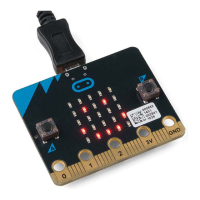
1x micro:bit
1x Micro B USB Cable
1x micro:bit Breakout (with Headers)
1x Breadboard
14x Jumper Wires
1x Piezo Buzzer
2x Momentary Push Buttons
2x 10kΩ Resistors


 To Next Page
 Loading...