Why Are There Unpopulated Parts?
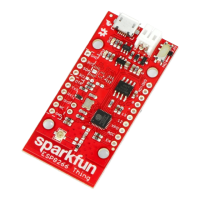
We initially set out to make the Thing a secure, common-sensor base station. The empty pads
you see are landing spots for three unique IC’s:
• ATECC108A – A “full turnkey Elliptic Curve Digital Signature Algorithm (ECDSA)
engine”, which can be used for unique serial numbers, hashing, key storage, or
random numbers. A great start to securing your IoT project!
• TMP102 Temperature Sensor – A simple, 12-bit, digital temperature sensor.
• TSL2561 Light Sensor – A nifty luminosity/light sensor.
• Plus a few footprints for decoupling capacitors.
After a late change of heart, we decided to keep the board as low cost as possible (that’s the
ESP8266’s best feature!), while leaving the option for later expansion. The pads are still there.
If you want to add any of these components, hopefully all you should need is a hot air
station (maybe probably not a Heaterizer) and some tweezers.
Powering the Thing
The Thing provides for two methods of power delivery: USB or LiPo. The USB connector on
the Thing is of the Micro-B variety. A micro-B cable plugged into either a computer USB port
or a 5V USB Wall Wart can power the Thing.
Any of our single-cell LiPo batteries will also work to power the Thing – they all have the same
2-pin JST connector.


 To Next Page
