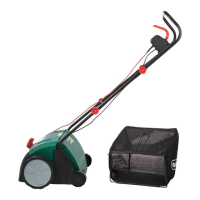
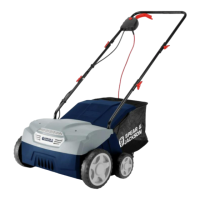
This document outlines the operation, assembly, and maintenance of a 1400W electric scarifier and raker, designed for domestic and hobby garden use. Spear & Jackson, a brand with over 250 years of experience in high-quality tools, emphasizes performance, comfort, and durability in its garden power tools.
The scarifier and raker is primarily intended for two main functions: scarifying and raking lawns. When used as a scarifier, the machine employs specially adapted prongs to scratch through and between the grass. This action collects and removes unwanted thatch and debris from the lawn while leaving the grass blades intact. Simultaneously, the scarifying process aerates the ground, promoting better air circulation to the roots. For raking, the device utilizes fine needles to scratch the lawn's surface, picking up light debris. This process enhances oxygen absorption, airing, and drainage, contributing to a healthier lawn. The product is not designed for use in wet weather conditions, nor for mowing dry, wet, or unusually high grass, such as pasture grass, or for shredding leaves. It is strictly for private domestic use and not for commercial or industrial applications.
Usage Features:
The device is equipped with a handle bar assembly that requires initial setup. This involves aligning the lower handle bars with the frame, securing them with screws, then aligning and securing the middle handle bars, and finally attaching the upper handle bar with the cord strain relief and securing the power cord with clips.
Before operation, users must install the correct cutting device. The scarifying cylinder blade comes pre-assembled. If raking is desired, the scarifying cylinder blade must be disassembled first. This involves placing the product upside down, sliding a lock release button towards the blade, lifting a lock lever to release the blade cylinder, and then pushing the scarifying blade cylinder out. The raker cylinder is then installed in reverse order.
The machine features a debris collection bag, which is optional for scarifying but recommended for raking. To install it, the rear deflector guard is lifted, and the bag is attached to the rear side of the machine.
A key operational feature is the adjustable working height setting. Users can push the depth adjustment lever towards the wheel and move it forward or backward to set the desired cutting depth. There are four depth settings: minimal (5mm), middle (0mm), deep (-5mm), and deep (-10mm). These settings are tailored for scarifying or raking healthy lawns, with specific recommendations for transport, storage, and when not to use for certain tasks. For instance, the minimal setting (5mm) is not recommended for scarifying, while the deepest setting (-10mm) is not recommended for raking.
To start the machine, the lock-off button must be pressed fully, followed by holding the start/stop lever. Once the machine is operating, the lock-off button can be released. Users are advised to maintain a straight body posture, hold the machine with both hands, and keep their feet away from the moving cylinder blade during operation.
Scarifying work should consider weather conditions. An increased depth setting is recommended between April and May to allow the lawn to recover. During a wet summer, scarifying with a decreased depth setting in late summer is suggested. Scarifying should be avoided during dry, hot weather, and a second scarification in autumn is not recommended after a dry, rainless summer.
For raking, the fine needles work to penetrate the area around the grass roots, promoting air circulation. Raking is recommended every 4-6 weeks, depending on the lawn's condition.
The machine includes an overload protection feature. This activates if there's a build-up of scarified material, if the scarified material exceeds motor capacity, or if there's excessive resistance against the cutting device. When activated, the circuit breaker will switch off the product. Users must then disconnect the power supply, allow the product to cool down, eliminate the cause of the overload, and wait 5 minutes before restarting.
To stop the machine, the start/stop lever should be released, and the lock-off button pressed and held to restart if needed. After finishing work, the power source should be disconnected. The debris collection bag should be emptied frequently, especially when it is half full. This involves lifting the deflector guard, pulling the bag off, emptying the collected material, and re-attaching the bag by aligning the hooks to the hinges.
Maintenance Features:
Regular maintenance is crucial for extending the service life of the scarifier and raker. After each use, the machine body, including the deflector guard and handle bars, should be cleaned with a clean cloth.
The scarifying cylinder with blades requires thorough cleaning after each use. All residual dirt and sand should be removed from the cylinder, blades, and plastic body using a clean cloth or soft brush. Users are warned to be aware of sharp edges and blades during this process.
Similarly, the raking cylinder with fine needles needs cleaning. Any residual grass, moss, or other debris should be carefully removed from the metal tines using a dry cloth or brush. Again, caution is advised due to sharp edges and needles.
For storage, the product should be kept in a dry place. All screws should be cleaned and oiled after each use to further extend the tool's service life.
The manual also emphasizes general power tool safety, including keeping the work area clean and well-lit, avoiding explosive atmospheres, keeping children and bystanders away, using personal protective equipment, and ensuring proper electrical safety. It highlights the importance of maintaining cutting tools sharp and clean, and using the power tool, accessories, and tool bits according to instructions and working conditions. The document also addresses residual risks such as health defects from vibration, injuries from broken application tools or hidden objects, and property damage from flying objects.


 To Next Page
 General