EasyManua.ls Logo

Spencer Buffalo Model 44 - Page 6

Spencer Buffalo Model 44
34 pages
Print Icon
To Next Page IconTo Next Page
To Previous Page IconTo Previous Page
Loading...
easily,
breathc on
the surface
and rub
gently.
If this
is
not successful,
try moistening
with
a little xylol,
ether
or
chloroform, if indeed,
water
previously
tried
does
not
accomplish the end.
Dry
as soon
as
possible.
lfeaer
use
alcohol on lacquered parts
unless you
hnow
Lhe
lacquer is
alcohol
proof.
Fortunately
nearly
all lac-
quers
now used
are not
soluble
in alcohol.
The
black
enamels
which are
more
and more
extensively
used
are not
affected
by
any of
the ordinary
reagents.
The
modern
microscope
is more
compact,
solid
and
rigidly
built than
those
in use
some
years
ago.
It is
better
adapted
to
the serious purpose
of modein
labo-
ratory
methods.
In
all makes
much
careful engineer-
ing skill
has
been exercised
to
make
a durable
and
efficient
instrument.
Base
and
Fillar
Beginning
n'ith
the base, stability
is
attained
more
by weight
than
by spread
of
the feet.
Usually
the
base
and
pillar
are
one
casting,
althougfr
on some
microscopes
tlr"V
g_"
made
separatcly
and securely
fastened
together.
There
is
no
advantage
either
way.
Inclination
Joint
Practically
all microscopes
are
provided
with incli-
nation
joints
by
which
the
body
of
the instrument
is movably
fastened
to
the
top of
the
pillar
so
that
it
may
be inclined
to any
angle
which
ease
and
con-
venie-nce- may
dictate.
The
joint
should
work
smoothly
and freely
and
yet
with
sufficient
friction
to
hold
thL
body
at any
inclination.
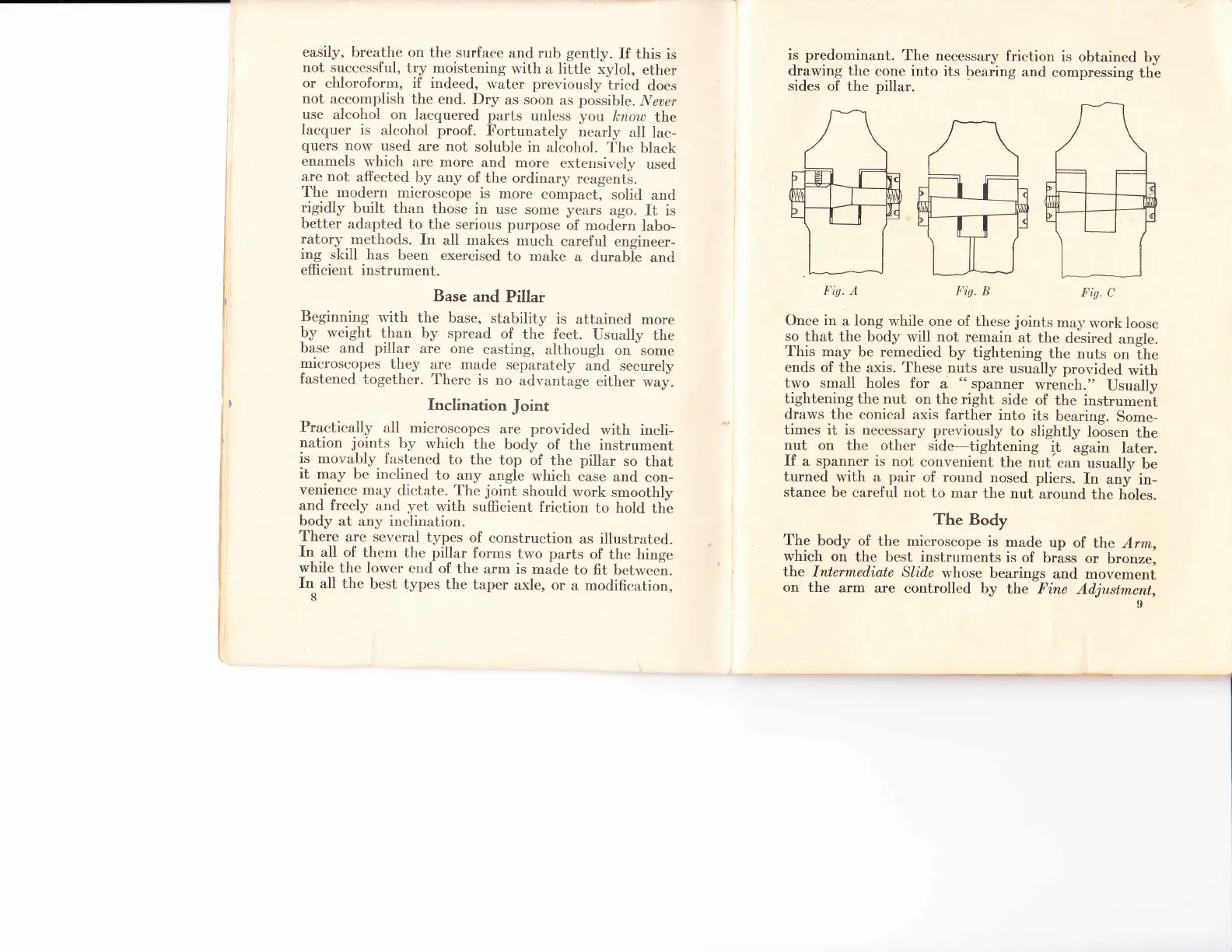
There
are several
types
of
construction
as illustrated.
fn
-all
of
them the
pil]ar
forms
two
parts
of
the hinge
while the
lowcr end
of the
arm is
made
to
fit
betwee"n.
In
all the
best types
the
taper
axle, or
a modification,
I
is
predominant.
The necessary
friction
is obtained
by
drawing the
cole into its
bearing and
compressing
th"e
sides of
the
pillar.
I
i
I
Itig. A
l,'is.
B
Fis.
C
Once
in a long
while one of
these
joints
may.work
loose
s.g_ that
the body
will not remain
at the
desired
angle.
This
may
be
remedied
by tightening
the
nuts
on
lhe
ends
of the axis. These
nuts
are
usually
provided
with
two small
holes for
a
"
spanner
wrenr.h."
Usuallv
tightening
the nut on
the right
side
of
the
instrumenl
draws the
conical axis
farther
into
its
bearing.
Some-
times it
is
necessary previously
to slightly
loosen
the
nut
on
the other side-tightening
it
again
later.
ff a spanner is not
convenient
the
nut'can
usually
be
turned_with
a
pair
of round
nosed pliers.
In
any
in-
stance
be
careful
not
to mar
the nut
around
the
lioles.
The
Body
The
body of
the microscope
is made
tp
of
the Arm,
which on
the
best instruments
is of
briss
or
bronze,
Lhe
Intermediate
Slide
whose
bearings
and movement
on the
arm
are controlled
by
the Fine
Adjustment,
I,'i11.
B
Fis.
C