and the
Body
Tube,
rvhose bearings
and
movement
on the intermediate slide
are
controlled
by the
Coarse
Adjustment.
The Fine
Adjustment
The
fine adjustment
is the vital
part
of the microscope
stand. No high
power
work can
be done
without its
proper
functioning.
One of
the essentials
is a
perfectly
fitting
bearing which
permits
a free up
and
down move-
ment
in a line at 90o from
the
plane
of the stagc,
with
no
lateral motion. The metal
forming
these
bearing
surfaces should
be
of such
texture,
the fitting
so
per-
fect,
and the lubrication such
that
the movement
always responds immediately
to
the least
impulse.
These
bearings should
be
protected
from
dust and
other
foreign matter,
and
should
be lubricated
with
oil
which will not become
gummy
and sticky.
If for any reason
these, or any other,
bearing surfaces
should
become
gummed,
clean them
ofr
with
xylol
or
chloroform, and re-lubricate
with
white vaseline.
On all Spencer micros<:opes oil
grooves
are
put
in all
bearing surfaces to hold
&
reserve
supply of
the
lubri-
cant.'l'his
insures a smooth movement
which
can not
be accomplished in any
other
way.
ff, when working the fine adjustment
up
and
down,
while the
eye
is at the eyepiece,
the object
appears
to move
sidewise, the
light coming
from the
mirror
is not central,
or there
is a lateral movement
in
the
fine
adjustmcnt
bcarings.
If upon carefully
centering
the
light
the :rpparent movement
of
the object
per-
sists,
the trouble is in the fine
adjustment-either poor
fitting,
a
decided lateral thrust in
the mechanism pro-
ducing the movement impulse-or
both.
It
should
not
occur.
t0
The
mechanism
for
supplying
the
impulse
must
of
ne-cessit-y_
b_e_ of
extreme
accuracy,
delicacv
and
dura_
bilit)'.
N.othing
in
mechanics
*ill
"""o*plish
this-as
well
as
the mrcrometer
screw
l,ith
a sufficient
number
of threads
in
contact
with
its
nut;
especiatty
*t
""
"."a
in
conjunction
with
the
lever.
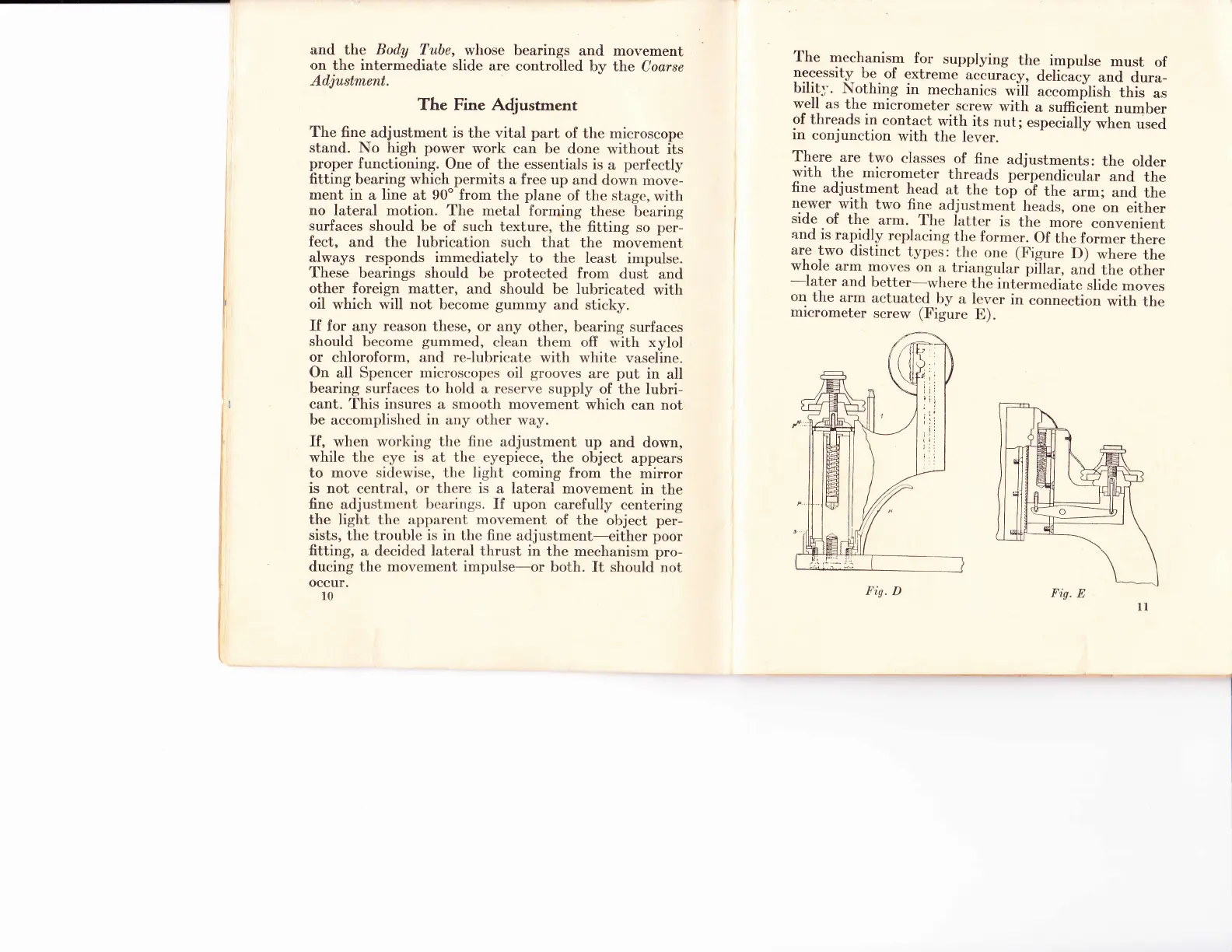
There
are
two
classes
of
fine
adjustments:
the older
with
the
micrometer
thleads peipendicular
and
the
fine
adju.stment
head
at
the
to|
oi
the
arm;
and
the
newer
with
two
fine
adjustment
heads,
one
on
either
side
of
the
arm.
The
latter
is
the
more
convenient
and
is rapidly
replacing
the
former.
Of
the former
there
are
two
disl.inr.t
types:
the
one
(Figure
D)
where
the
whole
arm
mov('s
on
a triangular pillar,
and
the olher
-later
and
better-rvhere
the
intermecliate
slicle
moves
on
the
arm
actuated
by
a lever
in
connection
with the
micrometer
screw
(Figure
E).
tr'is.
D
Fis.
E


 To Next Page
 Loading...