44
Yagi Gain / Front to Back Modeling
SteppIR antenna designs are all close to 22 ohms at all frequencies, so we needed a broadband match-
ing system. We found an excellent one designed by Jerry Sevick, that is described in his book
“Building and Using Baluns and Ununs”.
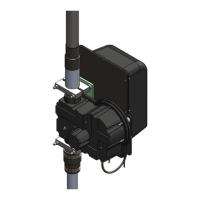
Our matching network is a transmission line transformer that is wound on a 2.25 inch OD ferrite core
that operates with very little internal flux, thus allowing it to function at very high power levels. The
transformer includes a 22 ohm to 50 ohm unun and a balun. Jerry has espoused these transformers for
years as an overlooked but excellent way to match a Yagi, he would probably be proud to know they
are being used in a commercial Yagi. This matching network does not require compressing or stretch-
ing a coil, or separating wires to get a good match – something that can easily be bumped out of adjust-
ment by birds or installation crews.
When we claim our Yagi outperforms much larger arrays we are referring to multi-band Yagi’s that
interlace elements on a long boom and don’t use the entire band boom for each band, and additionally
have degraded performance due to element interaction. There are many antennas out in the world that
are not getting the maximum theoretical gain from their boom! Because we have tunable elements and
a very efficient antenna, we are getting close to the maximum gain from our boom. Traps, linear load-
ing and interlaced elements all contribute to this degradation.
Stacking Two Antennas
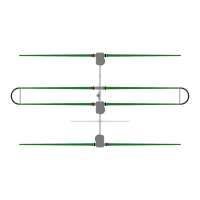
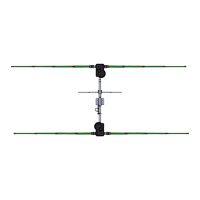
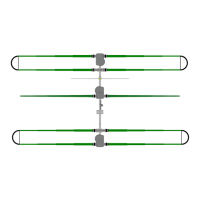
Since SteppIR™ antennas are super-tuned mono-banders they stack very well because there are no
destructive interactions going on. A good distance is anywhere from 32’ to 64’, the best being closer
to the 32’ value. You can also stack them with other non-SteppIR™ antennas and get some reasonably
good results. You must ensure that the “hot” side (center conductor) of the driven elements of all the
antennas in the stack are on the same side or you will get attenuation instead of gain (see Figure 23 ).
If you want a good demonstration of this phenomenon turn one SteppIR™ 180 degrees to the other in
physical direction and run one antenna in the 180 degree reverse mode. You will be amazed at how
much it kills the performance. Stacking them as described will result in excellent performance over the
entire frequency range (except 6M) because stacking distances aren’t that critical, just don’t put them
too close.


 To Next Page
 Loading...