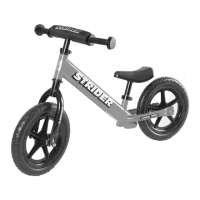
UNIVERSAL OWNER’S MANUAL
www.StriderBikes.com
2
©2019 Strider Sports Int’l, Inc. All Rights Reserved. 11240 A Owner’s Manual
Make sure your child is wearing appropriate attire and safety gear when riding. This includes, but is not
limited to, a helmet, close-toed shoes, and knee and elbow pads.
CHECK THE TIRES
• Use a tire pump with a gauge to make sure your tires are inflated within the recommended pressure
range. Do not exceed the pressure limit as stated on the side of the tire or rim; whichever is lowest.
NOTE: It is better to use a hand or foot pump than a service station pump or an electric compressor. The
latter is more likely to over-inflate, which can cause the tire to blow out.
CHECK THE CABLES
• Make sure all cables and housings are properly secured to the frame or fork so that they cannot
interfere with or get caught on moving parts.
CHECK REFLECTORS, LIGHTS, AND ACCESSORIES
• Check that the reflectors are clean and positioned perpendicular with the rim.
CHECK THE PEDALS
• Make sure your pedals and shoes are clean and free of debris that could affect your grip or interfere
with the pedal system.
• Grab your pedals and crank arm and wiggle to see if there is anything loose. Spin the pedals to make
sure they rotate freely.
CHECK THE BRAKES
• While standing still, make sure you can apply full braking force without the brake lever touching the
handlebar. (If the lever touches, your brakes may need adjustment.)
• Check that the front wheel brake is working properly. Ride the bike at a slow speed and apply the front
wheel brake. The bike should come to an immediate stop.
WARNING: Brake force applied to the front wheel suddenly or too forcefully could lift the rear wheel off
the ground. This could decrease your control and cause you to fall. For best results, apply both
brakes at the same time.
• For lever operated brakes, repeat the process with the rear wheel brake.
• For coaster brakes, start with the back pedal crank slightly higher than horizontal. Apply pressure
downwards on the back pedal. When you move the pedal downward, the brake should engage.
CHECK THE CHAIN
• Make sure your chain has the correct tension so that it can’t fall off. If you’re unsure of the correct
tension, see your bike shop.
• Check that the chain has no kinks, rust, broken pins, plates, or rollers.


 To Next Page