L4
E
Za
E2b
sltion.
The
tape tension balance
must be turned slightly
from lts rest
positlon
ln order
to
swltch
the
capstan
motor on. The
welghted
and
unwelghted signal-to-nolse
ratio
should
be within
spe-
clficatlon
(
see
"Technlcal
Detalls"
)
Alignment
of
Record Channel
Once
the
playback
channel has been aligned
to withln speclfication,
the
gain
and
frequency
re-
sponse
of the
record chain can be set up.
the
procedure
ls as
follows:
Alignment
of
Record Head Azlmuth
-
Load the machine
wlth
a blank
tape.
Select
the tape speed
15
ips
and switch into
"
record"
-
Feed a
10
or
72 kc/s signal from the signal
generator
to the inputs of channels I
and
4
at a
Ievel of
-10
db
(measured
at
the output of
the
playback
amplifier)
-
measure the replay
voltages of channels I and
4
by
means
of 2
WVMs.
The azimuth
of
the record head 1s
adjusted
by
means
of
the
screw
C
(
fig.
6
)
for
maximum voltage
on
both
channels as descrlbed
under E la for the
playback
head.
It should
be remembered that
there is
a
certaln delay
between the
adjustment
of
the screw C and
the re-action
on the
VTVMS
due to the dlstance between
the record ans replay heads. It
is therefore advlsable to
turn the
azlmuth adJustlng
screw very slowly,
Settlng
the
Bias LeveI
The
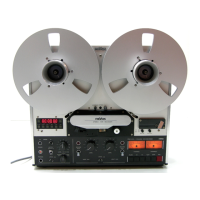
STUDER
J-37
is set at
the factory
for the
correct
bias level
for the tapes
AGFA
PER or BASF
LGR which are
preferred
tapes in
European recording studlos '
It
is recommended
to repeat the blas adjustment
for optlmum results
wlth the type of tape that is
golng
to be used.
It ls essentlal
that the
allgnments
descrlbed above
have been completed
before
setting
the bias
level,
The bias level affects both
the high frequency
response
and
the distortion
produced
on the tape.
The followlng
method of
adrustment
will
give
a sultable compromise
between these two
factors.
If
specialtapesaregoingtobeusedsuchashlghoutputtapes
(AGFAPER555,
SCOTCH722) a
dlfferent setting
up
procedure
may be used and
thls will depend on
whether
a
low distortlon, or
a
hlgh modulation
level
and
therefore lncreased signal-to-noise
ratio
are
primary
requlrements. As
these are
very speclal
requlrements, the relevant technlques
wlll not be described any further,
The
Normal Settlng Up Procedure
for the Bias Level ls as Follows:
Load blank tape. Select deslred
tape
speed
and switch
to
"record".
Set the slgnal
generator
to
1000 c/s
f.or
15 lps
or to 333 c,/s f.or 7 L/2 lps at a
level of l0 db below reference level and connect
to lnput.
Measure
the output level of the
playback
ampllfier
by means of a VTVM.
Loosen the lock nuts of the
pre-set potentlometers
for
the bias level
whlch
are
mounted on the front of the osclllator section
(
see
fig, ll
)
and
turn the
potentio-
meters
fully
antl-clockwlse, Flgure
Il
shows
whlch
potentlometer
belongs to which
channel at
elther
speed.
Their
settings
do not lnfluence
each other.
At 7 L/2 ips the blas should be lncreased by turnlng
the
potentlometer
clockwise


 To Next Page
 Loading...