(not only Synth Sounds) making possible to edit the starting sound, as an example make a Strings
sound mellower or an Electric Piano sound emphasized at the Cutoff Frequency with the addition
or a certain level of Resonance. As mentioned before, with some setting of the Cutoff + Resonance
you might have to re-balance the part Volume, to avoid clippings of unwanted side-effects, unless
you want to reach a certain sound that could also include some clipping as a desired effect.
Filter and Amplitude Envelope
A typical Synthesizer section is made of controls named ADSR (Attack, Decay, Sustain, Release)
and they are normally duplicated for the FILTER and the AMPLITUDE controlled sections.
The simplified available parameters are a sub-set of these controls, selected from the ones more
effective in the instrument’s SYNTH engine sound generation.
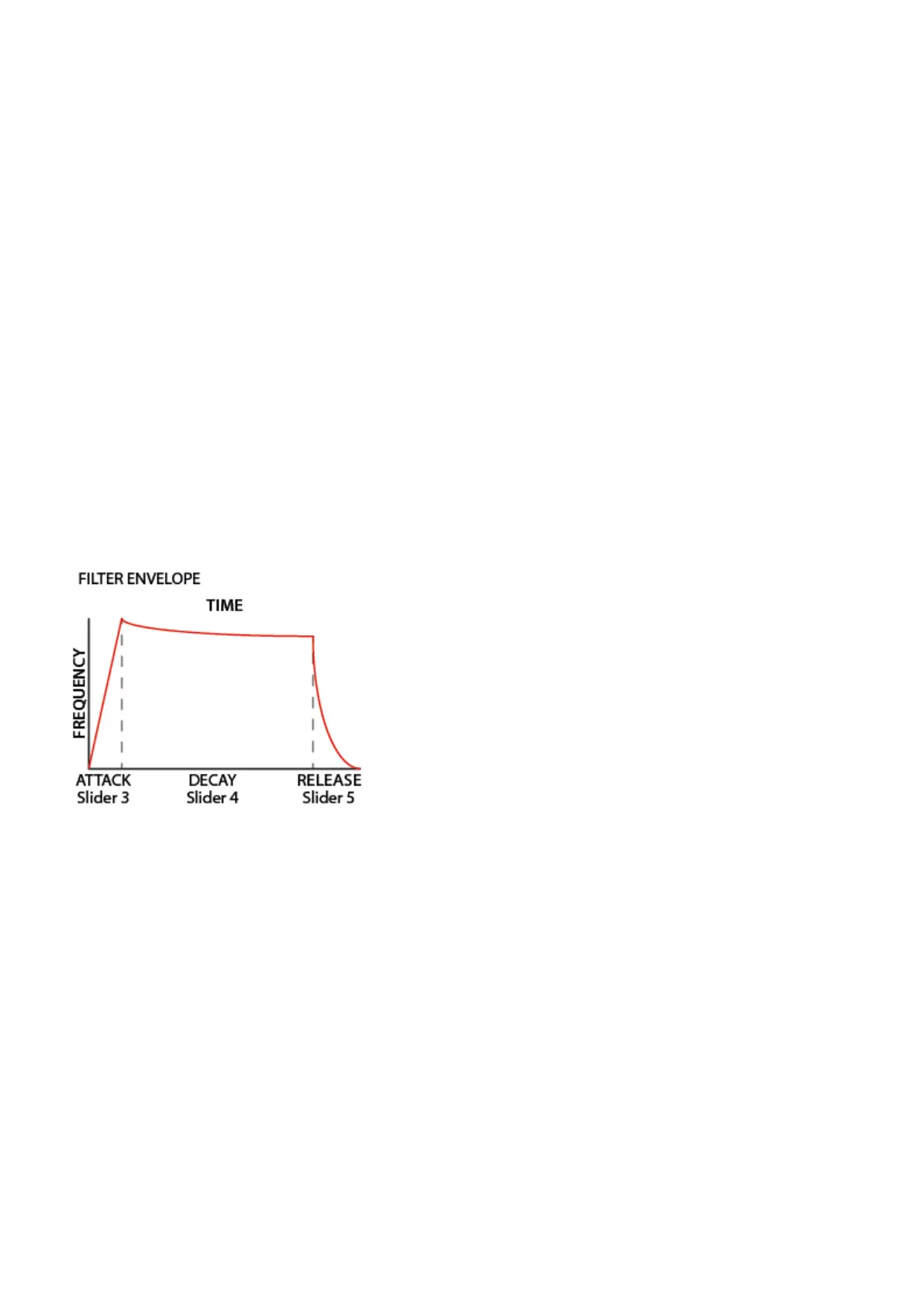
The ATTACK Slider controls the time that the FILTER needs to reach the desired CUTOFF starting
The DECAY Slider controls the time that the FILTER needs to reach the final CUTOFF frequency,
when the keys are kept played.
As a simplified setting, the DECAY also effects the SUSTAIN Level (a parameter not listed within
the nine Sliders) and a long DECAY time will also simulate the final Cutoff Frequency almost
identical to the starting frequency: the sound will not change after the ATTACK, while keeping the
note played, or it will change very slowly.
The RELEASE Slider controls the time needed by the FILTER to reach the final Cutoff when the
The LFO Rate and Speed allow to control the related parameters of the LFO that is internally
assigned to the CUTOFF Frequency; as an example, setting the values in a certain way, while the
Resonance is set to mid-hi levels, could create SOUDS with a kind of looping WOW effect.
This LFO’s destination is the FILTER, while the Modulation (Vibrato etc) is controlled either by
the STICK 2 and the AFTERTOUCH, allowing to select all possible combinations of all settings.
The last two sliders are controlling the ATTACK and DECAY of the AMPLIFIER and they do not
User manual - Numa Compact X SE https://www.studiologic-music.com/support/articles/ncxse_manual/?l...
14 di 32 01/03/2024, 13:41


 To Next Page