This document is an owner's manual for a Summit Wine Cooler, specifically models SWC530BLBIST and SWC182Z. It provides comprehensive instructions for installation, operation, and maintenance, along with important safety information and troubleshooting tips.
Function Description
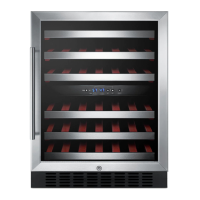
The Summit Wine Cooler is designed for the storage and chilling of wine. It features a dual-zone temperature control system, allowing for different temperature settings in the upper and lower chambers to accommodate various types of wine, such as red, dry/white, and sparkling wines. The appliance maintains a stable internal temperature, crucial for preserving the quality and flavor of wine over time. It is equipped with an internal light for viewing the contents and a control panel for adjusting settings. The unit can be installed as either a free-standing appliance or built-in (fully recessed), offering flexibility in placement. Its cooling system utilizes an eco-friendly hydrocarbon refrigerant (Isobutane R600a), which is CFC- and HFC-free, minimizing environmental impact.
Usage Features
The manual emphasizes several key usage features to ensure optimal performance and user convenience:
- Installation Flexibility: The wine cooler can be used as a free-standing unit or built-in. Specific clearance requirements are provided for both installation types to ensure adequate ventilation and proper operation.
- Leveling: The appliance includes front leveling legs, which are essential for proper functioning and stability. Users are instructed to adjust these legs to ensure the unit is level.
- Door Swing Reversal: A notable feature is the ability to reverse the door swing from left to right, or vice versa. Detailed, step-by-step instructions are provided, including the necessary hardware pieces (top left hinge and bottom left hinge) found in a plastic bag inside the appliance. This allows users to customize the door opening direction to suit their space and preference.
- Temperature Control: The wine cooler offers precise temperature control for both its upper and lower zones. The upper zone is adjustable from 5°C to 10°C (41°F to 50°F), and the lower zone from 10°C to 18°C (50°F to 64°F). Users can set the desired temperature using dedicated "Left" and "Right" arrow buttons, with each press adjusting the temperature by 1 degree. The set temperature flashes for approximately 5 seconds before reverting to display the internal temperature.
- Temperature Display Conversion: The unit can display temperatures in either Celsius or Fahrenheit. A simple button combination (pressing and holding both the "Left" arrow and "LIGHT" buttons simultaneously for about 3 seconds) allows users to switch between these scales.
- ON/OFF Power: The appliance is turned on or off by pressing and holding the "ON/OFF" button for 3 seconds.
- Control Panel Lock: To prevent accidental changes to settings, the control panel can be locked by pressing and holding the "LOCK" button for 3 seconds. Pressing it again unlocks the panel.
- Interior Light: The interior light can be toggled ON or OFF using the "LIGHT" button. For optimal wine storage, it is recommended to keep the light off except when viewing the contents, as the light can affect cabinet temperature. The light also turns off automatically after 10 minutes if left on.
- Ambient Temperature Considerations: The manual specifies an optimal ambient temperature range of 16°C to 35°C (61°F to 95°F) for the appliance to perform correctly. Extreme ambient temperatures outside this range can impact the unit's performance and cause internal temperature fluctuations.
- Power Failure Protocol: In the event of a power failure, the unit requires a 3 to 5-minute delay before restarting to protect the compressor. This built-in time delay prevents immediate restarts that could damage the appliance.
- Condensation Management: The manual addresses the possibility of condensation on the glass door, explaining that it occurs when water vapor in the air contacts the cold surface. This is a normal phenomenon, especially in humid environments.
- Compressor Protection: The control system includes a feature that prevents the compressor from restarting immediately if the appliance has been off for less than 5 minutes, further protecting the compressor from damage.
Maintenance Features
The manual outlines essential maintenance procedures to ensure the longevity and efficient operation of the wine cooler:
- Cleaning: Regular cleaning is recommended for both the interior and exterior surfaces.
- Interior: The interior surfaces, including shelves and racks, should be cleaned with a solution of warm water and baking soda (approximately 2 tablespoons per quart of water). Care must be taken to wring out excess water from sponges or cloths when cleaning near electrical parts or controls.
- Exterior: The exterior should be cleaned with a warm solution of mild liquid detergent, rinsed well, and wiped dry with a clean, soft cloth. For stainless steel surfaces, routine cleaning involves warm water and a cloth, wiping in the direction of the brush lines to prevent water spots. A mild detergent can be used for more intensive cleaning, followed by thorough rinsing.
- Defrosting: The appliance features an automatic defrosting system. Approximately every 8 hours, the compressor temporarily stops for about 30 minutes, allowing any accumulated frost to melt. The defrost water is collected in an evaporating tray above the compressor and automatically evaporates. During this process, the internal temperature may temporarily rise above the set point.
- Vacation Care: For vacations lasting less than three weeks, the appliance can be left operating. For extended periods, it is advised to turn off the unit and leave the door slightly ajar to prevent odor buildup.
- Transporting the Appliance: If the wine cooler needs to be moved after its original packaging has been discarded, specific steps should be followed:
- Securely tape down all loose items, such as shelves, inside the unit.
- Turn the adjustable legs up to the base to prevent damage.
- Tape the door shut.
- Ensure the appliance remains in an upright position during transportation and protect its exterior with a blanket or similar item.
- Energy-Saving Tips: To minimize energy consumption, the manual suggests placing the appliance in the coolest area of the room, away from heat-producing appliances and direct sunlight.
The manual also includes a "Troubleshooting Guide" to help users diagnose and resolve common issues, such as the appliance not operating, not cooling sufficiently, cycling on and off frequently, or making excessive noise. It clarifies that some noises, like gurgling sounds from refrigerant flow or popping/crackling from internal wall expansion, are normal. The document concludes with a "Limited Warranty" section, detailing the coverage for parts and labor, compressor, and exclusions, along with a California CARB/SNAP Disclosure regarding refrigerant use.


 To Next Page
 General