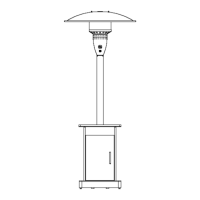
This document is a Use and Care Guide for a Patio Heater, model A306006403. It provides comprehensive instructions for assembly, operation, safety, maintenance, and troubleshooting of the device.
Function Description:
The Patio Heater is an outdoor infrared gas-fired appliance designed to provide heat in outdoor spaces. It operates using LP (liquefied propane) bottled gas and is intended for outdoor use only. The heater features a burner head, a reflector to direct heat, and a control knob for adjusting the flame intensity. It also incorporates safety features such as a flame failure and tilt device, which automatically cuts off the gas supply if the flame goes out or the unit tips over.
Important Technical Specifications:
- Overall Height: Approximately 88 inches
- Overall Weight: 35.2 lbs
- Overall Width: 30 inches
- Heater Heat Input (-Qn): 47,000 Btu/h
- Heater Gas Consumption: 1.77 Lbs per hour
- Heater Injector Size: 0.0778 inches
- Setting Pressure: 11.0 inches per W.C
- Regulator Outlet Pressure: 11.0 inches per W.C
- Standard: ANSI Z83.26-2014 Gas Fired Outdoor infrared Patio heaters
- Gas Supply Pressure: Max. 150 PSI, MIN.5 PSI
- Fuel Type: LP bottled gas only (20 lb gas cylinder)
Usage Features:
- Outdoor Use Only: The heater is strictly for outdoor use on a flat, level, non-flammable surface or ground. It must not be used indoors, in enclosed areas, or below ground level.
- Clearance Requirements: Maintain a minimum distance of 40 inches (1 meter) from flammable items or structures on all sides and above. The reflector should not be within 36 inches (91 cm) of any flammable structure or surface.
- Ignition Procedure:
- Turn on the valve on the gas supply cylinder.
- Press and turn the variable control knob to the 'HI' position.
- Press down the variable control knob and hold for 30 seconds.
- While holding down the variable control knob, press the igniter button several times until the burner head flame ignites.
- Release the variable control knob 10 seconds after ignition.
- For new tanks, allow at least one minute for air to purge from the gas pipeline.
- Flame can be observed through the viewing hole on the base.
- Adjust the variable control knob to 'LO' for 5 minutes before setting to the desired temperature.
- Extinguishing Procedure:
- Turn the control knob clockwise to the 'OFF' position.
- Close the cylinder valve on the propane gas tank if not in use for a long time.
- Flame Characteristics: When lit for the first time, a slight odor and smoke may be emitted, which is normal and temporary. The emitter screen will become bright red. Flame patterns should be blue, not yellow, as yellow flames indicate an obstruction of airflow.
- Safety Features:
- Flame Failure and Tilt Device: Automatically cuts off gas supply if the flame blows out or the unit tips over. If this occurs, set knobs to 'OFF' and wait 5 minutes before re-lighting to allow gas to dissipate.
- Leak Testing: Essential before first use, annually, or after storage/parts replacement. Use a soap and water solution on all connections; bubbles indicate a leak. NEVER use an open flame for leak testing.
- Cylinder Positioning: Always keep the cylinder level and vertical when positioning inside the base.
- Windy Conditions: In high winds, store the unit away or ensure it is at a safe distance from other items. Do not leave the heat focusing reflector in the tilt position during rain or windy conditions; always position it in the full down position when not in use or unattended.
- Assembly: The manual provides detailed, step-by-step instructions for assembling the heater, including attaching the wheel assembly, ground fixtures, support legs, post support, tank housing, reflector studs, reflector, head assembly, post, and finally, placing the gas cylinder and attaching the regulator.
Maintenance Features:
- Regular Cleaning: Clean the patio heater regularly between uses and especially after extended periods of storage.
- Cool Down Before Cleaning: Ensure the heater control is fully off, the gas supply is shut off, and the heater and its components are sufficiently cool before cleaning. Never douse the heater with water when hot.
- Burner Inspection: Visually inspect the burner for obstructions and keep the tank enclosure free from debris. Use a soft brush for mild stains, dirt, and soil after the burner has cooled.
- Screw and Bolt Connections: All screws and bolts should be checked and tightened on a regular basis.
- Storage:
- Do not leave the heater exposed to outside weather or in damp, moist conditions.
- For long-term storage, the reflector can be removed, taking care not to damage or deform it.
- If storing indoors, the gas bottle must be disconnected and left outside in a dry, well-ventilated area, away from heat or ignition sources.
- Do not let children tamper with the bottle.
- Always place a lid or protective cover on the heating item when not in use.
- Hose Inspection: Regularly check that the regulator seal and hose are fitted and in good condition. Replace parts if necessary. Do not use the heating unit without inspecting the gas hose for signs of wear or abrasion.
- Servicing: Recommended after every 100 hours of use or annually, whichever comes first. Contact a local authorized agent or qualified gas technician for maintenance, repairs, or replacement parts. Spare parts can be obtained from Hampton Bay Customer Service.
- Avoid Harsh Chemicals: Permanent damage may occur if powder or solvent comes into contact with painted or plastic components.
- Direct Sunlight: Keep the heating unit stored away from direct sunlight.
- Approved Parts: Only use manufacturer-approved or supplied parts/accessories to avoid voiding the warranty.

 Need help?
 General

 To Next Page