Backside shading
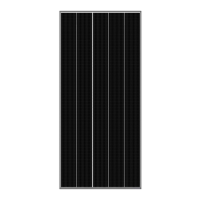
The design of the racking system—the quantity, placement,
and size of rails—is a common source of rear-side shading in
bifacial panels. Albedo is the primary factor that impacts
bifacial gain. Based on experiments run at SunPower
Corporation’s Davis, California R&D lab, it was shown that
while a higher albedo does produce higher bifacial gain, the
rear irradiance shading impact increases as well.
6
This can
cause rear side shading of certain tracker elements to
increase due to a larger difference in irradiation between
rear-side areas without shade versus those shaded by the
racking system. As the albedo decreases, the shading impact
on bifacial gain becomes insignificant. Once again, as with
front-side shading, the unique parallel circuitry architecture
of the SunPower Performance panel minimises the impact of
shading. It is suggested that developers contact their tracker
OEM for additional information.
Electrical architecture dissipates effects of hotspots
Cell cracks, shading and soiling increase stress on the panel,
and can lead to encapsulant browning, backsheet
embrittlement, diode failure, and most importantly, hotspots.
While hotspots initially reduce panel output, they represent a
significant reliability risk to long-term system operation.
Hotspots occur when a portion of a panel, usually a single
cell or a spot on a cell, has reduced performance and no
longer produces enough current to match neighbouring
cells. The solar cell then operates in reverse, consuming
power from its neighbours and converting it to heat. The
weakest spot on the cell becomes a resistive load, and the
cell temperature increases. This effect can be caused by a
single event, such as a cell crack, or by regular events such as
daily shadows from nearby objects.
In a conventional panel, all of the current must go through
the affected cell. The heat dissipation in the weak cell, or
hotspot, can be described by P = I * V where the current (Isc)
of the panel is available, often as much as 11-18A in panels
using larger 182mm and 210mm cells. In the case of panels
using larger wafers and full cells, the higher cell current
increases the heat dissipation. Slicing the cell in half, reduces
the current by half—while slicing the cell into smaller strips,
such as the SunPower Performance panel, further decreases
current.
Independent research has shown that hotspot temperatures
are positively correlated with the panel current, meaning
higher current panels generate higher hotspot
temperatures.
7
As larger cells enter the market, it is
becoming imperative that manufacturers adopt some form
of cell slicing to mitigate the impact of hotspots. In the case
of a full cell panel with a current of 13A and negative bias of
15V, the cell could generate upwards of 195W of heat energy
from a single hotspot, which can translate into temperatures
well above 150 °C, enough to cause permanent damage to
the encapsulant and backsheet. It’s worth noting here that
some panel manufacturers are beginning to include
exclusions in their warranties for panels affected by shading.


 To Next Page
 Loading...