Parallel circuitry mitigates the effects of shading and soiling
Landscape orientation (panel)
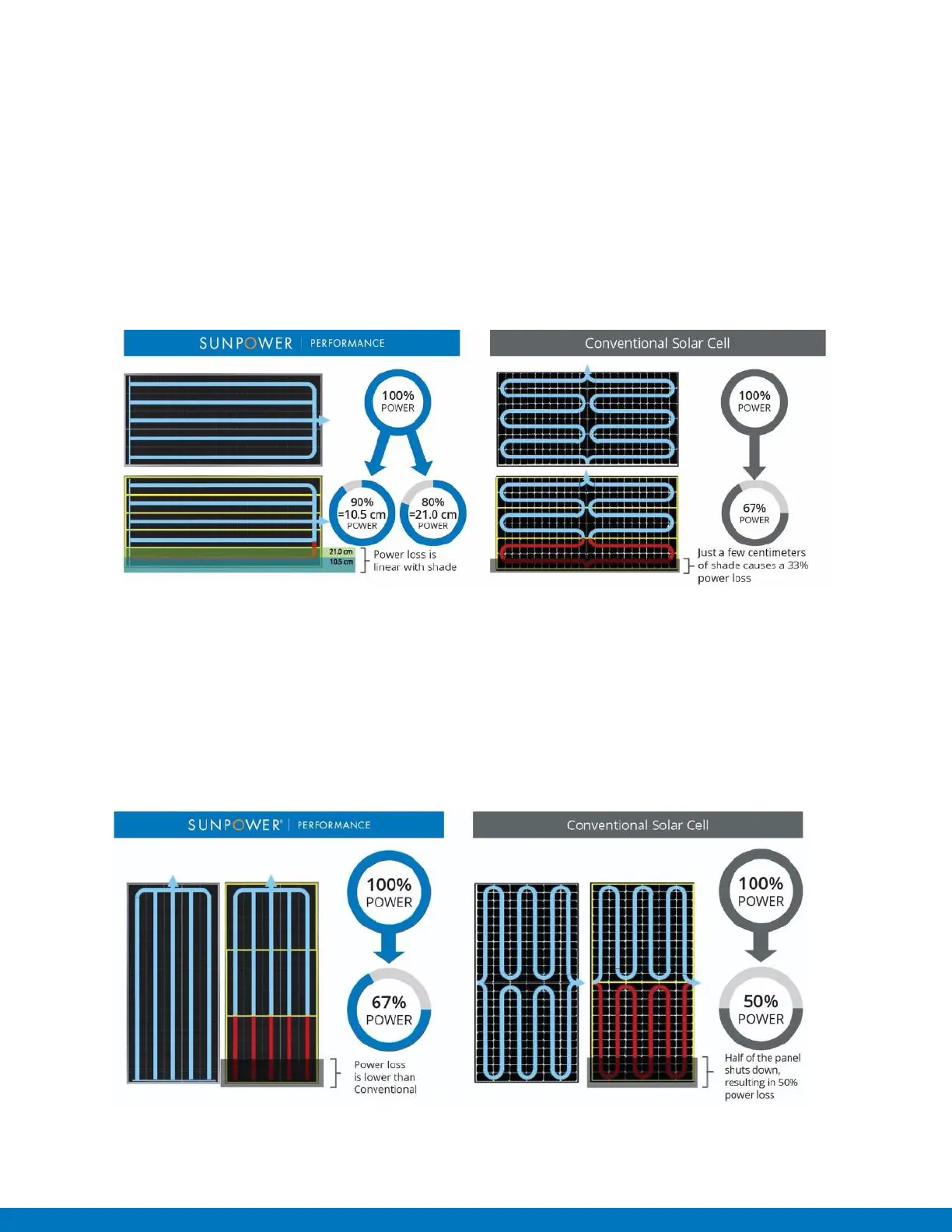
The unique parallel cell architecture (hypercell) of the
SunPower Performance panel ensures optimal performance
against shading in landscape-orientation (figure 7). When
the bottom of the panel encounters inter-row shade or
soiling, the panel loses power in proportion to the amount of
shade covering the hypercell. In a scenario where an entire
hypercell of a 5-hypercell panel is shaded, only 1/5 of panel
power is lost, without activation of the bypass diodes.
In comparison, current flows through conventional panels in
a continuous, serial circuit. Any obstruction to this flow, can
have detrimental effects on panel operation. Therefore, the
panel is typically partitioned into three distinct electrical
zones, allowing the panel to bypass obstructions to energy
flow should one occur. A linear shadow cast along the
bottom of the conventional panel forces one of the bypass
diodes to activate, resulting in a 33% power loss.
Figure 7: The parallel cell architecture of the SunPower Performance panel minimises power loss from shading and soiling in landscape
orientation.
Portrait orientation (panel)
Should the SunPower Performance panel be installed in a
portrait orientation, its shading performance still surpasses
that of conventional panels (figure 8). The bypass diodes of
the Performance panel are arranged horizontally. When the
bottom row cells are shaded in portrait orientation, one of
the bypass diodes will activate. In this situation, energy flow
is re-routed through the top 2/3 of the panel, resulting in a
33% power loss. For this reason it is recommended that
Performance panels be installed in landscape orientation
where possible to maximise energy output.
For conventional panels positioned in portrait orientation,
the bypass diodes split the panel in half. Shading the bottom
portion of the conventional panel will result in 50% power
loss.
Figure 8: The SunPower Performance panel outperforms conventional panels when shaded in portrait orientation.


 To Next Page
 Loading...