12 Instructions for use and maintenance
EN
Section IV, or upon connecting the plug to the
electrical contact (in the case of an extension
cable with plug).
2. Water heaters with electromechanical control
Fig. 2 where:
1 - Moisture-proof button for heater switching
(for models with a switch)
2 -Regulator handle (only for models with
adjustable thermostat).
Electrical switch with one knob:
0 – switched o;
I – switched on;
The knob indicates the state (the mode) in
which the appliance is placed: it is lit when
the water is being heated and is switched o
when the specied by the thermostat water
temperature level is reached.
Electrical switch with two knobs:
0 - switched o;
I; II- switched on;
Choosing of dierent power levels of heating:
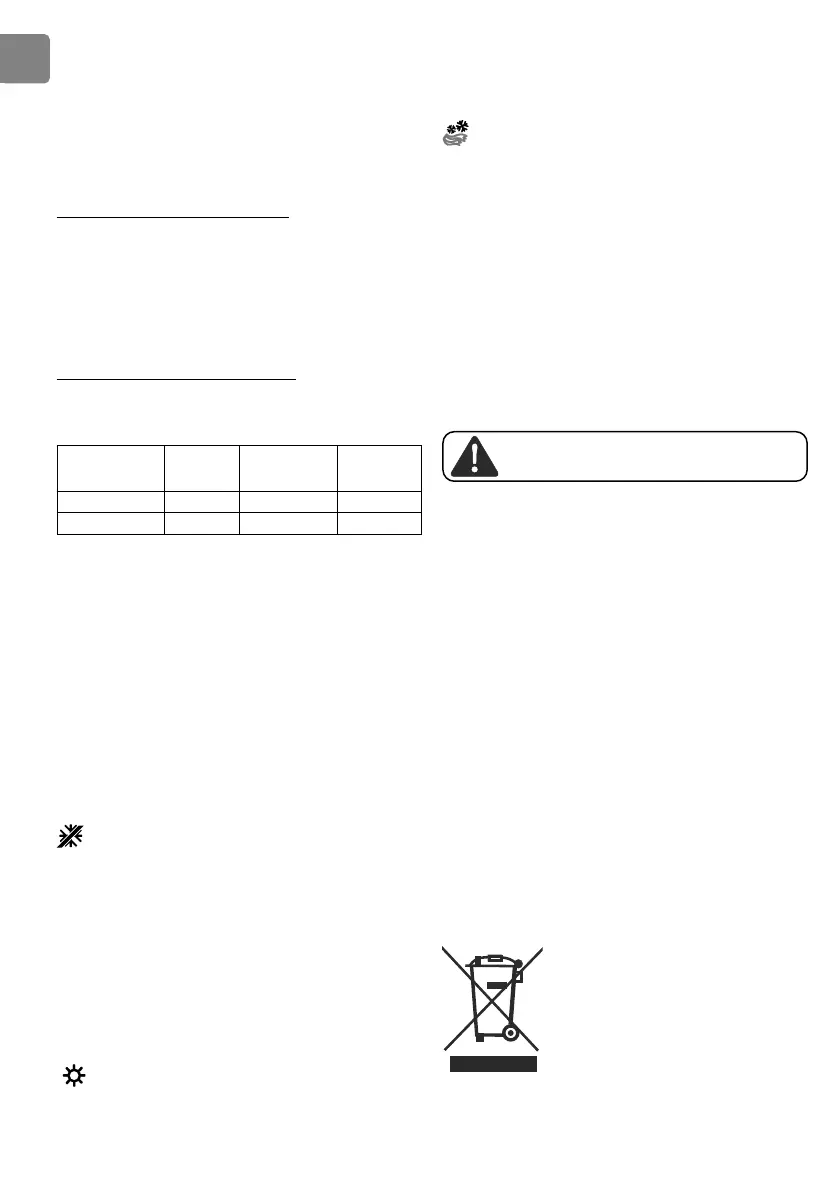
Rated power
(marked on the
rating label)
Switched
on knob (I)
Switched on
knob (II)
Switched on
knob I and II
1600 W 800 W 800 W 1600 W
2400 W 1200 W 1200 W 2400 W
The buttons of the switch lit on, if they are
switched on and during heating. They stops to
lit when the preset temperature of the water
is reached and the thermostat switch-o the
voltage supply.
•
Temperature setup (for models with
adjustable thermostat):
This setup allows the gradual setting of the
desired temperature, achieved by using a
handle on the control panel.
•
Operation mode selection for models
displayed on Fig.2 :
Four positions indicate dierent operation
modes of the device:
ANTI-FREEZE MODE.
With this setup the device maintains
temperature that does not allow the water
freeze in it. The electrical supply of the
appliance should be turned on and so must be
the appliance. The safety valve and the pipe
between the valve and the appliance must be
protected from freezing. In case that for some
reason the electrical supply is cut o, there is a
risk of freezing of the water in the water tank.
For this reason we recommend draining the
water out of the appliance before long absences
(longer than a week).
SUMMER MODE.
This setup is suitable for the summer season.
And is characterized with lower maximum
temperatures for heating the waters secures an
economic working regime for the appliance.
e ENERGYSAVE MODE.
At this mode, water temperature reaches up to
approximately 60°С. Heat losses are reduced in
this way.
WINTER MODE.
This setup is suitable for the winter season and is
characterized with high maximum temperatures
for heating the water in the appliance. This
mode secures maximum quantity of water with
comfortable temperature.
Fig. 2 indicates the direction of rotation of the
knob for the models with externally adjustable
thermostat.
3. Protection according to the temperature
(valid for all models).
The appliance is equipped with a special facility
(thermal circuit-breaker) for protection against
over-heating of the water, which is switching o
the heater from the electricity network, when the
temperature reaches too high values.
When this device operates, it does not self-reset and the
appliance will not work. Please call an authorized service for
solving the problem.
VII. PERIODIC MAINTENANCE
Under normal use of the heater, under the
inuence of high temperature, lime scale /the
so-called lime scale layer/ is deposited upon
the heating element’s surface. This worsens the
heat exchange between the heating element
and water. The heating element’s surface
temperature increases along /of boiling water/.
The thermoregulator begins to switch on and
o more frequently. A ‘’deceptive” activation of
the thermal protection is possible. Due to these
facts, the manufacturer recommends preventive
maintenance of your water heater every two
years by an authorized service center or service
base. This protective maintenance must include
cleaning and inspection of the anode protector
(for water heaters with glass-ceramic coating),
which shall be replace with a new one if need
arises.
In order to clean the appliances use a damp
cloth. Do not clean with abrasive or solvent
content detergents. Do not pour water over the
appliance.
THE MANUFACTURER DOES NOT BARE THE
RESPONSIBILITY FOR ALL CONSEQUENCES CAUSED
BY NOT OBEYING THE INSTRUCTIONS, GIVEN HEREBY.
Instructions for protecting the
environment
Old electric appliances contain
precious materials and thus
should not be thrown together
with the household litter. We
kindly ask you make your active
contribution for protecting the
resources and the environment
by handing over the appliance in the authorized
buy-back stations (if such exist).



 To Next Page
 Loading...