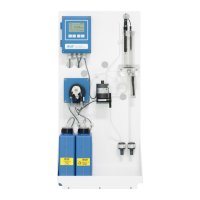
The provided document is an Operator's Manual for the SWAN AMI Sodium P analytical instrument, with firmware V6.22 and higher. The manual's ID is A-96.250.211 / 171121.
Function Description
The AMI Sodium P is an analytical instrument designed for sodium measurement in high-purity water applications. Its primary function is quality control, monitoring breakthrough of mixed-bed ion exchangers, detecting condenser leaks, and preventing caustic corrosion in turbines. It is specifically suitable for samples with a pH value greater than 7. For samples with a pH lower than 7, the AMI Sodium A is recommended.
The instrument operates based on a potentiometric measuring method, utilizing a proven sodium ion-sensitive glass electrode and a reference electrode. The electrical potential difference between these electrodes is used to calculate the sodium concentration. According to Nernst's Law, ion concentration is temperature-dependent, so a temperature sensor measures the sample temperature. The measured value is then expressed for a standard temperature of 25 °C using programmed temperature compensation curves.
For sodium measurements below 1 ppb, a special glass formulation is used for the sensing electrode response. Ammonium and pH interferences from unconditioned samples are eliminated by a suitable reagent, typically Diisopropylamine (DIPA). The sample is conditioned to a minimum pH of 10.5 to achieve a measuring limit of 0.1 ppb sodium while maintaining sample integrity.
The fluidic system involves the sample flowing into a constant head, then through a flow regulating valve into the measuring chamber where the sodium electrode is located. Subsequently, it flows into a second chamber containing the pH electrode, temperature sensor, and reference electrode, before exiting through the sample outlet. During online operation, reagent-saturated air is drawn into a reaction tube, raising the sample pH and forming a regular stream of air bubbles. A bubble detector monitors this stream to ensure correct sample flow. An inconsistent bubble formation triggers a system error.
An optional automatic regeneration module allows for automated etching (regeneration) of the sodium sensor at configurable intervals. The instrument also supports a second sample stream option for measuring two different streams, and can be connected to an AMI Sample Sequencer to measure up to six sample streams.
Important Technical Specifications
Power Supply:
- AC variant: 100–240 VAC (± 10%), 50/60 Hz (± 5%)
- DC variant: 10–36 VDC
- Power consumption: Max. 35 VA
Transmitter Specifications:
- Housing: Aluminum, with a protection degree of IP 66 / NEMA 4X
- Ambient temperature: -10 to +50 °C
- Storage and transport: -30 to +85 °C
- Humidity: 10–90% rel., non-condensing
- Display: Backlit LCD, 75 x 45 mm
Sample Requirements:
- pH value: ≥pH 7.0
- Ammonium concentration: <10 ppm
- Flow rate: Min. 100 ml/min.
- Temperature: 5–45 °C (41–113 °F)
- Inlet pressure: 0.3–3 bar (4–43 PSI)
- Outlet pressure: Pressure free
- Note: No oil, no grease, no sand.
On-site Requirements:
- Sample inlet: Tube 4 x 6 mm
- Sample outlet: 1/2” hose nozzle for flexible tube diam. 20x15 mm
Dimensions:
- Standard Panel: Stainless steel, 280 x 850 x 200 mm, 9.0 kg / 19.85 lbs (without sample water)
- Panel with 2nd sample stream: Stainless steel, 400 x 850 x 200 mm, 12.0 kg / 26.5 lbs (without sample water)
- Compact panel version: Stainless steel, 375 x 700 x 200 mm, 9.0 kg / 19.85 lbs (without sample water)
- Screws: 8 mm diameter
Signal Outputs:
- Two programmable potential-free current outputs (0/4 - 20 mA, max. burden 510 Ω) for measured values (scalable, linear, or bilinear) or continuous control.
- An optional third signal output (0/4 - 20 mA) can be operated as a current source or sink.
Relay Contacts:
- Two potential-free contacts programmable as limit switches, controllers, or timers for system cleaning with automatic hold function. Maximum load: 1 A / 250 VAC.
- One potential-free alarm relay contact for summary alarm indication or instrument faults.
Communication Interface (optional):
- USB Interface for logger download.
- RS485 with Fieldbus protocol Modbus or Profibus DP.
- HART interface.
Usage Features
The AMI Sodium P offers a user-friendly interface with a backlit LCD display and four keys for navigation and input: Exit, Down, Up, and Enter. The software structure is organized into main menus: Messages, Diagnostics, Maintenance, Operation, and Installation.
- Operation Menu: Allows users to set limits, alarm values, and other process-related parameters. It can be password-protected for process operators.
- Grab Sample Measurement: The standard bottle holder can be used for grab sample measurements. This temporarily diverts sample flow from the constant head to the grab sample bottle, allowing the instrument to measure the grab sample.
- Channel Selection: If the second sample stream option is installed, the instrument can switch between channels automatically, manually (user-defined), or via fieldbus.
- Programming: All parameters for external devices (interface, recorders, etc.) and instrument operation (limits, alarms, measuring interval) can be programmed.
- Data Logging: Equipped with an internal logger that can store approximately 1500 data records (date, time, alarms, measured value, pH, temperature, flow). Data can be downloaded to a PC via an optional USB stick.
Maintenance Features
Regular maintenance is crucial for the AMI Sodium P's correct operation and longevity. The manual provides a detailed maintenance schedule and instructions for various components.
Maintenance Schedule:
- Weekly or every 2 weeks: Check for regular bubble formation, DIPA bottle fill level, etch the sodium electrode, perform a one-point calibration. If automatic regeneration is installed, check the regeneration solution bottle level.
- Monthly: Check reagent bottle sealing, KCl reservoir level, etch the sodium electrode, perform a two-point calibration, and correct pH measurement if necessary.
- Yearly: Replace the sodium electrode, reference electrode, and pH sensor. Remove deposited iron with soft detergent and rust remover; replace the reaction tube if heavily covered.
- As required: Replace the air filter.
Specific Maintenance Procedures:
- Stopping Operation for Maintenance: Instructions include stopping sample flow, shutting off power, disconnecting and closing reagent and regeneration solution bottles, and emptying the constant head and flow cell.
- Sodium Electrode Maintenance: Emphasizes keeping the sensing glass bulb clean, free of air bubbles, and electrical connectors dry. Includes steps for removal, etching (using SWAN's etching kit), rinsing, and reinstallation. The etching solution has a limited lifespan of 6 months after mixing.
- Reference Electrode Maintenance: Focuses on maintaining a clean ground joint diaphragm and a consistent KCl flow. Instructions cover preparing the KCl bottle, cleaning the diaphragm (especially after long storage), and installation. KCl is corrosive, so care is advised.
- pH Sensor Maintenance: Steps for cleaning the pH sensor, including removal, rinsing, wiping the shaft, and reinstallation. Caution is given against inserting the sensor into acids and storing it dry.
- Solenoid Valve Maintenance (for 2nd Sample Stream and Automatic Regeneration Options): Detailed steps for disassembling, cleaning (using soft detergent), and reassembling the solenoid valve, including membrane replacement. It is crucial not to reuse membranes after opening the valve.
- Flow Cell and Constant Head Maintenance: Acrylic glass parts are fragile and scratch-sensitive. Cleaning should only be done with soft detergent, avoiding organic solvents or scrubbing materials. Rust remover can be used for iron deposits. Instructions cover disassembling, cleaning, and reassembling these components, with a note to grease O-rings with Teflon paste or spray.
- Replacing the Air Filter: Simple steps for removing the old filter and pushing in a new one.
- Preparing Standards: Instructions for preparing sodium standards directly in graduated bottles using a precision pipette and deionized water, ensuring correct concentration programming.
- Calibration: A critical feature, requiring pH calibration before sodium calibration. pH process calibration involves using a high-quality handheld pH meter. Sodium calibration includes etching the electrode and performing one-point or two-point calibrations.
- Tube Replacement: Provides a numbering scheme for the various tubes and instructions for replacing the reaction tube, EPDM seal, and air inlet tube. Special attention is given to light protection sleeves for the bubble detector.
- Longer Stop of Operation: Instructions for preparing the instrument for extended periods of non-use, including draining, filling rubber caps with deionized water or KCl, and proper storage of sensors and bottles.
- Troubleshooting: An error list with descriptions and corrective actions is provided, covering non-fatal errors (alarms) and fatal errors (system interruptions or hardware failures).
- Replacing Fuses: Instructions for safely replacing fuses, emphasizing disconnecting power and using only original SWAN fuses.

 Need help?
 General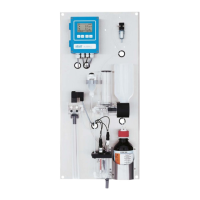

 To Next Page