
 Need help?
Do you have a question about the Tadiran Telecom T208M and is the answer not in the manual?
Explains typographical conventions used in the guide for clarity and consistency.
Lists other relevant manuals and guides for comprehensive understanding.
Details the front view components and layout of the T207M and T207M/NP phones.
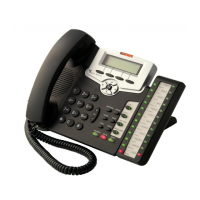
Illustrates the front view of T207M/NP phones with the TEM expansion module.
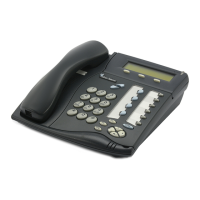
Details the front view components and layout of the T208M and T208M/BL phones.
Illustrates the front view of T208M/BL phones with the TEM expansion module.
Details the various ports and switches located on the bottom of the phone.
Provides views of the phone's bottom and side panels, highlighting key features.
Instructions for placing the phone on a desk at different viewing angles.
Provides instructions and guidance for mounting the phone securely on a wall.
Explains how to use the phone's display panel for information and controls.
Details the functionality and actions of the phone's fixed and navigator keys.
Introduces the basic principles of operating the phone using soft and fixed keys.
Explains how to activate Coral Sea Softswitch telephony features using soft keys.
Details the nine fixed function keys and their system-wide programmable functions.
Explains how to use the phone as a speakerphone for hands-free conversations.
Details how to adjust the volume levels for the speaker and handset.
Explains how to adjust the phone's ring volume and type.
Provides methods for initiating internal and external phone calls.
Outlines methods for answering incoming calls and available options.
Describes features and options available when the phone is in an idle state.
Explains how to handle calls that are returned due to busy, no answer, or errors.
Introduces the array of telephony features available via the Coral Sea Softswitch.
Details the default code used for programming features and its symbol.
Explains how to set the phone to automatically answer incoming calls.
Details options for forwarding incoming calls based on terminal state (all, busy, no answer).
Explains how call groups work and how to call or receive calls from them.
Describes how to view and redial recent outgoing and incoming calls.
Explains how to answer ringing phones in the system or pickup groups.
Allows showing or hiding your phone number on the called party's display.
Outlines choices when another call is waiting while you are engaged in a call.
Explains how to be notified when a busy or unanswered line becomes available.
Details the default code used for canceling features and its symbol.
Covers Meet Me and N-Way conference call procedures.
Allows diverting an incoming call to a programmed destination without interruption.
Blocks incoming calls and allows forwarding to another number when DND is active.
Provides instructions for making emergency calls from the phone.
Explains how to place a call on hold and retrieve it.
Procedure for logging into or out of the phone with user settings.
Introduces the ability to leave and receive messages at stations.
Guides on accessing personal voice messaging systems.
Details Call-through and Callback services for connecting off-site phones.
Explains how to be reached on multiple devices simultaneously.
Allows temporarily turning off the microphone during a conversation.
Allows parking calls into Page Queue destinations for later pickup.
Details how to program user-dedicated keys on the phone and expansion module.
Guides on creating and applying custom labels for programmable buttons.
Allows redialing the last dialed number from the phone.
Enables programming a private directory for speed dialing long numbers.
Covers transferring established and held calls, including screened and unscreened methods.
Details the procedure for establishing a 3-way conference call.
Guides on setting phone parameters like ring type, volume, and time zone.
Overview of system-level parameters for administrators, including network and diagnostics.
Definition of Coral as an IP converged communications platform.
Explanation of the 'Dial' action in the context of the phone's operation.
Definition of an endpoint as a hardware or software that rings when called.
Definition of an extension as an internal telephone or station.
Definition of an external call originating from outside the local network.
Definition of a Hot Station that automatically dials a specified number.
Definition of a soft key as a context-sensitive button on the display panel.
Definition of a station as an internal telephone or extension.
Tone heard when the dialed destination is busy.
Tone indicating another call is waiting while engaged in a call.
Tone heard after lifting the handset from idle.
Tone indicating a denied feature access, misdial, or unavailable destination.
Tone heard when the dialed destination is ringing.
Indicates feature inactivity or idle destination.
Indicates a call is on hold, typically without ringing.
Indicates an active key, or user/call in progress for DSS/line/speaker.
Lists common failure messages, their causes, and recommended solutions.
 General
| Model | T208M |
|---|---|
| Type | IP Phone |
| Lines | 2 |
| Speakerphone | Yes |
| Headset Port | Yes |
| Protocols | SIP |
| Ethernet Ports | 2 |
| Power over Ethernet (PoE) | Yes |
| Supported Codecs | G.711, G.729 |
| Features | Hold, Transfer, Conference, Mute |


 To Next Page
