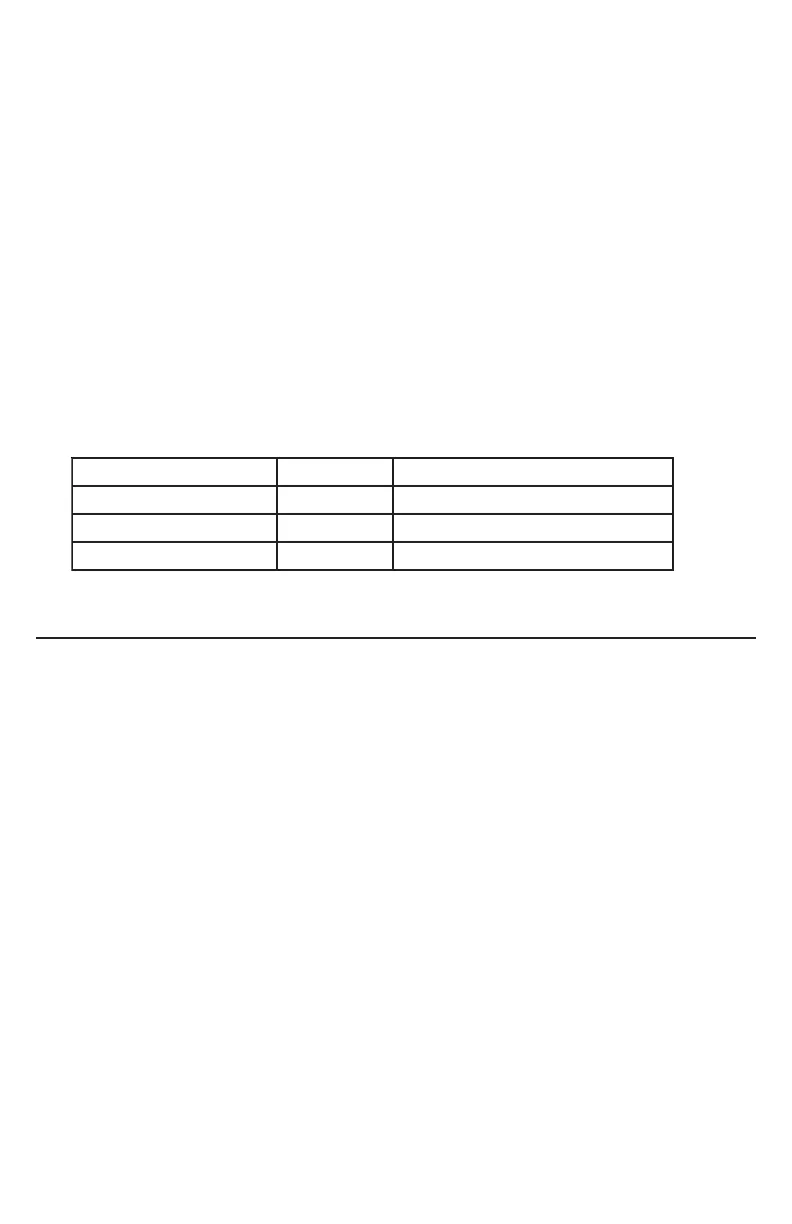
T61622_STI, and T61622_EIR control DIN[0..15], STI[1..0] and EIR groups
respectively.
Examples:
Using I_GPIO_T61622_FLT_EN
Enable DIN group for filtering
igpioctrl(id, I_GPIO_T61622_FLT_EN, T61622_DIN);
Read groups are enabled
igpiostat(id, I_GPIO_T61622_FLT_EN, &fen);
Using I_GPIO_T61622_FLT_TM
Set filtering to 1 us (microsecond)
igpioctrl(id, I_GPIO_T61622_FLT_TM, 1000)
Read the time set for filtering in nanoseconds
igpiostat(id, I_GPIO_T61622_FLT_TM, &ftm)
Important time defines for line filtering (in nanoseconds)
NIM_TLF_22616T03emitgniretlifmuminiM
PTS_TLF_22616T06petsevitceffeerawdraH
TFD_TLF_22616T051toobnodedaoleulaV
XAM_TLF_22616T00351emitgniretlifmumixaM
TAMS 61622 Polarity
This function allows the setting of detailed polarity for DIN, STI0, STI1, and
EIR. The polarity of nineteen lines (DIN[0..15], STI[0..1] and EIR) can be
controlled independently. It enables interrupt control of either rising or falling
edge of a line level transition.
For DIN lines interpretation and implementation of the polarity is identical to the
standard GPIO DIN polarity as described in the SICL manuals.
For the STI and EIR lines, standard GPIO does not provide polarity configuration.
This is a TAMS 61622 extension to the GPIO.
To maintain maximum compatibility with the standard GPIO, the following rules
apply:
♦ For STI and EIR lines, if polarity is set to 0, their behavior is fully compatible
with standard GPIO. If set to 1, polarity is reversed for these lines.
♦ For DIN lines, 61622 extensions allow to set polarity for each line independently.
Setting the DIN polarity with standard GPIO SICL igpioctrl
(id, I_GPIO_POLARITY, setting) is still supported and will cause setting or
clearing of all the DIN polarity lines with a single call. This is
29


 To Next Page