line assuming polarity set to 0, or HI to LO transition if polarity is set to 1 (please
refer to point 3: TAMS 61622 Polarity).
If this function is combined with the TAMS 61622 latching function, then the
interrupt will fire only once. If this is the case, the latched lines need to be
cleared before other interrupts could happen from those lines.
If one or more interrupts occur, the interrupt handler is called with the “reason”
parameter equal to I_INTR_GPIO_T61622 and the “sec” parameter is the mask
of the lines that interrupted.
The mask is always a subset of the following:
T61622_DIN | T61622_STI | T61622_EIR | T61622_RDY
Examples:
Enabling DIN4 line to interrupt
igpioctrl(id, I_GPIO_T61622_INT_EN, T61622_INT_DIN04)
Checking what lines can interrupt
igpiostat(id, I_GPIO_T61622_INT_EN, &int)
TAMS 61622 Pull-up
I_GPIO_T61622_PUL controls if DOUT[0..15], CTL[0..1], PCTL, I/O, and
PRESET lines are pulled up with 4.7k resistors to +5V. There is no control for
individual lines. All lines are controlled at the same time.
Examples:
Turn all pull-ups ON
igpioctrl(id, I_GPIO_T61622_PUL, 1)
Check if pull-ups are on
igpiostat(id, I_GPIO_T61622_PUL, &pull)
Turn pull-ups OFF
igpioctrl(id, I_GPIO_T61622_PUL, 0)
TAMS 61622 Board ID
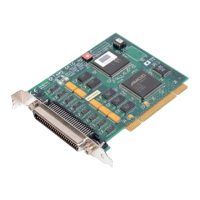
The 61622 is equipped with a rotary switch. This switch is set by the user. The
purpose is identification of each GPIO board on a system with multiple GPIO
cards. This feature is especially useful if multiple boards are residing on a PCI
bridge since some PCI bridges do not provide a reliable way for PCI slot
identification.
This switch has no effect on the GPIO functionality itself.
31


 To Next Page