∑
Storing a program
Up to 32 tracks can be selected from any
discs and played in any desired order.
To store a program, follow the steps listed
below:
O
A program cannot be entered during
PLAY mode.
O
A track number can be entered easily
into a program by using the TRACK
NO.(1~9, 0) buttons instead of the
Ú
or
Æ
buttons.
1. Press the STOP (
∑
) button.
2. Press the DISC NO.(1~5) button to select
a disc number.
3. Press the
Ú
or
Æ
button to select a
track number.
4. Press the PROGRAM button.
The PROGRAM indicator lights.
The TIME display shows “P-01“.
O
If the PROGRAM button is pressed
before a disc number and a track
number are selected, track 1 of the
displayed disc number is entered as
program selection number 1.
O
To enter all of the tracks on a disc, select
the disc number with a DISC NO.(1~5)
button, then press the PROGRAM
button.
The TRACK number display shows “A”.
O
The first program selection is now
stored in the program memory.
5. Repeat steps 2 to 4 to store more tracks
(a maximum of 32 tracks can be stored).
O
If you try to enter more than 32
selections,
the
TIME display shows
“FULL” for about 1 second.
6. Press the STOP (
∑
) button to complete
the programming process.
Otherwise, press the PLAY (
∏
) button
to start disc play.
∑
Changing a program
1. Display the selection to be changed by
pressing the CHECK (or PROGRAM
CHECK) button.
2. Enter a new program selection.
Notes:
O
Track numbers which exceed the
highest track on a disc can be
programmed, but during play these
tracks will be deleted.
O
The time shown in the TIME display may
differ slightly from the time listed in the
literature from the compact disc.
∑
Playing a program
1. Press the PLAY (
∏
) button after
programming.
2. Programmed play starts from the
beginning of the first programmed
track.
O
When programmed play starts, all the
entered track numbers are displayed for
each disc, and the currently playing
track number blinks.
O
When all of the programmed tracks
have been played, the CD changer
stops.
The
∏
indicator goes off.
The PROGRAM indicator remains lit.
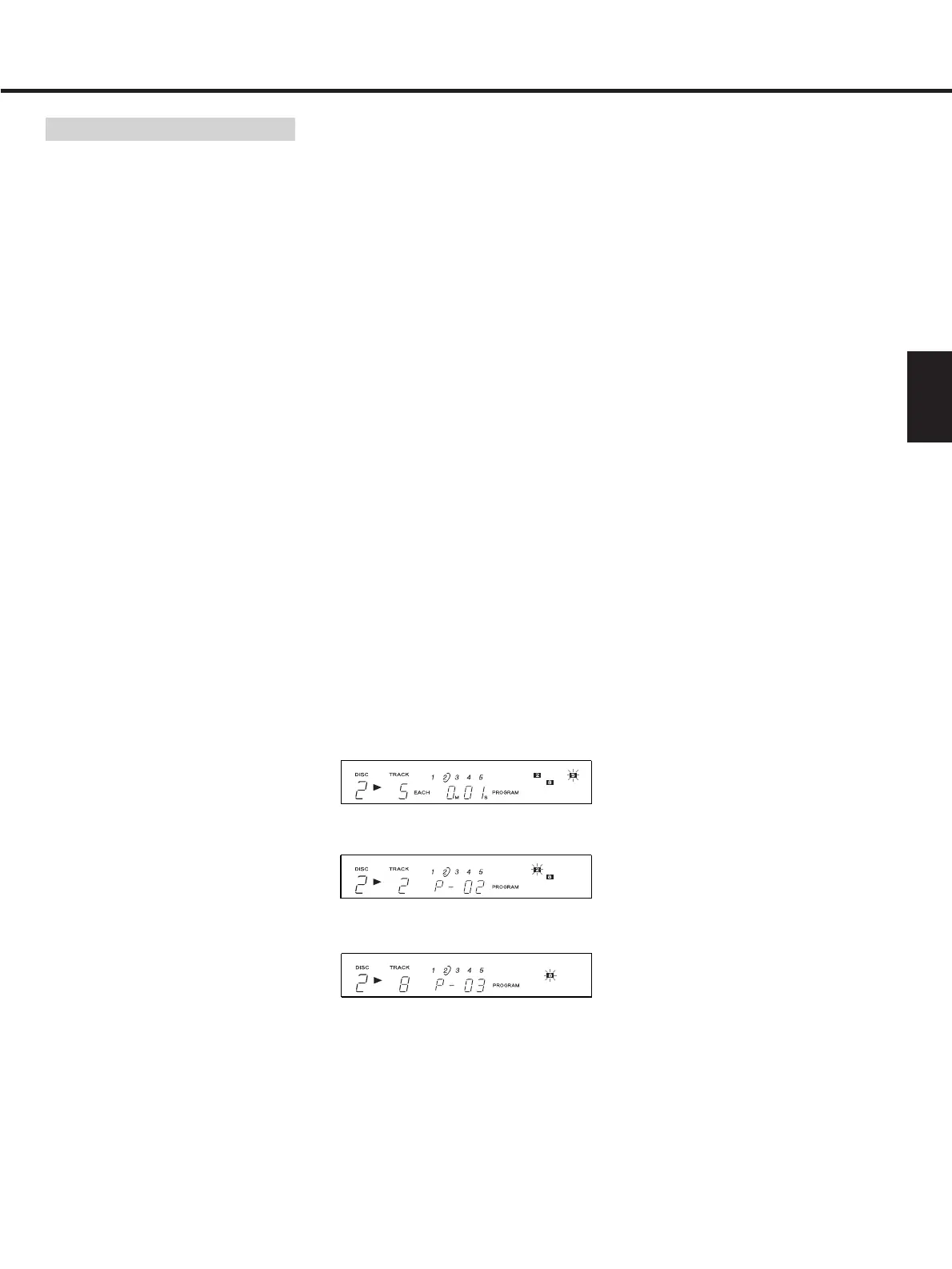
Example:
a) To play track 5, track 2, and track 8 on
disc number 2 in the programmed
sequence.
b) The first programmed track starts to
play.
c) The second programmed track starts to
play.
d) The third programmed track starts to
play.
Notes:
O
Disc and track numbers cannot be
selected during programmed play.
O
The DISC SKIP button cannot be used
during programmed play.
∑
Checking the programmed
contents
The programmed contents can be checked
easily using the CHECK (or PROGRAM
CHECK) button.
1. Press the STOP (
ª
) button.
2. Press the CHECK (or PROGRAM CHECK)
button.
Each time the CHECK (or PROGRAM
CHECK) button is pressed, the TRACK
number and DISC number appear in the
programmed order.
∑
Adding selections to a program
1. To add new selections to a program
after programming, first press the STOP
(
∑
) button.
2. Press the CHECK (or PROGRAM CHECK)
button repeatedly until the last
programmed number lights.
3. Select the DISC/TRACK number.
4. Press the PROGRAM button.
∑
Ending programmed play
1. Press the STOP (
∑
) button to end
programmed play.
2. Press the CLEAR button to clear the
program memory.
The PROGRAM indicator goes off.
O
During programmed play, if the CLEAR
button is pressed, programmed play
ends and normal play continues from
that point.
O
The program memory is also cleared if
the CD changer’s power is switched off.
∑
Directly accessing a track
1. Select a disc number using the DISC
NO.(1~5) buttons.
2. Select a track number using the TRACK
NO.(1~9, 0) buttons and then press the
PLAY (
∏
) button.
O
Track numbers can be designated from
“1” to “99”. When a track number which
is not contained in a disc is designated,
the last track of the disc will be played.
Program and Program Play
– 7 –
ENGLISH


 To Next Page