Patient Seating Guide
Call 0800 9808998 | teal.co.uk v1/21
• Check the chair is suitable for the individual patient (i.e correct seat width, height, depth)
• Ensure the patient’s feet have full contact with the oor
• Ensure regular repositioning whilst in the chair (regular assessments and limit seating time to
less than 2 hours
• Patients at risk of pressure damage: consider the length of time spent sitting in relation to
the patient’s current Waterlow score and level of mobility, as documented in their Pressure
Ulcer Prevention Care Plan
• Balance issues when sitting/other seating issues which cannot be addressed by standard
seating options below - refer to an O.T or Physiotherapist
Call 0800 9808998 | teal.co.uk v1/21 Call 0800 9808998 | teal.co.uk v1/21
Patient+Seating
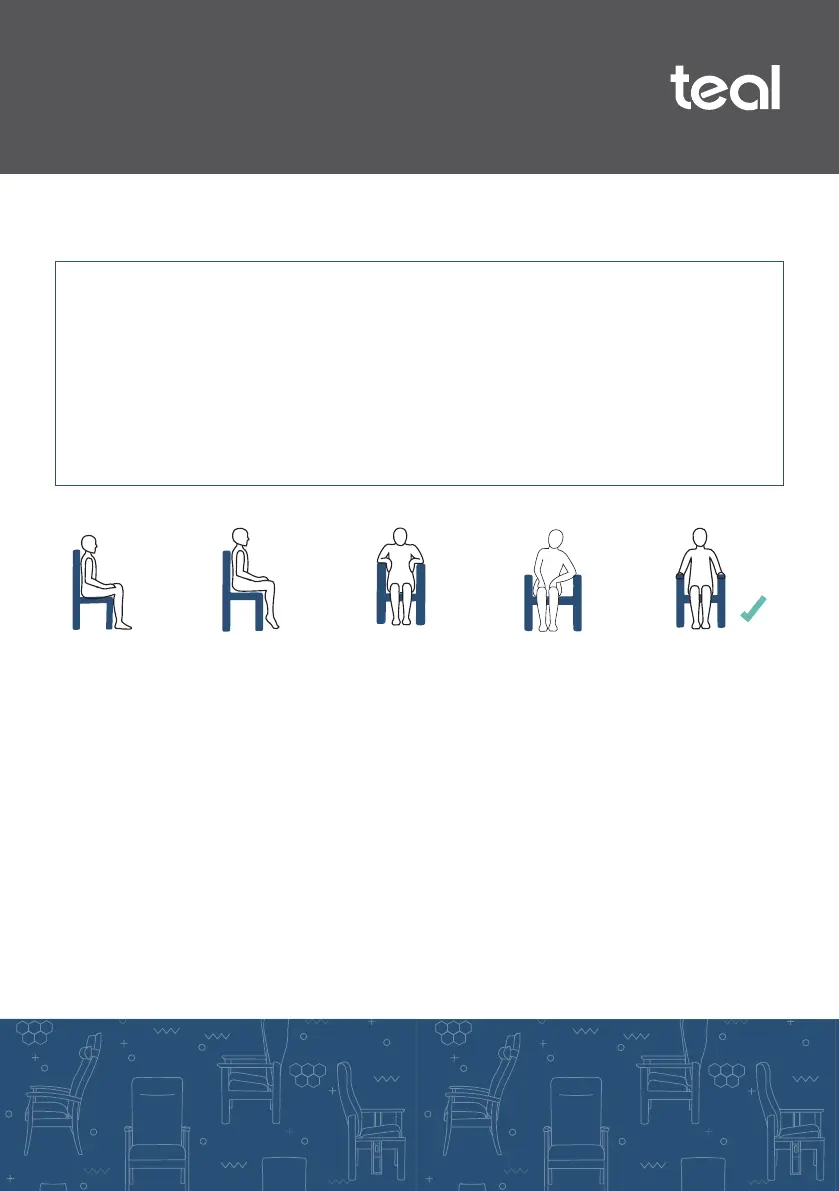
Seat too low
Body weight is
supported on a small
area, leading to high
pressure under the
buttocks and coccyx,
and with resultant
increased heel
pressure. The chair is
dicult to get out of.
Seat too high
Dicult to get in
to the chair with
inadequate support
for feet. Heels at risk
when client moves
forward for comfort.
Armrest too high
Uncomfortable, with
poor
posture and high
pressure
under elbows. May be
dicult to eat and drink.
Seat too wide
No support, leading
to poor posture. No
stability may lead to
xed spinal deformities
with time and pressure
on ischial
tuberosities.
Correct Seating
Good posture and arm
support. A correctly
sized seat provides
good sitting position
and allows the
individual to move in
the seat.
operation+maintenance
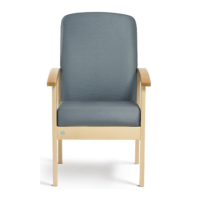
Apollo, Aylesbury, Geo and Perry
All models: 160kg (25st)
Whittle Bariatric
747/747D 254kg (40st)
747X, 747XD, 747XX, 747XXD 320kg (50st)
Maximum User Weights


 To Previous Page
 Loading...