I ofinchk lum -',/
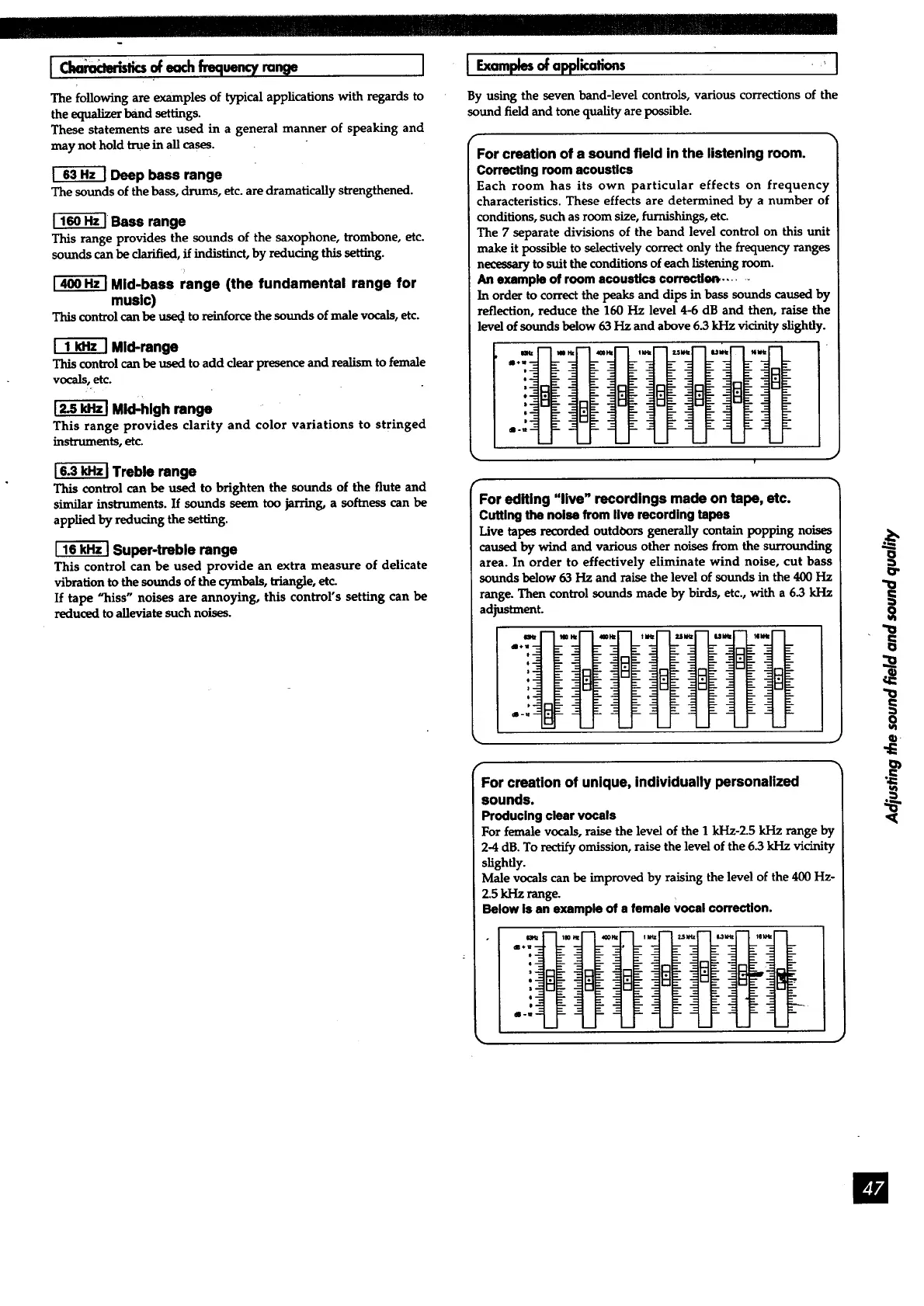
The following are examples of typical applications with regards to
the equalizer band settings.
These statements are used in a general manner of speaking and
may not hold true in all cases.
Deep bass range
The sounds of the bess, drums, etc. are dramatically strengthened.
['T'_'_"] Bass range
This range provides the sounds of the saxophone, trombone, etc.
sounds can be clarified, if indistinct, by reducing this setting.
Mid-bass range (the fundamental range for
music)
This control can be _ to reinforce the sounds of male vocals, etc.
Mid-range
This control can be used to add clear presence and realism to female
vocals, etc.
Mid'high range
This range provides clarity and color variations to stringed
instruments, etc.
1-_ Treble range
This control can be used to brighten the sounds of the flute and
similar instruments. If sounds seem too jarring, a softness can be
applied by reducing the setting.
Super-treble range
This control can be used provide an extra measure of delicate
vibrationtothe sounds of the cymbels, triangle, etc.
If tape "hiss" noises are annoying, this control's setting can be
reduced to alleviate such noises.
I [xamph_ d applications " _' I
By using the seven band-level controls, various corrections of the
sound field and tone quality are possible.
For creation of a sound field in the listening room.
Correcting room acoustics
Each room has its own particular effects on frequency
characteristics. These effects are determined by a number of
conditions, such as room size, furnishings, etc.
The 7 separate divisions of the band level control on this unit
make it possible to selectively correct only the frequency ranges
necessary to suit the conditions of each listening room.
An example of room acoustics correcti_r_ ......
In order to correct the peaksand dips in bass sounds caused by
reflection, reduce the 160 Hz level 4-6 dB and then, raise the
level of sounds below 63 Hz and above 6.3 kHz vicinity slightly.
r
For editing "live" recordings made on tape, etc.
Cutting the noise from live recording tapes
Live tapes recorded outdoors generally contain popping noises
mused by wind and various other noises from the surrounding
area. In order to effectively eliminate wind noise, cut bass
sounds below 63 Hz and raise the level of sounds in the 400 Hz
range. Then control sounds made by birds, etc., with a 63 kHz
adjustment.
r
For creation of unique, individually personalized
sounds.
Producing clear vocals
Forfemale vocals,raise the levelof the I kHz-2.5 kHz range by
2-4 dB. To rectify omission, raise the level of the 6.3 kHz vicinity
slightly.
Male vocals can be improved by raising the level of the 400 Hz-
2.5 kI-hrange.
Below is an example of a female vocal correction.



 To Next Page