
 Need help?
Do you have a question about the Technoline WS6825 and is the answer not in the manual?
Describes automatic and manual DCF signal reception modes.
Instructions to permanently disable radio controlled time function.
How to enable or disable the alarm function.
How to activate the snooze feature when the alarm sounds.
Steps to resolve loss of outdoor temperature data transmission.
The WS6825 is an LED Weather Station with a Radio Controlled Clock and Alarm, designed to provide comprehensive environmental information and timekeeping functionalities. This device serves as a central hub for monitoring indoor and outdoor temperatures, displaying weather forecasts, and offering precise time synchronization through radio control. Its user-friendly interface and various features make it a practical addition to any home or office.
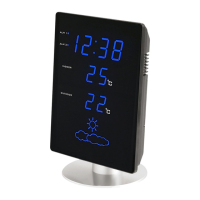
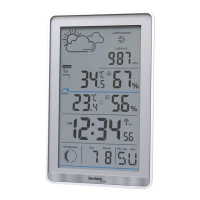
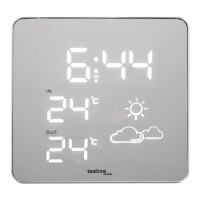
The core function of the WS6825 is to display time, alarm status, and environmental data. The front view of the station clearly shows the current time, indoor temperature, and outdoor temperature. An "ALARM ON" indicator illuminates when the alarm is active, and an "RCC INDICATOR" signifies the status of the radio-controlled time signal reception. The device also provides a weather forecast, represented by intuitive icons, which predicts conditions for the next 6-12 hours based on barometric pressure changes.
The radio-controlled clock feature ensures accurate timekeeping by automatically synchronizing with the DCF signal. This eliminates the need for manual time adjustments and ensures the clock is always precise. The alarm function includes a snooze feature, allowing users to temporarily silence the alarm and get a few extra minutes of rest. The LED display offers adjustable brightness, catering to different lighting conditions and user preferences.
For temperature monitoring, the station utilizes an outdoor temperature sensor that wirelessly transmits data to the main unit. This allows users to keep track of external conditions without having to go outside. The weather forecast, derived from an internal barometer, provides a helpful prediction of upcoming weather, aiding in daily planning.
Setting up the WS6825 is a straightforward process. Users need to place the station and its outdoor sensor next to each other initially. The outdoor sensor requires two AAA batteries, inserted with correct polarity, and its channel selector should be set to position 1. The main station is powered by an AC/DC adapter, which plugs into a standard household outlet, and also requires one CR2032 lithium battery for backup, ensuring time and alarm settings are retained during power outages. Once powered, the station will automatically begin receiving data from the outdoor sensor and attempt to synchronize with the DCF radio signal.
The device offers both automatic and manual reception of the DCF signal. The station attempts automatic reception daily at specific times (1:00, 2:00, 3:00, and subsequent attempts if failed). Users can also initiate manual reception by pressing and holding the "/ WAVE" button. During reception, a flashing icon indicates the process, and a static icon confirms successful synchronization. If reception fails, the icon disappears. The signal strength can be checked by pressing the "/ WAVE" button, which displays the reception mode and signal strength with up to three bars.
Time setting is intuitive. By pressing and holding the "SET" button, users can adjust hours, minutes, and the snooze duration. The device also allows for setting a time zone offset (e.g., GMT +0, GMT +1, GMT +2) once a radio signal is successfully received. The time is displayed in a 24-hour format.
The alarm setting is equally simple. Pressing and holding the "ALM" button allows users to set the desired alarm hours and minutes. A single press of the "ALM" button toggles the alarm on or off, indicated by the "AL" icon on the display. When the alarm sounds, pressing "SNOOZE" temporarily silences it for the set snooze duration. To stop the daily alarm, any button except "SNOOZE" can be pressed.
The dimmer function is controlled by the "SNOOZE / DIMMER" button, allowing users to adjust the brightness of the LED display to their preference.
The weather forecast feature displays one of four icons: Sunny, Sunny & Cloudy, Cloudy, or Rainy. It's important to note that the station requires approximately 24 hours to gather sufficient barometric pressure data to provide an accurate forecast. Moving the station within the house or vicinity can affect the accuracy of the forecast, as it relies on stable barometric pressure readings.
The WS6825 is designed for minimal maintenance. The primary maintenance tasks involve ensuring proper power supply and battery replacement. The main unit operates on an AC/DC adapter, but the CR2032 lithium battery acts as a backup, preserving time and alarm settings during power interruptions. The outdoor sensor requires two AAA batteries, which should be replaced when low to ensure continuous temperature data transmission.
If the outdoor temperature display shows "--", it indicates an interruption or loss of wireless transmission. To resolve this, users should press and hold the "UP/RF" button on the station and then press the "RESET" button on the back of the outdoor transmitter. If the issue persists, relocating the transmitter to a different, dry, and shaded area with fewer obstructions may improve signal transmission. The outdoor transmitter has a limited range, and obstructions like walls, roofs, and thick trees can significantly reduce its effective distance.
In cases where the station displays false digits, which can be caused by electrostatic discharge or interference from other devices, a "RESET" button is located on the back of the station. Pressing this button will reset the station to its default settings for time and calendar and initiate a new radio-controlled time signal reception.
For general care, it is advised not to expose the unit to extreme temperatures, water, or direct sunlight. Contact with corrosive materials should be avoided, and the unit should not be subjected to excessive force, dust, or humidity. Users are also cautioned against opening the inner back case or tampering with any internal components of the unit.
Regarding battery disposal, old batteries should not be discarded with domestic waste due to potential environmental and health hazards. End-users are legally obligated to return used batteries to distributors or designated collection points.
 Operating Environment
| operation temperature | 0°C to +45°C |
|---|---|
| indoor temperature measuring range | 0°C to +50°C |
| outdoor temperature measuring range | -50°C to +70°C |
Temperature Measurement| temperature resolution | 1°C |
|---|---|
| alarm duration | 2 minutes |
| snooze duration | 5 to 60 minutes |




 To Next Page