Section
3-2225
Service
THEORY OF OPERATION
SECTION ORGANIZATION
This section of the manual contains a general
summary of instrument functions followed by a
detailed description of each major circuit. A basic
block diagram, (Figure 9-4), and the schematic
diagrams are located in the tabbed diagrams section
at the back of this manual. They are used to show
the interconnections between parts of the circuitry,
to indicate circuit components, and to identify
interrelationships with the front-panel controls.
circuits are represented by logic symbology and
terminology. Most logic functions are described
using the positive-logic convention. Positive logic is
a system where the more positive of two levels is
the TRUE (or
1)
state; the more negative level is the
FALSE (or
0)
state. In this logic description, the
TRUE state is HI, and the FALSE state is LO. The
specific voltages which constitute a
HI
or a LO state
vary between specific devices. For specific device
characteristics, refer to the manufacturer's data
book.
The schematic diagram number associated with
each description is identified in the text and is shown
on the block diagram. For best understanding of the
circuit being described, refer to the appropriate
schematic diagram and the block diagram.
Linear Devices
IN'TEGRA'TED CIRCUIT DESCRIPTIONS
The operation of individual linear integrated circuit
Digital Logic Conventions
devices in this section use waveforms or other tech-
niques such as voltage measurement and simplified
Digital logic circuits perform many functions within simplified diagrams to illustrate their circuit
the instrument. Functions and operation of the logic
operation.
GENERAL
DESCRIPTION
In the following overall functional description of the position, the ac-coupling capacitor is allowed to
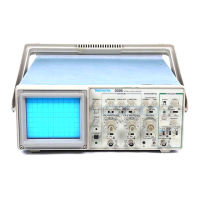
2225
Oscilloscope, refer to the block diagram precharge to the dc level present at the input con-
(Figure 9-4) located in the diagrams section of this nector. This precharging prevents large trace shifts
manual. In Figure 9-4 the numbered diamond of the display when switching from
GhlD to AC
symbol in each major block refers to the appropriate coupling. The Attenuators are switched by the
front-
schematic diagram number. panel VOLTS/DIV switches and scale the applied
signal level to obtain the desired display amplitude.
Vertical
Signals to be displayed on the crt (cathode-ray
tube) are applied to either or both the CH
1
OR
X
and the CH
2
OR
Y
input connectors. The signals
may be coupled to the attenuator either directly
(DC) or through an input-coupling capacitor (AC)
.
The inputs may also be disconnected, and the input
to the attenuators grounded, by switching to the
GND position of the input coupling switch. In the GND
The output signals from the Attenuators are applied
to the Vertical Preamplifiers for amplification. The
Channel
2
Preamplifier has additional circuitry, per-
I
mitting the operator to invert the Channel
2
display
on the cathode-ray tube (crt). Trigger pickoffs in
I
each channel supply a trigger signal to the Trigger
Amplifier when internal triggering is selected.
Input signals are selected for display by the Channel
Switching circuit under control of the front-panel
VERTICAL MODE switches. The output signal from
Scans
by
ARTEK
MEDL4
*


 To Next Page
 Loading...