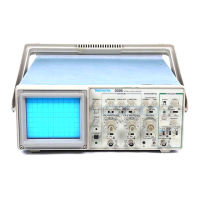
Maintenance-2225 Service
I
WARNING
)
To avoid an electric-shock hazard, observe
the following precautions before attempting
any soldering: turn the instrument off,
disconnect it from the ac power source, and
wait at least three minutes for the
line-
rectifier filter capacitors to discharge.
Use rosin-core wire solder containing 63% tin and
37%
lead. Contact your local Tektronix Field Office
or representative to obtain the names of approved
solder types.
When soldering on circuit boards or small insulated
wires, use only a 15-watt, pencil-type soldering
iron. A higher wattage soldering iron may cause
etched-circuit conductors to separate from the
board base material and melt the insulation on small
wires. Always keep the soldering-iron tip properly
tinned to ensure best heat transfer from the iron tip
to the solder joint. Apply only enough solder to make
a firm joint. After soldering, clean the area around
the solder connection with an approved
flux-
removing solvent (such as isopropyl alcohol) and
allow it to air dry.
Attempts to unsolder, remove, and
resolder
leads from the component side of a circuit
board may cause damage to the reverse side
of the circuit board.
The following techniques should be used to replace
a component on a circuit board:
1. Touch the vacuum desoldering tool to the lead
at the solder connection. Never place the iron
directly on the board; doing so may damage
the board.
NOTE
Some components are difficult to remove
from the circuit board due to a bend placed in
the component leads during machine inser-
tion. To make removal of machine-inserted
components easier, straighten the com-
ponent leads on the reverse side of the circuit
board.
2.
When removing a multipin component,
especially an
IC, do not heat adjacent pins con-
secutively. Apply heat to the pins at alternate
sides and ends of the
IC as solder is removed.
Allow a moment for the circuit board to cool
before proceeding to the next pin.
Excessive heat can cause the etched-circuit
conductors to separate from the circuit
board. Never allow the solder extractor tip to
remain at one place on the board for more
than three seconds. Damage caused by poor
soldering techniques can void the instrument
warranty.
3. Bend the leads of the replacement component
to fit the holes in the circuit board. If the com-
ponent is replaced while the board is installed in
the instrument, cut the leads so they protrude
only a small amount through the reverse side of
the circuit board. Excess lead length may cause
shorting to other conductive parts.
4.
Insert the leads into the holes of the board so
that the replacement component is positioned
the same as the original component. Most com-
ponents should be firmly seated against the
circuit board.
5.
Touch the soldering iron to the connection and
apply enough solder to make a firm solder joint.
Do not move the component while the solder
hardens.
6.
Cut off any excess lead protruding through the
circuit board (if not clipped to the correct length
in step
3).
7.
Clean the area around the solder connection
with an approved flux-removing solvent. Be
careful not to remove any of the printed infor-
mation from the circuit board.
REMOVAL AND REPLACEMENT
INSTRUCTIONS
The exploded view drawings in the Replaceable
Mechanical Parts list (Section 10) may be helpful
during the removal and reinstallation of individual
subassemblies or components. Circuit board and
component locations are shown in the Diagrams
section.
Scans
by
AR
TEK
MEDL4
=>


 To Next Page
 Loading...